Services

Surface Finishing

High-Precision Custom Parts Manufacturing (China Factory)

Why US

Choose our Surface Finishing Services

Zhuohua Hardware offers a one-stop surface treatment service covering CNC machined parts and sheet metal parts, improving appearance consistency, corrosion resistance, wear resistance, and functional reliability. All surface treatments can be customized according to drawings, tolerances, and functional requirements, suitable for everything from small-batch prototyping to mass production.

Surface Finishing Capabilities

We offer a variety of surface treatment options for CNC-machined and sheet metal parts. Each surface treatment is performed as an independent process module, with clearly defined applicable materials, surface finish, machining mark control, and impact on dimensions and tolerances, ensuring that part performance matches design expectations.

1. As Machined (Machined Original Surface)

Applicable processing services: CNC machining, sheet metal processing

  • Applicable materials: aluminum, steel, stainless steel, copper, engineering plastics
  • Surface finish: Preserves tool marks and presents a realistic machining appearance.
  • Processing marks: clearly visible
  • Dimensional/Tolerance Effect: None

Suitable for parts that do not require a certain appearance but have high requirements for dimensional accuracy and functionality, it is the most cost-effective surface condition.

2. Smooth Machining

  • Applicable machining services: CNC machining
  • Applicable materials: metal, plastic
  • Surface finish: Uniform machined texture for a smoother feel.
  • Processing marks: Visible but significantly reduced
  • Dimensional/Tolerance Effect: None

Reducing surface roughness without adding post-processing steps is often used for functional parts and semi-finished parts.

3. Fine Machining

  • Applicable machining services: CNC machining
  • Applicable materials: Metal
  • Surface finish: Higher consistency in the finished surface
  • Processing marks: Slightly visible
  • Dimensional/Tolerance Effect: None

Achieving more stable surface quality through smaller cutting parameters makes it suitable for assemblies, sealing surfaces, or high-precision mating parts.

4. Polishing

  • Applicable machining services: CNC machining
  • Applicable materials: Metal
  • Surface finish: High-gloss or mirror finish
  • Processing marks: removal of main exposed surfaces
  • Size/tolerance effect: May have a slight impact (mainly decorative).

It is commonly used for parts with high requirements for visual and tactile feel, but is not recommended for use in critical fits or areas with strict tolerance control.

5. Bead Blasting

  • Applicable processing services: CNC machining, sheet metal processing
  • Applicable materials: Metal
  • Surface finish: uniform matte or finely textured
  • Processing marks: significantly weakened or removed
  • Size/tolerance effect: minimal

Sandblasting is used to unify the surface appearance, reduce glare, and cover up minor machining marks. It is a very common industrial-grade finishing method.

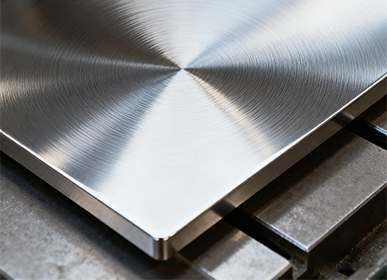
6. Brushing (textured finish)

  • Applicable processing services: CNC machining, sheet metal processing
  • Applicable materials: Metal
  • Surface appearance: Regular linear texture
  • Processing marks: Significantly reduced
  • Size/tolerance effect: minimal

Directional wire drawing creates a stable visual effect and is often used for panels, casings, and decorative metal parts.

7. Anodizing Type II

  • Applicable processing services: CNC machining, sheet metal processing
  • Applicable materials: Aluminum and aluminum alloys
  • Surface appearance: Uniform oxide film, available in a variety of colors
  • Processing marks: weakened but still visible
  • Dimensional/Tolerance Impact: Yes (must be factored in during the design phase)

Type II anodizing combines aesthetics and corrosion resistance, making it the most commonly used functional and decorative surface treatment for aluminum parts.

8. Anodizing Type III (Type III Hard Anodizing)

  • Applicable machining services: CNC machining
  • Applicable materials: Aluminum and aluminum alloys
  • Surface appearance: Thick oxide layer, dark surface, industrial texture
  • Processing marks: still visible
  • Dimensional/tolerance impact: Significant (compensation must be designed)

Type III anodizing offers higher wear resistance and hardness, making it suitable for parts where functionality is more important than appearance, such as moving parts or wear-resistant contact surfaces.

9. Black Oxide

  • Applicable processing services: CNC machining, sheet metal processing
  • Applicable materials: carbon steel, alloy steel, stainless steel (specific models)
  • Surface finish: Black or dark matte appearance
  • Processing marks: Visible
  • Size/tolerance effect: minimal

Black anodizing improves the appearance of parts with almost no change in size and provides basic rust protection, and is often used for mechanical parts and fasteners.

10. Chromate Conversion Coating

  • Applicable machining services: CNC machining
  • Applicable materials: Aluminum and aluminum alloys
  • Surface appearance: Thin chemical protective film, color varies with process.
  • Processing marks: Visible
  • Size/tolerance effect: minimal

This treatment forms an extremely thin conversion film, primarily used for corrosion protection or as a base layer for subsequent coatings, and is not suitable for applications seeking decorative effects.

11. Electroless Nickel Plating (ENP)

  • Applicable machining services: CNC machining
  • Applicable materials: steel, stainless steel, aluminum, copper, etc.
  • Surface finish: Uniform metallic coating, semi-gloss to matte.
  • Processing marks: weakened but still identifiable
  • Dimensional/tolerance effects: Yes (controllable, coating thickness must be specified)

Electroless nickel plating can achieve a uniform coating on complex geometries, significantly improving corrosion resistance and wear resistance, making it suitable for high-performance parts.

12. Powder Coating

  • Applicable processing services: CNC machining, sheet metal processing
  • Applicable materials: Metal
  • Surface finish: Thick coating, wide range of colors and gloss options.
  • Processing marks: Completely covered
  • Dimensional/tolerance effect: Significant (not applicable to precision mating surfaces)

Powder coating is mainly used for parts with high requirements for appearance and environmental durability. The masking area and assembly surface should be clearly defined during the design stage.

13. Brushed + Electropolishing

  • Applicable machining services: CNC machining
  • Applicable materials: Stainless steel
  • Surface appearance: High-cleanliness, low-roughness metal surface
  • Processing marks: mostly removed
  • Size/tolerance effect: minor

This combined process ensures both consistent appearance and corrosion resistance, and is commonly used in medical and food equipment as well as high-requirement stainless steel parts.

14. Vapor Smoothing

  • Applicable processing services: 3D printing
  • Applicable materials: Engineering plastics
  • Surface finish: Smooth or semi-gloss appearance
  • Processing marks: Layer texture significantly reduced
  • Dimensional/Tolerance Effect: None

Vapor smoothing is primarily used to improve the appearance and feel of plastic printed parts, while also enhancing sealing without affecting critical dimensions.

Surface Finish Design and Acceptance Criteria

When selecting a surface treatment solution, different processes have varying impacts on appearance, consistency, defect tolerance standards, and batch consistency. To ensure that the delivered results meet expectations, we recommend clearly specifying the requirements in the drawings or inquiry according to the following standards.

Definition of Cosmetic Acceptability

Different surface treatment processes may produce minor visual defects (such as oxidation marks, inconsistent brushing direction, uneven sandblasting particle size, etc.). To ensure consistent acceptance standards, we recommend that customers specify these defects in their technical requirements.

  • Side A (Key Visual/Front): The most important surface, where no obvious defects are allowed.
  • Surface B (non-critical surface): Minor marks or minor defects are permissible.

This A/B definition method helps optimize the balance between cost and quality, ensuring that the most important aspects reach a level acceptable to the customer.

Batch Visual Consistency Requirements

For mass-produced parts, we perform conformity checks:

  • Inspect all batches of goods under the same viewing angle and lighting conditions.
  • Parts manufactured using the same process should use consistent abrasives or polishing parameters.
  • When brushing is required, the texture direction should be consistent.

These standards can reduce aesthetic differences between different parts, which is especially necessary for products that require a uniform appearance after assembly.

Inspection Conditions for Project Acceptance

To ensure transparency in acceptance criteria, we recommend that acceptance inspections be conducted under the following conditions:

  • Observation distance: approximately 45–50 cm
  • Visual acuity standard: 10/10 or equivalent optical examination conditions
  • Lighting: Neutral white light (500–1000 Lux, 3300–5300K)

These standardized inspection conditions help engineers and suppliers reach an agreement when accepting the appearance, preventing judgment deviations caused by differences in ambient light or distance.

Functional vs Cosmetic Finishes

Based on application requirements, surface treatments can be broadly categorized into two types: functional and decorative.

Functional surface treatment

Suitable for parts requiring performance indicators such as corrosion resistance, wear resistance, adhesion, and mechanical bonding; its appearance may not be optimal, but its performance is reliable.

  • Original machining
  • Smoothing/Precision machining
  • Hard anodizing (Anodizing Type III)
  • Electroless Nickel Plating
  • Black oxidation, Chromate Conversion

These processes are preferred when high dimensional accuracy and functional requirements are needed.

Decorative surface treatment (Cosmetic)

If the product’s appearance is a design focus (e.g., consumer products, display elements, or customer-visible casings), consider:

  • Polishing and high-gloss treatment
  • Sandblasting/Wire drawing (can be designed according to direction)
  • Type II anodizing (color customization available)

Some processes can also combine functional and decorative features, such as sandblasting + Type II anodizing or wire drawing + electropolishing.

Scroll to Top