Services
Plastic CNC machining
Plastic CNC machining services and custom plastic parts manufacturing
Why US
Choose our Plastic CNC machining services
We offer stable and reliable CNC machining services for plastics, specializing in the manufacturing of custom and high-precision plastic parts. Through mature CNC machining processes, we provide clients with a one-stop solution from prototype verification to mass production.
Whether it’s structural components, functional components, or precision-machined plastic parts with high requirements for dimensional stability, we can match suitable materials and processing methods according to the drawing requirements to achieve repeatable and mass-producible parts delivery.
If you are looking for a custom CNC machining supplier with long-term delivery capabilities, this page will help you quickly determine if we are the right fit for your project.
One-stop plastic CNC machining service
We offer CNC machining services for plastics, covering multiple materials and processes, tailored to real-world application scenarios, rather than focusing on a single machining method. All plastic parts machining is designed based on actual production conditions, balancing precision, cost, and delivery efficiency.
Core plastic CNC machining capabilities:
CNC milling of plastics
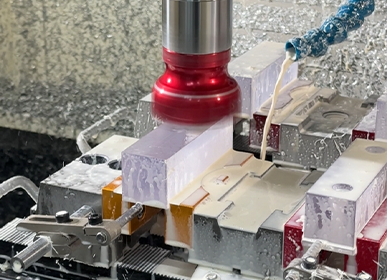
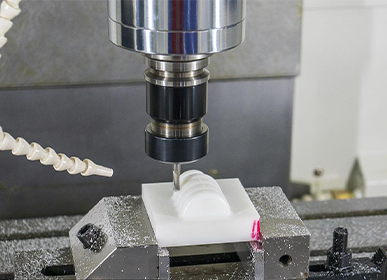
Suitable for machining plastic parts with flat surfaces, cavities, slots, and complex shapes, it is one of the most commonly used precision machining methods for plastics.
CNC plastic turning service
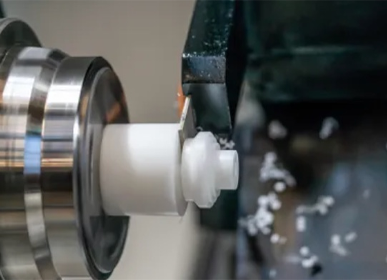
Suitable for shafts, sleeves, and cylindrical plastic parts, ensuring dimensional consistency and coaxiality.
Plastic CNC prototyping
Used for early-stage product development to validate structures and assemblies, enabling rapid iterative design.
Mass production of parts
After the prototype is verified, stable mass production is supported to ensure that the manufacturing results of each batch of plastic parts are consistent.
Through a unified parts processing flow, we can simultaneously support customized CNC plastic parts and long-term bulk supply needs.
Processable plastic materials
We select only engineering plastics suitable for CNC precision machining to ensure the stability of parts during processing and in actual use. The following materials are suitable for CNC machining of plastic parts, custom plastic machining services, and mass production.
POM possesses excellent mechanical strength, wear resistance, and dimensional stability, making it a commonly used material in the machining of precision plastic parts. It is suitable for plastic parts with high tolerance requirements, such as gears, sliders, and functional structural components.
Nylon is a high-strength and tough material, suitable for manufacturing plastic parts that can withstand certain mechanical loads. It is commonly used in CNC machining projects for industrial equipment parts and functional structural components.
ABS combines strength and machinability, making it suitable for machining shell and structural plastic parts. It is widely used in plastic CNC prototyping and small-to-medium batch custom plastic processing.
Polycarbonate has high impact resistance and good dimensional stability, making it suitable for parts requiring strength and safety. It is often used for precision machining of transparent or translucent plastic structural components.
PVC is stable to process, resistant to chemical corrosion, and suitable for industrial environments. It is commonly used in pipe components, functional parts, and other plastic parts related to PVC processing.
PP has good chemical resistance and low density, making it suitable for manufacturing lightweight plastic parts. It offers high cost-effectiveness in industrial and functional applications.
PE material has good flexibility and wear resistance, making it suitable for processing plastic parts that require impact resistance and low friction.
PTFE possesses an extremely low coefficient of friction and excellent corrosion resistance, making it suitable for manufacturing plastic parts under special working conditions. It is commonly used in applications where material performance requirements are higher than appearance precision.
PMMA (polymethyl methacrylate) has excellent transparency and processing performance, making it the most common material in acrylic processing services. It is suitable for display parts, transparent shells, and CNC acrylic processing projects.
Plastic CNC Machining and Precision Manufacturing
The core of plastic CNC machining lies not in “whether it can be cut,” but in dimensional stability, surface quality, and repeatability. Based on the physical properties of different plastic materials, we match appropriate CNC milling and CNC turning processes to ensure that plastic parts have controllable machining results in both the prototyping and mass production stages.
Plastic CNC milling is suitable for machining most plastic parts with complex structures and varied shapes, and is the most widely used process in custom plastic processing services.
Suitable part types include:
- Multifaceted plastic parts
- Functional components with cavities, slots, and holes.
- CNC parts requiring high flatness and contour accuracy
In the CNC milling process of plastics, we focus on controlling cutting parameters and tooling strategies to reduce material melting, burrs, and deformation, thereby achieving the dimensional and surface finish required for precision machining of plastics.
CNC plastic turning services are primarily used for rotationally symmetrical parts, such as shafts, sleeves, and cylindrical plastic parts. This process offers significant advantages in ensuring dimensional consistency and coaxiality, making it suitable for repetitive production.
Typical application scenarios:
- Machining of cylindrical plastic parts
- Functional components requiring stable dimensional fit
- Small-batch to large-batch plastic parts processing projects
During the turning process, we adjust the feed and cutting speed according to the material properties to avoid dimensional deviations caused by heat accumulation and ensure the stability of CNC machining of plastic parts.
Key control points for precision machining of plastic parts
Unlike metals, plastics are more susceptible to heat and stress during processing. Therefore, in our precision plastic machining services, we focus on the following points:
- Material fixation and stress control to prevent deformation after processing.
- Choose appropriate cutting tools to reduce surface burrs
- Optimized processing sequence improves part dimensional consistency
These control measures make plastic CNC machining not only suitable for CNC prototyping, but also able to reliably support the subsequent demand for large-volume CNC machined parts.
From CNC prototyping to mass production of plastic parts
Plastic parts projects typically don’t jump straight to mass production; instead, they go through a process of prototype verification → small-batch testing → stable mass production. Our plastic CNC machining services are designed around this real-world manufacturing path, ensuring that each stage is controllable and replicable.
Plastic CNC prototyping
In the early stages of product development, CNC prototyping is a crucial step in validating the structure, assembly, and functionality. Through CNC machining of plastics, plastic parts that closely resemble the performance of the final product can be obtained quickly without relying on molds.
The core value of the prototyping stage:
- Verify the relationship between structure and assembly
- Test material suitability
- Provides a reliable basis for subsequent custom processing of plastic parts
Small batch plastic parts processing
Once the prototype is validated, small-batch production is typically required for functional testing, trial assembly, or market validation. We ensure consistency in size and quality for small batches of plastic parts through standardized CNC service processes.
Advantages of small-batch production:
- No molds required, flexible design adjustments
- Controllable costs and lower risks
- Processing parameters can be directly carried over to the mass production stage.
Mass production of plastic parts using CNC machining
Once the design and material options are confirmed, we can support high-volume manufacturing of plastic parts. Through stable processing strategies and quality control, we ensure that every batch of CNC plastic parts meets established standards.
Key considerations during mass production:
- Size consistency
- Processing stability
- Long-term supply capability
Mass production-oriented processing planning
In the early stages of a project, we will assess the feasibility of processing from a mass production perspective, including:
- Material stability during long-term processing
- Combination of CNC milling and CNC turning processes
- Production cycle time and cost structure
Frequently Asked Questions
Plastic CNC machining is a manufacturing method that uses computer numerical control equipment to perform high-precision cutting and shaping of engineering plastics. Through processes such as CNC milling and CNC turning, raw plastic materials can be processed into customized plastic parts and precision-machined plastic parts that meet the requirements of drawings.
Compared with traditional molding methods, plastic CNC machining has advantages such as no need for molds, flexible design adjustments, and controllable machining accuracy. It is widely used in prototyping, small-batch production, and plastic parts processing projects that require dimensional consistency.
CNC machining is suitable for parts with specific requirements for dimensional accuracy, structural consistency, and material properties. Common applications include structural components, functional parts, assemblies, and precision plastic parts. Compared to injection molding, CNC machining is better suited for prototyping, small-batch production, and custom-made plastic parts with diverse designs.
Plastic CNC machining is a form of subtractive manufacturing, which does not require mold making and can be directly processed according to drawings, making it suitable for projects with frequent design iterations. Injection molding is more suitable for large-scale standardized production, but the initial mold cost is high.
During the product development and validation phase, CNC machining of plastic parts is often a more flexible and controllable option.
CNC machining of plastics can achieve high dimensional accuracy, but the final result depends on the material type, part structure, and process design. Through proper control of CNC milling and turning processes, we can reliably machine plastic parts that meet assembly requirements and ensure consistency in mass production.