


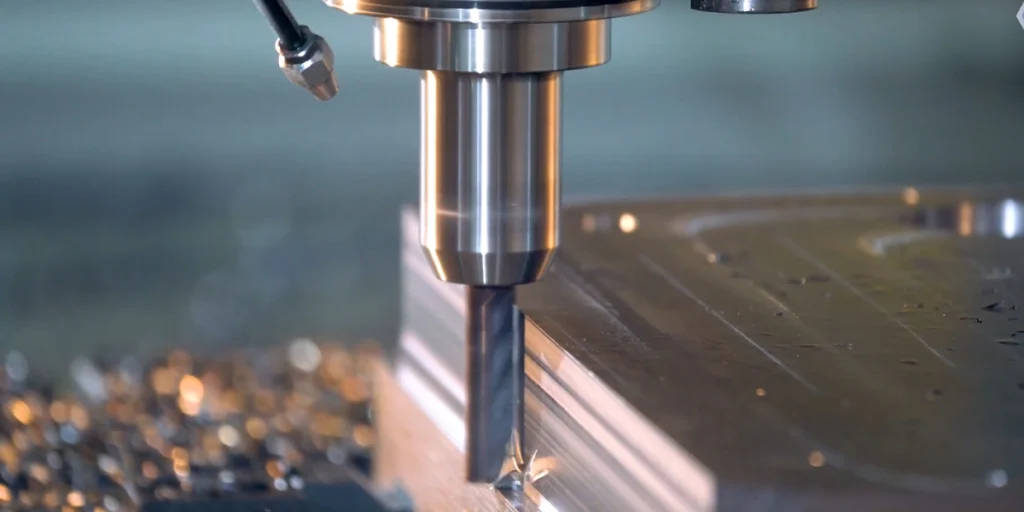
In the field of modern machining, whether it is automotive parts, medical device structural components, or precision electronic housings, a large number of high-precision parts rely on CNC technology for processing.
However, many people’s understanding of CNC remains limited to the superficial concept of “automated machine tools.” In reality, CNC is not just a type of equipment; it represents a manufacturing control method centered on digital programs and characterized by precision and repeatability. To truly understand CNC, one needs to start with its definition, control logic, and differences from traditional machining methods.
CNC Full Name and Meaning
Its core meaning can be broken down into three parts:
- Computer: A computer system is responsible for data processing and execution of control logic.
- Numerical: Controlling machine tool movement through digital codes (such as G codes, M codes)
- Control: Precisely controlling parameters such as displacement, feed, and speed of the machine tool.
In the actual machining process, engineers first use CAD software to complete the part design, and then use CAM software to generate the machining path program. This program is input into the CNC control system in the form of digital code, and the system precisely controls the movement of each axis to achieve automated machining of the workpiece.
Unlike manual operation, the control precision of CNC comes from:
- Digital coordinate positioning
- Servo system closed-loop feedback
- Stable ability to repeat program execution
Therefore, CNC is essentially a high-precision machining control technology that uses computer programs to drive the movement of machine tools.
The fundamental difference between CNC and traditional machining
Traditional machining (such as on conventional lathes and milling machines) relies primarily on manual operation. Operators control the tool movement by manually adjusting handwheels or mechanical mechanisms. This method has significant limitations:
- Highly dependent on operator experience
- Machining accuracy is affected by human factors
- Poor consistency in repeated processing
- Complex curved surfaces are difficult to process.
In contrast, CNC machining has fundamental differences:
- Different control methods
Traditional machining relies on manual mechanical control, while CNC relies on digital program control. - Differences in accuracy and stability
CNC can achieve stable micron-level repeatability positioning accuracy through a closed-loop control system and precision lead screw transmission. - Different processing complexity
Complex curved surfaces, multi-axis linkage, and precision contour machining are almost impossible to complete efficiently by hand, but CNC can achieve this through multi-axis control. - Different production efficiencies
Once the program is written, it can achieve stable batch copying, greatly improving production efficiency.
Applications of CNC in Modern Manufacturing
CNC is not a single device, but a core execution unit in modern manufacturing systems. In a highly competitive industrial environment, companies need to balance precision, efficiency, cost, and delivery cycle, and CNC is a key technology for achieving this balance among these four dimensions.
1. Infrastructure for precision component manufacturing
In industries such as automotive, aerospace, medical devices, and industrial automation, many critical components have stringent requirements for dimensional tolerances, surface roughness, and consistency. CNC machining can reliably achieve these requirements.
- Strict dimensional tolerance control
- High repeatability
- Stable batch consistency
This makes it a fundamental technology for manufacturing precision parts, rather than an option.
2. Core tools for small-batch and multi-variety production
In today’s manufacturing environment, product lifecycles are shortening and customization demands are increasing. CNC machining, which eliminates the need for complex mold preparation, offers significant advantages:
- Suitable for small-batch production
- Quickly switch between different products
- Supports prototype verification and rapid iteration
Compared to processes like injection molding or die casting that rely on molds, CNC has a clear advantage in terms of flexibility.
3. An important component of a digital manufacturing system
CNC is the execution terminal in the digital manufacturing chain:
- CAD Design → CAM Programming → CNC Machining
- Integration with ERP and MES systems
- Supports data traceability and process monitoring
In a smart factory environment, CNC equipment is typically combined with automatic tool changers, automatic loading and unloading systems, and online inspection systems to form semi-automatic or fully automatic production units.
4. Core processes for producing high value-added parts
When parts have complex structures, high precision requirements, and expensive materials, the stability and controllability of CNC machining become particularly crucial. Especially in:
- Medical implants
- Aerospace structural components
- Precision mold components
CNC machining is a primary means of ensuring machining quality and reliability.
Common Misconceptions about CNC
Misconception 1: CNC is equivalent to automated production
CNC stands for Digital Control System, but it is not synonymous with full automation. Automated production typically also includes:
- Automatic loading and unloading
- Robot Integration
- Production cycle coordination
A single CNC machine tool is merely a processing unit; whether automation is achieved depends on the overall production system design.
Misconception 2: CNC can process any material.
While CNC machining is applicable to a wide range of materials, it is not without limitations. The following material properties may be limiting factors:
- Excessive hardness
- Extremely low thermal stability
- Fragile or easily deformable characteristics
In addition, some materials are technically workable, but are too costly or inefficient to be commercially viable.
Misconception 3: CNC precision is infinitely high
The accuracy of CNC is affected by a variety of factors:
- Machine tool grade
- Tool quality
- Process planning
- Material properties
- Ambient temperature control
Even high-end equipment has reasonable tolerance ranges. Overly pursuing precision may lead to a significant increase in costs without any actual improvement in functionality.
Misconception 4: With CNC, there’s no need for technicians
CNC operation relies on programs, but program development requires experienced engineers. Process planning, tool selection, and cutting parameter optimization still heavily depend on technical capabilities. CNC improves the consistency of machining, but it does not eliminate the need for specialized knowledge.