


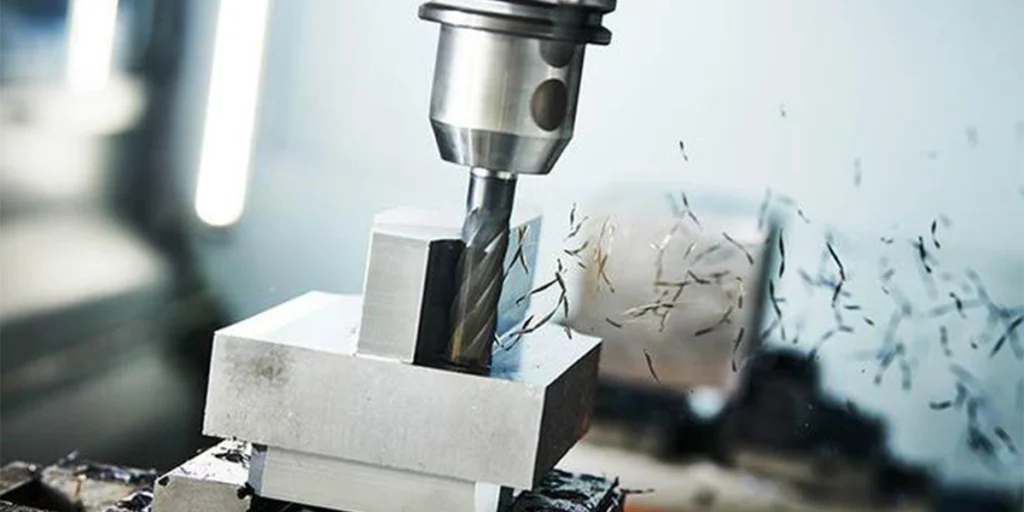
In modern manufacturing, product structures are becoming increasingly complex, and precision requirements are rising, making it difficult for manual operations to meet the demands for stability and consistency. Against this backdrop, CNC machining has become one of the core technologies in the field of mechanical manufacturing.
Whether it’s precision metal parts, complex curved surface structures, or small-batch customized products, CNC machining plays a crucial role. However, “CNC machining” is not just about using an automated machine tool, but a complete digital machining control system.
To understand CNC machining, we need to explore it from three levels: definition, system structure, and application scenarios.
Basic definition of CNC machining
Numerical control machining (CNC Machining) is a manufacturing method that uses a computer numerical control system to program and control parameters such as the motion trajectory, feed rate, and spindle speed of a machine tool, thereby achieving automated machining.
Its basic logic is as follows:
- Use CAD software to complete the 3D modeling of the part.
- Generate machining paths using CAM software.
- Input the generated program (such as G-code) into the CNC system.
- The machining process is completed by the precise control of the machine tool movement by the CNC system.
Compared with traditional manual machining, CNC machining has three core characteristics:
- Digital control: All movements are defined by a program.
- High repeatability: The same procedure can be stably replicated for production.
- High-precision execution: Precise positioning is achieved through a servo system.
Essentially, CNC machining is a precision machining technology driven by programs, rather than simply an upgrade of mechanical operations.
Core components of CNC machining
CNC machining is not a single piece of equipment, but rather a collaborative system composed of multiple key components. Its stability and machining capabilities depend on the following three core parts.
CNC system
The CNC system is the “brain” of the entire machining process. It is responsible for:
- Read the processing program
- Analyzing G-code and M-code
- Control each motion axis to execute commands
- Real-time monitoring of operational status
High-end CNC systems typically employ closed-loop control, achieving precise positioning through encoder feedback. System performance directly determines machining accuracy, response speed, and multi-axis linkage capabilities. Different control systems vary in functional scalability, interpolation accuracy, and ability to handle complex surfaces, which is one of the core sources of differences in equipment level.
Machine tool body
The machine tool body is the mechanical structure that actually performs the cutting action, including:
- Bed structure
- Spindle system
- Feed drive system
- Guide rails and lead screws
The rigidity and stability of a machine tool directly affect the machining quality. Insufficient rigidity can lead to vibration, dimensional deviations, and even tool damage. For high-precision parts machining, the structural stability of the machine tool is often more critical than the control system.
Cutting tools and fixtures
The cutting tool and fixture determine the actual cutting effect and workpiece stability.
The function of a knife:
- Determines cutting efficiency
- Affects surface quality
- Affects processing time and cost
The function of the clamp:
- Ensure workpiece positioning accuracy
- Prevent displacement or deformation during processing
- Improve consistency in batch production
In actual production, proper tool selection and fixture design often improve machining results more effectively than simply upgrading the machine tool grade.
Which production scenarios are suitable for CNC machining?
CNC machining is not suitable for all manufacturing scenarios, but its advantages are most obvious in the following types of production scenarios.
1. Small batch and medium batch production
When the quantity of products is insufficient to support the investment in molds (such as injection molds and die-casting molds), CNC machining is often a more economical choice.
Typical characteristics:
- Production volume ranges from 1 piece to thousands of pieces.
- Frequent design changes
- Short product lifecycle
In this scenario, CNC machining eliminates the need for mold development; production can commence immediately after programming is completed, resulting in low initial investment and rapid response.
2. Prototype Development and Product Validation Phase
During the product development phase, engineers typically need to perform multiple rounds of structural optimization and functional testing. The advantages of CNC machining are:
- Enables rapid manufacturing of functional prototypes
- Supports real-world material testing.
- Can be repeatedly modified within a short period of time.
Compared to 3D printing, CNC machining is closer to the final mass production state in terms of material properties and structural strength, and is therefore more suitable for the functional verification stage.
3. High-precision parts manufacturing
When parts involve strict tolerance requirements or critical assembly structures, CNC machining is a more reliable choice.
Common scenarios include:
- Precision fit structure
- High-precision machining of shafts and holes
- Machining of sealing surfaces and assembly surfaces
Under appropriate equipment conditions, CNC machining can achieve stable dimensional control and good surface quality.
4. Complex structural parts
CNC machining is more advantageous for parts with the following characteristics:
- Multi-surface structure
- Multi-axis linkage profile
- Machining of deep cavities and complex contours
Multi-axis CNC equipment can complete multi-face machining under single clamping conditions, reducing clamping errors and improving overall accuracy.
5. Multi-material processing requirements
CNC machining is highly adaptable when products require the use of different metals or engineering plastics. By adjusting cutting parameters and tool types, it can support the machining of a variety of materials.
Compared to some forming processes, CNC machining offers greater flexibility in material switching.
Professional CNC machining manufacturer
After understanding the essence and applicable scenarios of CNC machining, choosing a CNC machining partner with genuine manufacturing capabilities is a crucial step in transforming design into product. High-quality suppliers not only provide stable machining output but also offer engineering-level support in process optimization, cost control, and delivery cycle.
Key considerations when selecting a manufacturer
- Equipment capabilities: Does it possess advanced equipment such as multi-axis CNC machine tools and precision machining centers?
- Process depth: Whether it can support complex materials, precision tolerances, and special process requirements.
- Quality System: Does it have a complete quality control process and testing capabilities?
- Delivery stability: Does mass production have a mature production scheduling plan and risk management system?
- Engineering response speed: Can the technical team respond quickly to design reviews and process issues?
Zhuohua Hardware is a professional supplier specializing in CNC machining and precision manufacturing, providing CNC machining, precision parts manufacturing, mass production, and customization services. Equipped with a variety of advanced CNC equipment and a mature process team, it caters to the parts processing needs of industries such as automotive, medical, and automation equipment.