


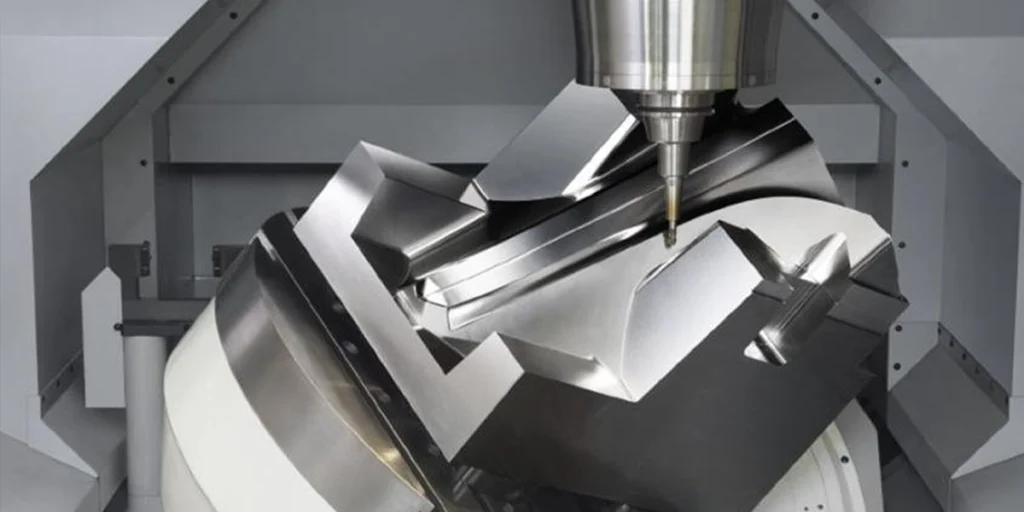
In the field of CNC machining, machining centers are one of the most frequently encountered equipment types, especially in the manufacturing of precision parts and complex structural components, where they have almost become standard equipment. Compared with ordinary CNC machine tools, machining centers not only have a higher degree of automation, but also significantly improve machining efficiency and stability through multi-process integration.
As product structures become more complex and machining precision requirements continue to increase, single-process machining methods can no longer meet the needs of modern manufacturing. Machining centers, through automatic tool changing, multi-axis linkage, and programmed control, integrate processes that originally required multiple machines into a single machine tool, significantly reducing the number of setups and minimizing error accumulation.
To understand what a CNC machining center is, we need to start by looking at the differences between it and a regular CNC machine tool.
The difference between machining centers and ordinary CNC machine tools
In essence, machining centers are still CNC machine tools, but there are significant differences between the two in terms of functional integration, automation level, and processing capabilities.
1. Different automatic tool changing capabilities
Conventional CNC machine tools typically only have a single tool installed or require manual tool changing, while machining centers are equipped with an automatic tool changer (ATC) system, which can switch between multiple tools under program control. This means:
- It can continuously complete multiple processes such as drilling, milling, and tapping.
- Reduce human intervention
- Improve processing efficiency and consistency
Automatic tool changing capability is one of the most crucial differences between machining centers and ordinary CNC machine tools.
2. Differences in process integration capabilities
Ordinary CNC machine tools are generally only suitable for a single type of machining, for example:
- CNC lathes are mainly used for rotating parts.
- CNC milling machines are mainly used for planar or contour machining.
Machining centers can achieve single-clamp machining of complex parts through multi-axis control and multi-tool combinations, including:
- Planar machining
- Surface machining
- Hole machining
- Thread machining
Reducing the number of clamping operations can significantly reduce the accumulation of dimensional errors.
3. Different levels of automation
Machining centers are typically equipped with:
- Automatic tool changer system
- Tool compensation system
- Programmed process management
And it can be further expanded:
- Automated tray exchange system
- Automated loading and unloading system
In contrast, conventional CNC machine tools rely more on manual operation and are less efficient in mass production and complex machining.
4. Different processing complexity
Machining centers are particularly suitable for machining complex structural parts, such as:
- Multi-faceted machined parts
- Precision structural components
- Three-dimensional curved surface parts
When machining complex structures, conventional CNC machine tools typically require multiple clamping operations, which significantly increases the difficulty of the process.
From a manufacturing perspective, the two can be understood as follows: ordinary CNC machine tools solve “single-process machining,” while machining centers solve “multi-process integrated machining.” This is also the main reason why machining centers are being used more and more widely in the field of precision manufacturing.
Typical structure of a machining center
The ability of CNC machining centers to achieve multi-process integrated machining relies primarily on their complete mechatronics structure. Compared to ordinary CNC machine tools, machining centers are more sophisticated in terms of tool management, motion control, and automation functions. A typical machining center usually consists of the following core components:
1. Numerical control system (CNC control unit)
The CNC system is the control core of a machining center, responsible for executing the machining program and coordinating the movement of each axis, including:
- Coordinate axis motion control
- Toolpath calculation
- Cutting parameter execution
- Compensation and Error Correction
The performance of a CNC system directly affects machining accuracy and stability.
2. Spindle System
The spindle drives the tool’s rotation and is the core power source for cutting processes. Key parameters include:
- Spindle speed range
- Spindle power
- Spindle rigidity
High-rigidity spindles can reduce vibration and improve the quality of machined surfaces, which is especially important in precision machining and machining of hard materials.
3. Automatic Tool Changer (ATC)
The automatic tool changer is one of the core structural features that distinguishes machining centers from ordinary CNC machine tools. Its main function is to automatically switch tools according to the program, enabling continuous machining of multiple processes.
Common tool magazine types include:
- Hat-style tool magazine (suitable for small machining centers)
- Disc-type tool magazine (suitable for medium to high speed machining)
- Chain-type tool magazine (suitable for complex machining with multiple tools)
Automatic tool changers can significantly reduce auxiliary time and improve production efficiency.
4. Feed system (each coordinate axis)
Machining centers typically have a three-axis or multi-axis motion structure:
- X-axis: Left and right movement
- Y-axis: Forward and backward movement
- Z-axis: vertical movement
High-end machining centers may also increase:
- A-axis (rotation axis)
- B-axis (oscillation axis)
- C-axis (rotation axis)
Multi-axis structures can achieve complex surface machining and multi-face machining.
5. Workbench and Fixture System
The worktable is used to fix the workpiece, and its structure varies depending on the processing requirements, including:
- Fixed worktable
- Dual exchange worktable
- Rotary worktable
A well-designed fixture can:
- Improve clamping stability
- Reduce clamping errors
- Improve batch processing efficiency
6. Cooling and chip removal system
During metal cutting, a large amount of heat and chips can affect the machining quality. Machining centers are typically equipped with:
- Coolant system
- Chip conveyor
- Protective structure
These systems can improve tool life and ensure machining stability.
Which parts are suitable for machining centers?
Because machining centers possess multi-process integration and multi-axis linkage capabilities, they are particularly suitable for machining parts with complex structures or high precision requirements. The following types of parts represent the most typical application scenarios for machining centers.
1. Multi-faceted machined structural components
When a part needs to be machined in multiple directions, conventional CNC machine tools often require multiple setups, while machining centers can complete the machining of multiple surfaces in a single setup. For example:
- Equipment structural components
- Automated mechanical components
- Precision connecting block
Reducing the number of clamping operations can significantly reduce the accumulation of dimensional errors.
2. Complex cavity-type parts
Parts with deep cavities or complex contours often require multiple cutting tools to machine, for example:
- Mold cavity
- Aluminum alloy casing
- Heat dissipation structural components
Machining centers can efficiently complete complex contour machining through automatic tool changing and three-axis or multi-axis linkage.
3. High-precision parts
When parts have strict tolerance requirements, machining centers can improve machining consistency through stable structure and precise control. Common examples include:
- Precision medical components
- Optical structural components
- Precision positioning components
Machining centers have a clear advantage in terms of repeatability and accuracy.
4. Small to medium batch parts
For production scenarios requiring frequent product model changes, machining centers can quickly switch programs without the need for molds, making them suitable for:
- Product trial production
- Small batch production
- Custom parts processing
Compared to traditional processes, machining centers have a greater advantage in flexible manufacturing.
5. High value-added material parts
When material costs are high or processing is difficult, machining centers can reduce the risk of scrap by stabilizing processing. For example:
- Stainless steel structural components
- Titanium alloy parts
- Precision parts made of engineering plastics
Stability and controllability are key advantages of machining centers in the processing of high-value parts.
When must a machining center be used?
While CNC machining centers offer significant advantages in terms of functionality and automation, not all parts require them. In practical manufacturing decisions, machining centers typically become a more reasonable, or even necessary, choice in the following situations.
1. The parts require multi-stage continuous processing.
When a part involves multiple processing techniques, for example:
- Milling
- Drilling
- Tapping
- Cavity machining
Using conventional CNC machine tools often requires multiple setups and equipment changes, which is not only inefficient but also prone to accumulating errors. Machining centers, through automatic tool changing and program control, can complete multiple processes in a single setup, improving dimensional consistency.
2. The parts have high precision requirements.
For parts with strict tolerance requirements, multiple clamping operations can introduce positioning errors. Machining centers can address this by:
- Stable structural rigidity
- Precise coordinate control
- Reduce the number of clamping operations
It effectively reduces the problem of error accumulation and is particularly suitable for machining precision structural parts and assembly reference parts.
3. The part has a complex structure or requires machining on multiple surfaces.
When a part needs to be machined in multiple directions, a machining center can complete complex machining through multi-axis control or a rotary table, for example:
- Multi-faceted structural components
- Three-dimensional curved surface parts
- Deep cavity structural components
If such parts are machined using ordinary machine tools, the difficulty and complexity of the process will increase significantly.
4. Products require rapid delivery in small to medium batches.
During product development or small-batch production, machining centers can quickly begin processing without molds, and can complete the production of different parts models simply by switching programs. Suitable for:
- New product trial production
- Custom parts production
- Rapidly iterating projects
Machining centers have significant advantages in flexible manufacturing.
5. High material costs or significant processing risks.
A stable machining process is especially important when using materials such as titanium alloys, stainless steel, or high-performance engineering plastics. Machining centers can reduce machining risks through precise control, thereby reducing material waste.
Professional CNC machining customization service provider
As a professional CNC machining customization service provider, we specialize in precision CNC parts manufacturing. Combining multi-axis machining equipment with mature process experience, we provide stable and reliable machining solutions for clients across various industries. From prototype development to mass production, we continuously optimize machining efficiency and quality consistency, helping clients shorten product development cycles and reduce manufacturing costs. Please leave your contact information and requirements; we will reply within 24 hours.