


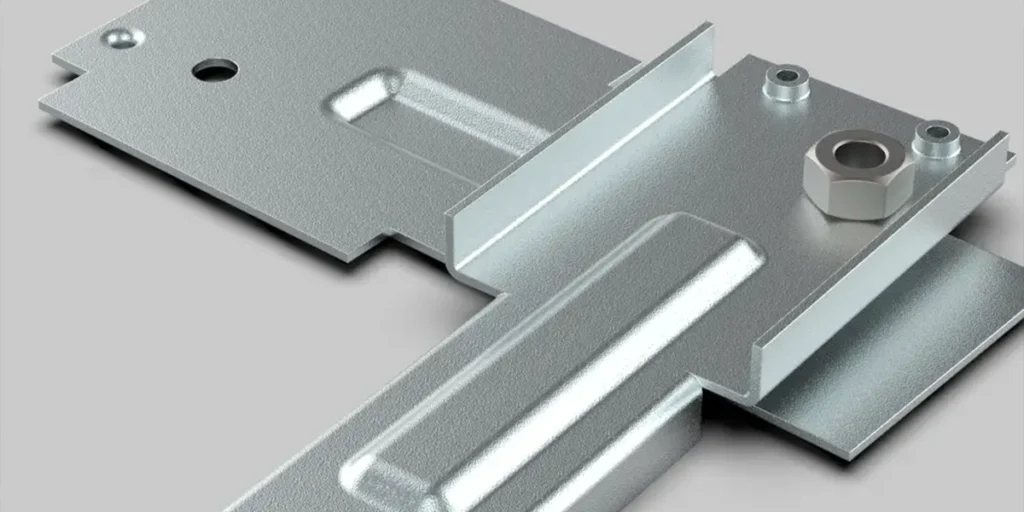
What is sheet metal forming process?
Sheet metal forming is a process that uses plastic deformation to shape and structure thin metal sheets into desired shapes and structures without removing the material.
The “metal sheet” mentioned here usually refers to sheet metal with a thickness of less than 6 mm; the “forming” emphasized here means that the material is still there, but the shape has changed.
Forming ≠ Cutting, and also ≠ Punching
To better understand “forming”, let’s make a simple distinction first:
Cutting/Punching
- Obtain the outline or hole location by cutting or punching away a portion of the material.
- Essentially, it is material separation
Forming
- No material removal
- Using pressure to induce plastic deformation in the sheet material
- Essentially, it’s a change in shape.
For this reason, the forming process often directly determines the quality of the part:
- Three-dimensional structure
- Spatial Form
- Intensity distribution
Is sheet metal forming a “separate process”?
Strictly speaking, sheet metal forming is not a specific process, but a general term for a category of processes.
It encompasses a variety of methods for shaping through deformation, such as:
- Change perspective
- Stretching to form a spatial structure
- Localized compression to enhance strength
These specific methods will be explained in detail in later chapters.
Why is forming indispensable in sheet metal processing?
The reason is simple:
- Cutting to solve the “shape” problem
- Form determines “structure”
If there is only cutting and no shaping, most sheet metal parts can only remain in a “flat state” and cannot meet the actual product’s requirements for strength, space and function.
Therefore, in actual manufacturing, forming usually occurs after cutting and before assembly, and is a key step in turning “two-dimensional sheet metal” into “usable parts”.
The position of sheet metal forming in the entire manufacturing process
From an overall process perspective, forming typically involves: blanking/cutting → forming → joining/assembly → post-processing.
It is the core link connecting “raw materials” and “finished product structure”, and it is also the part of sheet metal processing that best reflects the craftsmanship.
Main types of sheet metal forming processes
It is important to clarify one point first: sheet metal forming is not a single fixed method, but rather a large collection of processes that use plastic deformation to shape the structure of parts.
Depending on the forming method and the problem being solved, sheet metal forming processes can generally be classified into the following categories based on function and deformation direction.
1. Bending forming
Core function: Changing angle and outline
This type of forming method mainly uses external force to bend the sheet metal along a straight line or curve, giving the originally flat metal sheet a three-dimensional structure.
Common application goals are:
- Forming an angle
- Constructing a three-dimensional shape
- Provides basic structural strength
Bending is the most frequent type of forming in sheet metal parts and is the basis for the forming of many structural parts.
2. Stretch/draw forming
Core function: Forming spatial structure
This type of forming method applies continuous pressure to the sheet material, causing it to extend into space without being cut off, thereby creating recesses, cavities, or deep structures.
Its main problem is:
- How to turn a flat panel into a 3D component
- How to form depth or volume
Stretching and drawing forming are typically used for parts that require high shape integrity.
3. Localized plastic deformation forming
Core function: to locally alter the shape without affecting the overall structure.
This type of forming only involves plastic deformation of a localized area of the sheet metal without altering the overall contour of the part.
Common purposes include:
- Enhance local strength
- Improve rigidity
- Provides auxiliary structural features
It’s more like a “functional modification” to the parts than an overall design.
4. Functional/Structural Enhancement Molding
Core function: to improve performance, not simply to change the appearance.
In this type of forming method, the focus is not on “looks good,” but on making the parts:
- More durable
- More stable
- More suitable for subsequent assembly or use
Typically used for:
- Enhance structural performance
- Improve security
- Improve user experience
In actual production, this type of forming is often used in conjunction with other forming methods.
Explanation of common sheet metal forming methods
After understanding the classification of forming processes, this section has only one focus: to let readers “see” how sheet metal is transformed from a flat sheet into a three-dimensional structure.
The following introduces several of the most common sheet metal forming methods, each of which answers only three questions: how it deforms, what shape it becomes, and what features it usually has.
Bending Forming
Forming method in brief: The metal sheet is bent along a straight line or curve by external force.
Shape change characteristics:
- The flat plate generates an angle
- Forming corners, borders, or outlines
- The overall structure of the board remains continuous.
Common component features:
- Has a clear angle
- Clear structural outline
- Commonly found in box-type and frame-type structures.
Stretching/drawing forming
Brief description of the forming method:
The material is extended into space without cutting it off.
Shape change characteristics:
- Transformation from two-dimensional to three-dimensional
- Forms depressions, cavities, or deep structures
- The material undergoes significant plastic deformation in localized areas.
Common component features:
- Hollow or semi-enclosed structure
- Continuous surfaces
- The overall shape is intact and the transitions are natural.
Flanging/rolling forming
Forming method: The edges of the sheet material are bent or rolled.
Shape change characteristics:
- The edges change from “straight” to “raised or rounded”.
- Without changing the shape of the main body
- Emphasize edge structure
Common component features:
- Thicker or safer edges
- More stable contour lines
- Facilitates subsequent assembly or use
Embossing/Ribing
Brief description of forming method: Local protrusions or depressions are formed on the surface of the sheet material by using a mold.
Shape change characteristics:
- The overall shape remains almost unchanged.
- Surface generates regular structures
- Local rigidity is significantly enhanced
Common component features:
- The surface has ribs, embossing, or markings.
- More robust structure
- Significantly improves strength in thin plates
Ironing and shaping
Forming method in brief: Under pressure, the thickness of the sheet material tends to be uniform in some areas.
Shape change characteristics:
- No significant changes in appearance
- More consistent thickness distribution
- More stable surface quality
Common component features:
- High requirements for size and consistency
- More refined structural details
- Often used as an auxiliary step in the forming process
Application industries of sheet metal forming technology
Sheet metal forming is not about “folding and pressing the sheet metal”, but about making metal materials meet structural, spatial, strength and assembly requirements within a limited thickness.
When products have requirements for shape, stability, and batch consistency, forming technology becomes a fundamental capability in many industries.
The following section examines typical industry scenarios to see how sheet metal forming is “needed”.
Industrial equipment and automation industry
In industrial equipment, sheet metal forming primarily serves the “structure itself”.
- Through bending, ribbed construction, and edge curling, flat panels are transformed into strong three-dimensional structures.
- Improve overall rigidity and vibration resistance without significantly increasing thickness.
Common component features:
- Mostly box-shaped, framed, or supporting components
- Regular shape, but requires long-term stable use.
- Aesthetic requirements are less important than structural reliability.
The value of forming: enabling thin plates to assume a structural role
Automotive and Transportation Equipment Industry
The reliance of transportation equipment such as automobiles on sheet metal forming stems from two core needs:
- Structural strength: Complex curved surfaces are formed through stamping and stretching to improve load-bearing capacity.
- Batch consistency: A large number of parts must have uniform shapes to facilitate assembly.
Sheet metal forming transforms sheet metal from a “flat material” into a structural unit that can absorb energy and bear loads.
Common component features:
- Many curved surfaces and large dimensions
- Local areas need reinforcement or transitional fillets
- High repeatability requirements
The value of molding: achieving a reliable structure while maintaining lightweight design.
Electronics and Electrical Industry
Electronic and electrical products often have compact internal spaces, and sheet metal forming here serves more as a means of “layout and protection”.
- Bending is used to form mounting edges and fixing surfaces.
- Embossing and flanging are used to enhance specific areas or for positioning.
- The formed structure directly affects assembly efficiency.
Common component features:
- Small in size, but rich in detail.
- Requires multi-faceted coordination and concentrated hole positions
- Sensitive to flatness and dimensional stability
The value of molding: making limited space more controllable
Aerospace industry
In the aerospace field, sheet metal forming is not a “simple processing” but a part of structural design.
- Stretching and deep drawing are used to form continuous curved surfaces.
- The forming process must control material stress and deformation.
- Every shape change is related to safety and performance.
Common component features:
- Continuous surface with complex transitions
- Extremely sensitive to weight
- Extremely high requirements for molding quality
The value of molding: shaping reliable forms under extreme conditions.
Differences between sheet metal forming and other processes
In sheet metal processing, many processes seem to “all deal with metal sheets,” but they solve different problems.
The core value of sheet metal forming lies not in the processing action itself, but in its ability to “change the structural form”.
The following comparison of several common processes will help us understand this difference.
Sheet metal forming vs. sheet metal cutting processes
One is responsible for “transformation,” and the other for “separation.”
The essence of cutting technology:
- Remove material
- Divide a single board into the desired outline.
- Does not alter the three-dimensional structure of the board.
The essence of forming process:
- No (or very little) material removal
- Changing spatial form through bending, stretching, etc.
- Transform flat panels into three-dimensional structures
Key differences:
- Cutting determines the “boundary of the shape”
- Forming determines “three-dimensional shape and strength”
If a part only requires a “shape outline,” forming is not necessary. Once the part requires a three-dimensional structure, forming cannot be replaced by cutting.
Sheet metal forming vs. blanking/punching processes
One shapes the structure, the other manufactures the functional units.
The essence of punching/perforation:
- Removing localized material using molds
- Forming holes, grooves, and openings
- Serves functional needs such as assembly, ventilation, and fixing.
The essence of forming process:
- Change the overall or partial spatial form
- Provides strength, angle, and support surface
Key differences:
- Punching solves the problem of “where to install”.
- Forming a structure to address the question of “whether it can stand firm”
In most actual parts, the two are in a mating relationship . But only through forming can the thin sheet take on a structural role.
Sheet metal forming vs. connection and assembly processes
One is in the “processing stage,” and the other is in the “combination stage.”
The essence of connection and assembly processes:
- Connect multiple parts together
- Without changing the basic shape of individual parts
- The key point is the “combination method”.
The essence of forming process:
- Determine structural capabilities at the component stage
- Reduce subsequent connection dependencies
- Enable one part to perform multiple functions
Key differences:
- Assembly is “putting things together”.
- Forming is about “making the part itself more useful”.
A well-designed molding process can often:
- Reduce connection points
- Reduce assembly complexity
- Improve overall stability
At last
Returning to the core point: the significance of sheet metal forming lies not in the process itself, but in “giving thin sheets structural value”.
A metal sheet is essentially just material; only after being shaped does it begin to possess angles, strength, space, and function, and only then does it truly become a “usable part”.
This is why, in actual manufacturing, forming is never an optional step, but a crucial link connecting the design intent with the finished product structure.
Once you understand this, when you look at specific forming methods—whether it’s bending, stretching, flanging, or pressing ribs and deep drawing—you no longer focus on “what it’s called,” but rather: what structural problem it’s solving, and why it must be done this way.