


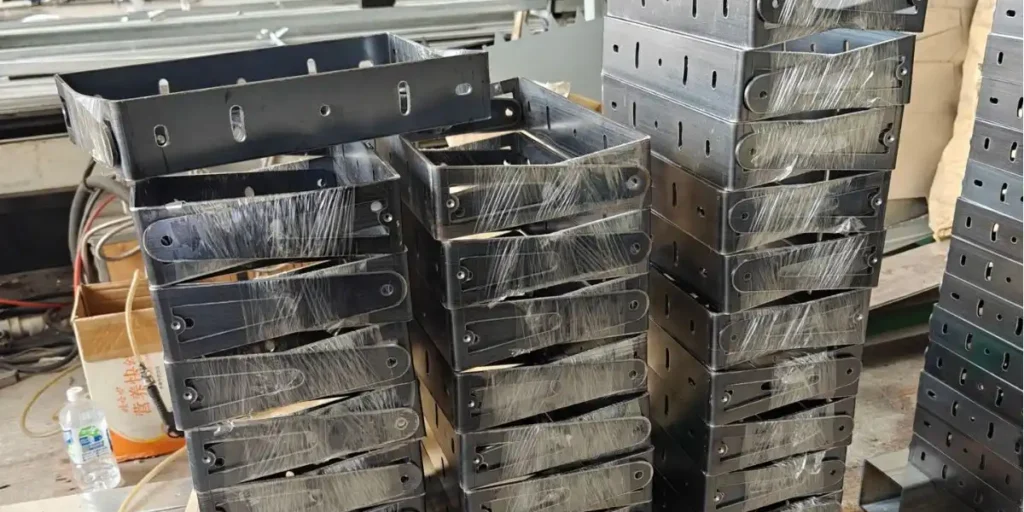
Basic concepts of sheet metal processing
In the manufacturing industry, “metal sheet processing” usually refers to sheet metal processing.
It is a processing method that uses thin metal sheets as objects and aims at forming and structural manufacturing. The focus is not on “how much material is removed”, but on how to turn a flat metal sheet into a structural component or shell with actual functions.
What are sheet metal?
From a processing perspective, sheet metal generally refers to thin metal materials supplied in sheet form, with common thicknesses typically below 6mm (the specific limits may vary depending on the industry).
These types of materials have several typical characteristics:
- It exists in flat form, making it easy to cut and shape.
- Uniform thickness is a fundamental prerequisite for subsequent processing.
- Suitable for changing shape through cold working without altering the overall volume.
Because of these properties, sheet metal is very suitable for manufacturing products such as shells, brackets, boxes, and structural components.
Under what circumstances would you choose sheet metal manufacturing?
Not all metal parts are suitable for sheet metal processing.
Sheet metal fabrication is typically a more suitable option in the following scenarios:
- The parts are primarily defined by their shape, rather than their complex internal structure.
- The product has requirements for consistency in weight, strength, and shape.
- It is necessary to minimize material and manufacturing costs while ensuring strength.
- There is a need for customization or small-to-medium batch production.
Simply put, when the core requirements of a product are **”reasonable structure, stable shape, and ease of manufacturing”**, sheet metal processing often has a greater advantage.
What is the core problem that sheet metal processing solves?
In essence, sheet metal processing is not simply about “cutting” and “folding,” but about solving three core problems:
- Shape issue: How to transform a flat metal sheet into a three-dimensional shape that meets design requirements.
- Structural issues: How to ensure that components meet strength and stability requirements while maintaining reasonable material and weight considerations.
- Functional issues: How to use structural design to enable parts to perform practical functions such as installation, support, protection, or load-bearing.
For this reason, sheet metal processing is more like a structural manufacturing method than just a single process.
The boundary between sheet metal processing and other metal processing methods
To avoid confusion, it can be simply understood as:
- Sheet metal processing: Based on thin metal sheets, focusing on structure, shape, and assembly relationships.
- Machining (e.g., turning, milling): Primarily involves block materials, emphasizing dimensional accuracy and complex geometries.
There is no “one replacing the other” relationship between the two; rather, they play different roles depending on the product requirements.
Standard process for sheet metal manufacturing
In actual production, sheet metal manufacturing is not simply a matter of arbitrarily stacking multiple processes, but rather a step-by-step process completed according to a clear manufacturing sequence. The core objective of this process is to achieve stable, controllable, and repeatable processing results while ensuring the structure and function are maintained.
A typical sheet metal manufacturing process usually includes the following key steps.
1. Design and Drawing Preparation
The starting point for sheet metal manufacturing is not in the workshop, but in the design stage.
This phase mainly addresses two issues:
- What kind of parts need to be made?
- Is it suitable to manufacture using sheet metal methods?
Drawings clearly define the shape, dimensions, structural relationships, and basic requirements of parts, providing a unified basis for subsequent processing. Insufficient consideration during the design phase often leads to rework or adjustments in later processes.
2. Material selection and preparation
After confirming the design scheme, the next step is to determine the appropriate metal sheet.
The core objective of this stage is:
- Ensure that material properties meet usage requirements.
- Provides a stable and controllable raw material base for subsequent processing.
At the same time, the entire sheet of board needs to be broken down into processable initial shapes according to the plan to prepare for formal processing.
3. Cutting/Punching Process
Cutting or punching is a crucial step in sheet metal manufacturing before it truly begins to “take shape”.
The main problem this process addresses is:
- Transform the raw sheet metal into planar parts that meet the required contours.
- Provides an accurate boundary and dimensional basis for subsequent forming.
The results at this stage directly affect the subsequent forming accuracy and assembly effect.
4. Forming and bending processes
After obtaining the planar part, the next step is to give the part a three-dimensional structure through forming operations.
The core function of this stage is:
- Transforming flat panels into three-dimensional forms with structural strength.
- Achieve functional layout of parts in space
The forming process usually determines the final shape of the part and is a key step in whether the structural design can be implemented.
5. Connection and Assembly
Once a single sheet metal part is manufactured, it is often necessary to connect multiple parts to form a complete structure.
This stage mainly addresses:
- Structural fixing issues between parts
- Overall strength and stability issues
By using a reasonable connection method, disparate sheet metal parts can be combined into a usable and installable whole.
6. Surface treatment and finished product inspection
After the structure is completed, surface treatment and final inspection are usually required.
The purpose of this stage is:
- Improve product durability and appearance consistency
- Ensure that the finished product meets basic quality requirements.
Only after the product has passed inspection and confirmation will it enter the delivery or subsequent application stage.
Combination of different sheet metal processes
In actual production, sheet metal manufacturing almost never relies on a single process. To balance structure, efficiency, and cost, it is often necessary to combine multiple sheet metal processes in a reasonable sequence.
This combination is not arbitrary, but rather revolves around a core objective: to complete manufacturing in the most stable and economical way while meeting design requirements.
Below are some common and representative sheet metal process combination ideas.
Cutting + Bending + Riveting
Suitable for structural components and enclosure products
This is the most common and easiest-to-understand combination.
- Cutting: First, determine the planar contour of the part.
- Bending: Transforming a flat part into a three-dimensional structure.
- Riveting: Quickly assembling multiple parts into a whole.
The advantage of this combination is:
- The processing sequence is clear, and the margin for error is relatively large.
- Does not rely on complex molds, suitable for multi-variety or customized needs
- Facilitates later assembly and maintenance
In practical applications, this type of combination is often used in structural components such as chassis, brackets, and shells.
Stamping + Forming + Surface Treatment
Suitable for mass production of parts with relatively fixed structures
This combination method is often used when the product shape is stable and the output is large.
- Stamping: Improves forming efficiency and consistency
- Shaping: Structural shaping is completed in one or more steps.
- Surface treatment: Unifying appearance and protective performance
The core value of this combination lies in:
- Improve processing efficiency per unit output
- Reduce unit manufacturing costs
- Ensure consistency in product appearance and dimensions.
However, this also places higher demands on the preliminary design and process planning.
Pulling + Trimming + Inspection
Suitable for parts with high requirements for structure and precision.
This type of combination is often used for parts that require a deep or complex three-dimensional structure.
- Drawing: Achieving the forming of the main structure
- Trimming: Controlling edge size and shape
- Inspection: Ensure the structure and dimensions meet requirements.
The key point of this combination method is:
- Controlling dimensional changes caused by material deformation
- Early detection and correction of forming deviations
- Ensure the stability of parts during subsequent use.
It is commonly found in application scenarios with high requirements for functionality and structure.
Why is the “sequence” more important than the “process itself”?
In sheet metal manufacturing, the process sequence is often more critical than the process name.
A reasonable combination order can be:
- Reduce redundant processing and rework
- Reduce material waste
- Improve overall manufacturing stability
An unreasonable order might lead to:
- Increased manufacturing costs
- Enlarged processing error
- Affects the final assembly result
Therefore, the combination of sheet metal processes is essentially a choice of manufacturing path, rather than simply a stacking of processes themselves.
Commonly used equipment in sheet metal manufacturing
In sheet metal manufacturing, processes don’t happen out of thin air; every machining action relies on corresponding equipment. Understanding the function of commonly used equipment helps you determine what a factory can do, what it excels at, and where its production capacity limits lie.
From a cognitive perspective, sheet metal equipment can be roughly divided into four categories.
1. Cutting equipment
The core function of cutting equipment is singular: to transform a whole sheet of metal into a two-dimensional part outline that can be further processed.
Common cutting equipment includes laser cutting equipment, CNC punching machines, and shearing equipment.
The difference between them is not whether they can be cut, but rather:
- Can it handle complex shapes?
- Cutting precision and edge quality
- The degree of impact on subsequent bending and welding
If the cutting stage is done well, subsequent processes will be significantly more stable.
2. Molding equipment
The forming equipment is responsible for solving a key problem: how to create a controllable spatial structure from a metal sheet without changing the material thickness.
These types of equipment typically include bending equipment, plate rolling equipment, and simple stretch forming equipment.
They directly affect:
- Structural strength of parts
- Size consistency
- Is it suitable for mass production and repetitive manufacturing?
The capabilities of forming equipment often determine whether a factory can stably produce structural components, not just “shells”.
3. Connection and assembly equipment
Individual sheet metal parts rarely exist independently; the task of connecting equipment is to integrate multiple parts into a functional whole.
Common connection and assembly equipment includes welding equipment, riveting equipment, and screw assembly stations.
Different connection methods have completely different impacts on the product:
- Welding emphasizes both strength and integrity.
- Riveting emphasizes efficiency and consistency.
- Screw connections emphasize disassembly and maintainability.
Whether a factory has multiple connection devices directly reflects the flexibility of its structural design.
4. Auxiliary and testing equipment
These types of equipment are often inconspicuous, but they are crucial to actual production. Their role is not “processing,” but rather ensuring that the processing results are controllable, reproducible, and deliverable.
Commonly included:
- Post-processing equipment such as leveling and deburring.
- Basic dimensional and appearance inspection equipment
These devices do not affect individual products, but rather:
- Batch consistency
- Appearance quality
- Factory stability
From a long-term cooperation perspective, these are often more important than a single high-end main equipment.
Key points for quality control in sheet metal processing
The quality of sheet metal processing is not about whether a particular process is done well or not, but whether the entire process, from materials to batch delivery, is controllable, repeatable, and predictable.
The following quality control points basically determine the true level of a sheet metal factory.
1. Material consistency
In sheet metal processing, the stability of the material itself is often more important than the processing technology.
The key point is not “what materials to use”, but rather:
- Is the material thickness stable?
- Are the properties of materials from the same batch consistent?
- Is the surface condition suitable for subsequent forming and surface treatment?
If the material batches are inconsistent, it will be difficult to maintain consistent results even with the most meticulous bending, welding, and surface treatment.
2. Dimensional and tolerance control
Sheet metal dimensional issues rarely arise during final inspection, but rather from inadequate front-end process control.
Key control points include:
- Are the blanking dimensions sufficient to allow for reasonable forming margins?
- Is bending springback included in process compensation?
- Are the accumulated tolerances resolved before assembly?
Truly mature quality control means allowing parts to naturally fall within tolerance ranges, rather than relying on repeated rework and correction.
3. Deformation control after forming
It is not uncommon for sheet metal parts to warp, twist, or bulge after forming.
The question is whether it can be predicted and controlled in advance.
Common control approaches include:
- Reasonable bending sequence design
- Structural reinforcement for thin plates and large-sized components
- Reserve space for deformation correction during the process stage
This step often best demonstrates whether a factory possesses “structural understanding capabilities”.
4. Surface defects and visual inspection
Scratches, dents, welding marks, and uneven coatings may seem like cosmetic issues, but they essentially reflect the following:
- Are the processes smoothly connected?
- Are the workpiece turnover and protection measures adequate?
- Was the preparation before surface treatment sufficient?
Experienced people can often tell which process might be causing the problem just by looking at the appearance.
5. Consistency in mass production
Making a single piece well does not equate to manufacturing capability. Batch consistency is the core objective of sheet metal processing quality control.
This usually depends on:
- Is the process standardized?
- Is the equipment in a stable condition?
- Detect whether a feedback loop has been formed
The quality systems underlying the ability to reliably deliver 10 pieces are completely different from those underlying the ability to reliably deliver 1000 pieces.
At last
On the surface, sheet metal manufacturing seems to consist of multiple processes such as cutting, bending, and welding; but from the perspective of manufacturing logic, it is essentially a complete path centered around “structural realization”.
From determining whether the design is suitable for sheet metal processing, to the reasonable combination of process sequences, and then to the matching of equipment capacity and quality control, what truly determines the result is never a single piece of equipment or a single process, but whether the overall process is clear, controllable, and repeatable.
Understanding the sheet metal manufacturing process is not just about “knowing how it’s done,” but also about being able to determine which solutions are reasonable and which manufacturing methods are more reliable during design, selection, or collaboration.
When you view sheet metal processing as a complete manufacturing system, rather than a collection of fragmented processes, many seemingly complex issues become clear.