


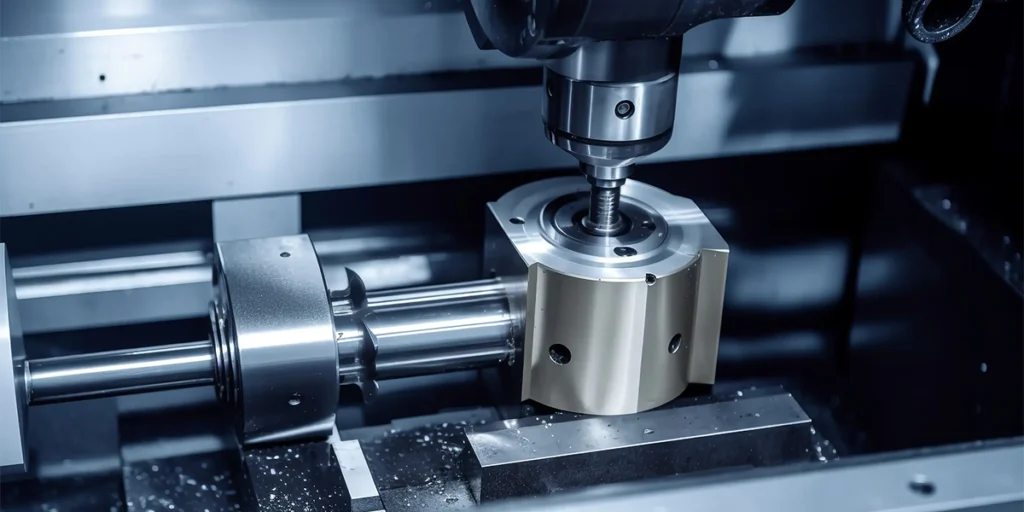
How precise are CNC machine tools?
The precision of CNC machine tools is not a fixed value, but varies significantly depending on the type of machine tool, its design purpose, and its application scenario. In practical applications, the precision level of CNC machine tools can generally be divided into the following three levels.
1. Precision level of conventional CNC machine tools
These types of machine tools are mainly used for general mechanical parts and batch processing, and are the most widely used in industrial manufacturing.
- Positioning accuracy: typically ±0.01 mm to ±0.05 mm
- Repeatability: Approximately ±0.005 mm to ±0.01 mm
- Dimensional accuracy: Part tolerances are generally controlled within ±0.02 mm to ±0.1 mm.
This level of precision can meet most conventional processing needs such as automotive parts, general mechanical structural parts, and standard hardware parts.
2. Precision level of high-precision CNC machine tools
High-precision CNC machine tools mainly serve industries with high requirements for dimensional consistency and machining stability.
- Positioning accuracy: ±0.002 mm to ±0.005 mm, with some high-end models approaching ±0.001 mm.
- Repeatability: Typically ±0.001 mm to ±0.003 mm
- Shape and contour accuracy: controllable within the micrometer range, with surface quality significantly superior to conventional machine tools.
These types of machine tools are commonly found in the fields of aerospace, medical devices, precision molds, and high-end industrial equipment manufacturing.
3. Precision level of ultra-precision CNC machine tools
Ultra-precision CNC machine tools are mainly used in micro-nano-level processing and cutting-edge manufacturing fields, and are not conventional production equipment in the traditional sense.
- Dimensional/positional accuracy: Approximately 0.01 μm to 0.3 μm
- Shape/contour accuracy: up to 0.003 μm to 0.1 μm
This level of precision typically requires nanoscale control systems, ultra-precision guides, and extremely stringent environmental control conditions to achieve, and is mainly used in optical components, semiconductors, and microstructure fabrication.
It should be noted that the above accuracy ranges are for reference only. Actual machining accuracy will also be affected by factors such as the specific machine tool model, manufacturing level, operating environment, and maintenance status. Currently, Chinese CNC machine tools have approached the international mainstream level in the field of conventional accuracy, but there is still a gap with international high-end equipment in high-precision and ultra-precision applications.
Standards for measuring the accuracy of CNC machine tools
In actual machining, the accuracy of CNC machine tools is not judged by a single numerical value, but rather by a comprehensive evaluation of multiple accuracy indicators. Common measurement standards mainly include the following aspects.
1. Geometric accuracy
Geometric accuracy primarily reflects the basic structure and assembly quality of the machine tool, and is a prerequisite for all other precision levels.
- Straightness: The deviation between the guide rail or cutter and an ideal straight line during linear motion.
- Flatness: The deviation between the worktable or moving plane and the ideal plane.
- Perpendicularity and parallelism: Deviations in the relative positions of the machine tool’s guideways and spindles.
- Spindle rotation accuracy: Radial runout and axial movement of the spindle during rotation.
Geometric accuracy is typically tested under no-load or low-load conditions on a machine tool to determine the manufacturing and assembly level of the machine tool itself.
2. Positioning accuracy
Positioning accuracy is used to measure the accuracy of motion under the control of a CNC system.
- Linear motion positioning accuracy: The deviation between the actual position and the theoretical commanded position of the endpoint of each coordinate axis motion.
- Rotary motion positioning accuracy: The deviation between the actual rotation angle and the commanded angle of the rotary axis (such as axes A, B, and C).
Positioning accuracy directly affects the dimensional accuracy and hole position accuracy of parts, and is one of the important indicators for evaluating the performance of CNC machine tools.
3. Repeatability
Repeatability reflects the stability of a machine tool during multiple reciprocating motions.
- Refers to the maximum range of actual positional change when a machine tool moves to the same position multiple times.
- Linear axes and rotary axes are typically evaluated using different methods.
This indicator is particularly critical in batch processing, as it directly relates to product consistency and interchangeability.
4. Transmission accuracy
Transmission accuracy primarily assesses the motion coordination and uniformity of the machine tool transmission system.
- Transmission errors, including those of components such as lead screws, gears, and drive chains.
- This is often seen in scenarios such as thread machining and synchronous motion machining.
Insufficient transmission accuracy can easily lead to cumulative errors and dimensional deviations.
5. Dynamic accuracy
Dynamic accuracy reflects a machine tool’s ability to maintain accuracy under actual cutting conditions.
- Affected by cutting load, thermal deformation and vibration
- It is usually assessed indirectly by measuring the dimensional and geometrical accuracy of a typical machined part.
Compared to static conditions, dynamic accuracy more closely reflects the actual production state.
It should be noted that different countries and industries have different definitions and testing methods for CNC machine tool accuracy. Common reference standards include ISO, JIS, and VDI/DGQ. In practical applications, it is usually necessary to combine specific standards and machine tool types to make a comprehensive judgment on accuracy.
Main factors affecting the accuracy of CNC machine tools
The machining accuracy of CNC machine tools is not determined by a single factor, but is the result of the combined effects of equipment, systems, processes, and environment. In actual machining, the following factors have the most direct impact on accuracy.
1. Machine tool structure and manufacturing precision
The manufacturing and assembly quality of the machine tool body is a fundamental factor affecting accuracy.
- Bed and guideway accuracy: The flatness, straightness, and stability of the bed directly affect the overall rigidity and motion accuracy of the machine tool.
- Spindle accuracy: The radial runout, axial runout, and rotational accuracy of the spindle affect the machining dimensions and surface quality.
- Precision of lead screw and transmission components: Errors in lead screw pitch, gear transmission, etc., can lead to positioning and motion deviations.
2. CNC System and Control Performance
The CNC system determines the accuracy and stability of machine tool motion control.
- Control accuracy: Parameters such as interpolation accuracy and pulse equivalent affect the positioning and contour machining accuracy.
- System stability: Anti-interference capability, power supply and temperature stability affect the consistency of machine tool accuracy during long-term operation.
3. Tool accuracy and wear condition
The cutting tool is the component that directly participates in cutting, and its condition has a significant impact on the machining result.
- Tool manufacturing precision: Tool dimensions and cutting edge quality affect part dimensions and surface roughness.
- Tool wear: Wear gradually amplifies machining errors and reduces dimensional consistency.
- Tool rigidity: Insufficient rigidity can easily cause vibration, affecting machining stability and accuracy.
4. Workpiece clamping method
The clamping method directly affects the stability of the workpiece during the machining process.
- Clamping stability: Unstable clamping can lead to workpiece displacement or vibration.
- Clamping repeatability: Insufficient positional consistency during multiple clamping operations can cause dimensional fluctuations.
5. Processing technology and parameter settings
Whether the processing technology is planned reasonably will directly affect the generation and accumulation of errors.
- Machining path planning: An unreasonable path may result in unnecessary cutting or cumulative errors.
- Selection of cutting parameters: Improper selection of cutting speed, feed rate, and depth of cut can easily lead to deformation or vibration.
- Cooling and lubrication conditions: Insufficient cooling increases the risk of thermal deformation.
6. Processing environment factors
The impact of the external environment on accuracy is often overlooked, but it is particularly crucial in high-precision machining.
- Temperature changes: Ambient temperature or the machine tool itself generating heat can cause thermal deformation.
- Vibration and Interference: Workshop vibration and electromagnetic interference may affect the accuracy of motion control.
- Humidity and dust: Dust and moisture can affect the stability of transmission components and measuring elements.
7. Programming and Software Factors
The processing procedures and system software also affect the final processing results.
- Program accuracy: Programming errors or unreasonable paths can directly lead to processing errors.
- System software performance: The accuracy of the compensation function and algorithm will affect the error control effect.
These factors are interrelated and collectively determine the accuracy performance of CNC machine tools in actual machining. Understanding these influencing factors helps in effectively controlling accuracy during subsequent machining and management processes.
How to improve and maintain the machining accuracy of CNC machine tools
Improving and maintaining the machining accuracy of CNC machine tools hinges not on “single improvements,” but on long-term, systematic management and optimization. In actual production, the following aspects can be emphasized:
1. Perform machine tool maintenance and basic adjustments.
Regularly inspect and maintain key components such as the spindle, guide rails, and lead screws, promptly cleaning, lubricating, and replacing worn parts. Through leveling, clearance adjustment, and backlash compensation, ensure the machine tool is in a stable and controllable working state; this is the foundation for stable precision.
2. Optimize processing technology and parameter settings
Properly differentiate between roughing and finishing, and adopt a staged cutting strategy to reduce the risk of deformation caused by single-step cutting. Match appropriate tools according to material properties, and optimize cutting speed, feed rate, and depth of cut to avoid affecting accuracy due to excessive cutting force or cutting heat.
3. Standardize programming and operation procedures.
Ensure clear program logic and accurate data to reduce machining errors caused by improper path planning or parameter settings. Simultaneously, strengthen the standardization of operator procedures in clamping, tool setting, and measurement to minimize the impact of human factors on accuracy.
4. Control the processing environment and strengthen quality monitoring.
Maintain a relatively stable workshop temperature and minimize vibration and external interference. Conduct necessary dimensional checks and process sampling inspections during key processes to promptly identify and adjust for accuracy deviations, preventing error accumulation.
Overall, the accuracy of CNC machine tools cannot be guaranteed in the long term with a single adjustment. Instead, it relies on the continuous coordination of equipment status, process control, operating procedures, and environmental management. Only by establishing a closed-loop management system for these aspects can we truly achieve stable and sustainable improvement in machining accuracy.
At last
The machining accuracy of CNC machine tools depends not only on the machine tool’s structure and performance but also on various factors such as process, operation, and environment. Maintaining consistent accuracy in actual production requires standardized maintenance, reasonable process settings, rigorous programming operations, and stable machining environment management. For enterprises, treating “precision control” as a long-term management task is often more crucial than a single equipment upgrade.