


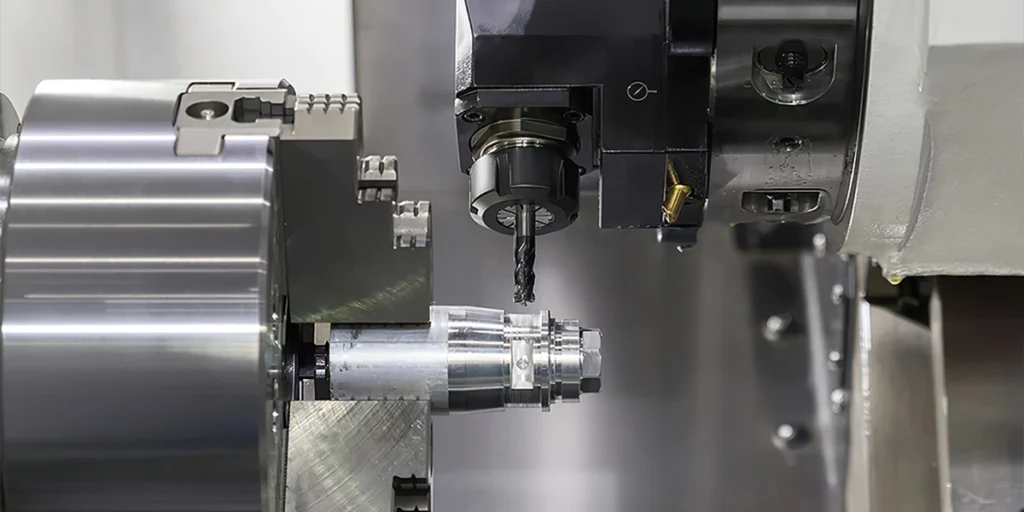
How to calibrate a CNC machine tool?
CNC machine tool calibration is not a single action, but a systematic process performed sequentially. A reasonable calibration approach can effectively restore and stabilize machine tool accuracy without increasing operational complexity. This can typically be approached from the following aspects:
1. Preparation for calibration under stable conditions
Before starting any calibration operations, ensure the machine tool is in a stable condition, including:
- The working environment should be relatively constant, avoiding interference from temperature, airflow, and vibration.
- The machine tool completes the necessary power-on preheating to allow all components to reach thermal equilibrium.
- The measuring tools are in good condition to avoid affecting the judgment due to tool errors.
The purpose of this step is to provide a reliable foundation for subsequent calibration.
2. Start with the overall state, rather than directly adjusting parameters.
When calibrating a CNC machine tool, you should first observe the overall operating status of the machine tool, rather than modifying system parameters at the beginning. For example:
- Is the movement of each axis smooth?
- Are there any abnormalities in the spindle operation?
- Does the machining dimension exhibit a regular deviation?
By making an overall assessment, it is possible to determine whether the problem originates from machinery, assembly, or system settings, thus avoiding blind adjustments.
3. Adjustments should be made according to the principle of “mechanical first, system second”.
In actual calibration, the following order is usually followed:
- Prioritize checking and adjusting the condition of the mechanical foundation.
- System compensation settings should be performed only after the mechanical conditions meet the requirements.
- Avoid relying entirely on software compensation to mask mechanical problems.
This approach helps ensure the stability of machine tools during long-term operation.
4. Verify each item one by one during the calibration process.
After each type of adjustment is completed, corresponding verification should be performed, for example:
- Observe motion consistency through no-load operation
- Confirm the trend of size change through simple trial cuts
Item-by-item verification can prevent problems from accumulating and also helps to quickly locate the source of error.
5. A traceable record is generated after calibration.
An effective calibration should not stop at “it’s done,” but should also:
- Record key adjustments.
- Determine the current accuracy status of the machine tool.
- Provides a reference for subsequent maintenance and re-inspection.
This step is particularly important for equipment management and long-term accuracy control.
The necessity of CNC machine tool calibration
The precision of CNC machine tools is not static. Even if the equipment is operating normally, a lack of calibration over a long period can subtly affect the machining results. The necessity of calibration is mainly reflected in the following aspects:
1. Ensure processing dimensions and consistency.
The positioning accuracy and repeatability of CNC machine tools directly determine the dimensional stability of parts. With increased use, factors such as wear and thermal deformation accumulate, leading to systematic deviations in the machined dimensions. Regular calibration can promptly detect and correct these changes, ensuring consistency across batches of parts.
2. Reduce the risk of rework and scrap.
When machine tool accuracy deteriorates unnoticed, the problem often manifests in the finished product stage, leading to rework or even the scrapping of the entire batch. Early detection of accuracy deviations through calibration allows for adjustments before the problem escalates, effectively reducing material waste and production losses.
3. Maintain a stable production pace.
Machine tools with unstable accuracy often require frequent shutdowns for adjustments. A calibrated machine tool has a more controllable operating status, which helps reduce temporary adjustment time, makes the machining process smoother, and thus improves overall production efficiency.
4. Identify potential equipment problems
Calibration is not only a process of adjusting accuracy, but also a system check. Through calibration, problems such as guide rail wear, transmission abnormalities, or loose assembly can be detected in advance, preventing small problems from developing into serious malfunctions and affecting normal production.
5. Meet quality management and customer requirements.
In fields such as precision machining, medical, and aerospace, machine tool accuracy is a crucial foundation for quality management. Calibration records demonstrate that equipment is under control, helping to meet internal quality management and customer requirements for machining capabilities.
6. Reduce operating costs in the long term.
Although calibration requires a certain investment of time and resources, its cost is lower than that of rework, scrapping, and major equipment overhauls. Preventative calibration keeps maintenance costs within a predictable range, leading to more stable production and management.
Common calibration items for CNC machine tools
CNC machine tool calibration is not limited to a single parameter, but rather focuses on the most critical accuracy performance during actual machining. Common calibration items typically include the following aspects:
1. Geometric accuracy related calibration
Geometric accuracy is the foundation of machine tool accuracy, mainly focusing on whether the spatial relationships between moving parts meet design requirements, including:
- Does linear motion maintain linearity?
- Are the coordinate axes maintained in the correct vertical relationship?
- Are key surfaces such as the worktable and guide rails flat?
- Do the moving parts maintain the necessary parallel relationship?
Geometric accuracy deviations are often directly reflected in the form and position errors of parts.
2. Positioning and repeatability accuracy calibration
This type of calibration focuses on “where the machine tool goes and whether it always goes to the same position,” and mainly includes:
- Positioning accuracy of each coordinate axis
- Consistency when repeatedly locating
- Control capability under minute displacements
- Gap conditions during forward and reverse motion
These indicators directly affect dimensional stability and consistency in batch processing.
3. Rotary axis and indexing accuracy calibration (if applicable)
For CNC machine tools with rotary tables or multi-axis structures, the following should also be noted:
- Accuracy of the rotation axis at a specified angular position
- Consistency of angles during multiple graduations
This type of calibration is particularly important for complex curved surfaces and multi-faceted machining.
4. Multi-axis linkage accuracy related calibration
On machine tools with dual-axis or multi-axis simultaneous drive, it is necessary to confirm:
- Synchronization during coordinated motion of all axes
- Positioning stability in linkage mode
Insufficient linkage accuracy may lead to contour errors or a decrease in surface quality.
5. Spindle accuracy related calibration
The condition of the spindle directly affects the cutting quality; common points of concern include:
- Radial stability during spindle rotation
- Is the axial movement controlled?
- Operational stability at different speeds
Abnormal spindle precision is often manifested in surface roughness and shape errors.
6. Dynamic performance related assessment
In addition to static accuracy, attention should also be paid to the machine tool’s performance during operation, such as:
- Whether abnormal vibrations occur during the movement
- Is the servo system responsive?
- Stability during low-speed and high-speed operation
Insufficient dynamic performance may amplify errors during high-speed or precision machining.
CNC machine tool calibration process
CNC machine tool calibration should be performed according to a clear and orderly process, rather than piecemeal adjustments. A reasonable calibration process helps improve efficiency and reduce the risks of repeated adjustments, and can generally be carried out in the following steps:
1. Pre-calibration status verification
Before formal calibration, it is necessary to confirm that the machine tool is in a calibrable state, including:
- The equipment is operating normally, with no obvious abnormalities or malfunctions.
- The machine tool has completed the necessary preheating.
- Relatively stable work environment
The purpose of this step is to ensure that the calibration results are of reference value.
2. Preliminary testing and error assessment
Basic testing helps understand the current accuracy status of the machine tool, with a focus on:
- Determine if a systematic bias exists.
- Distinguish between random errors and structural errors
Preliminary testing can provide direction for subsequent calibration, avoiding aimless adjustments.
3. Component calibration and step-by-step adjustment
Calibration is typically performed in order from basic to critical, for example:
- First process geometrically relevant precision
- Refocus on positioning and motion accuracy
- Finally, check items related to the spindle or multi-axis.
Item-by-item calibration helps reduce mutual interference and improve overall stability.
4. Verification and Validation after Calibration
After each calibration cycle is completed, necessary verification should be performed, such as:
- Observe the consistency of motion
- Conduct simple trial cuts or operational tests.
The verification process confirms whether the adjustments have achieved the desired effect.
5. Results Recording and Cycle Planning
After calibration, the results should be organized and recorded, including:
- Basic description of the current accuracy status
- Record of key adjustments
- Schedule for subsequent re-inspection or calibration
Good records are helpful for subsequent maintenance and long-term accuracy management.
At last
CNC machine tool calibration is fundamental to ensuring machining accuracy and production stability. Through a reasonable calibration approach, clearly defined calibration items, and standardized calibration procedures, accuracy deviations can be effectively controlled, rework risks reduced, and the stable operating cycle of equipment extended. For companies that perform precision or batch machining on a long-term basis, regular calibration is not only a technical requirement but also an indispensable part of quality management.