


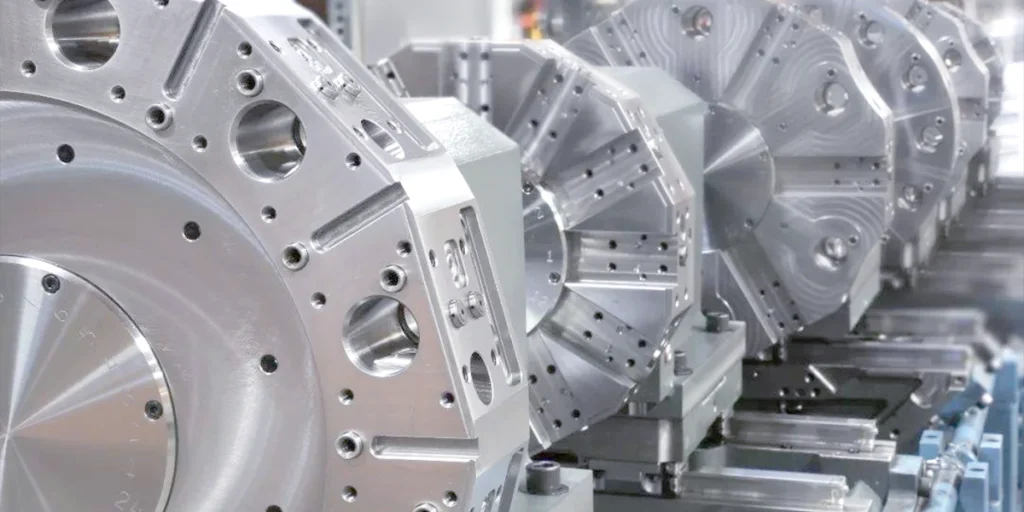
What is CNC milling?
Definition of CNC milling
CNC milling is a manufacturing process that uses a computer numerical control system (CNC) to control the movement of a cutting tool to perform cutting operations on materials. Its core characteristics are:
- Use a rotary cutter to remove material
- The workpiece is usually fixed on the worktable.
- Achieve high-precision, automated machining through programming (G-code)
The key advantages of CNC milling compared to traditional manual milling are:
- High repeatability (suitable for mass production)
- Capable of machining complex geometries
- High processing stability, reducing human error
In actual manufacturing, CNC milling is commonly used in manufacturing:
- Structural components (such as housings and supports)
- Functional parts (such as connectors, mechanical components)
- High-precision components (such as medical or aerospace parts)
Is CNC machining the same as milling? (Is CNC machining considered milling?)
This is a common misconception: CNC machining ≠ CNC milling, but CNC milling is a type of CNC machining.
CNC machining includes:
- CNC milling
- CNC turning
- Drilling, tapping and other processes
CNC milling is just one of the machining methods:
- Primarily based on the rotation of the cutting tool
- Suitable for machining complex contours, planes, and curved surfaces.
Selection suggestions in practical applications
In parts manufacturing, whether or not to use CNC milling typically depends on:
- The complexity of the part structure (complex structures are more suitable for milling)
- Is it a rotationally symmetric component (shafts are more suitable for turning)?
- Precision and surface requirements
For most non-circular, complex parts, CNC milling is usually the preferred process.
If you’re unsure whether your part is better suited for milling or turning, send us your CAD drawings for a quick evaluation. We can provide machining suggestions and cost estimates.
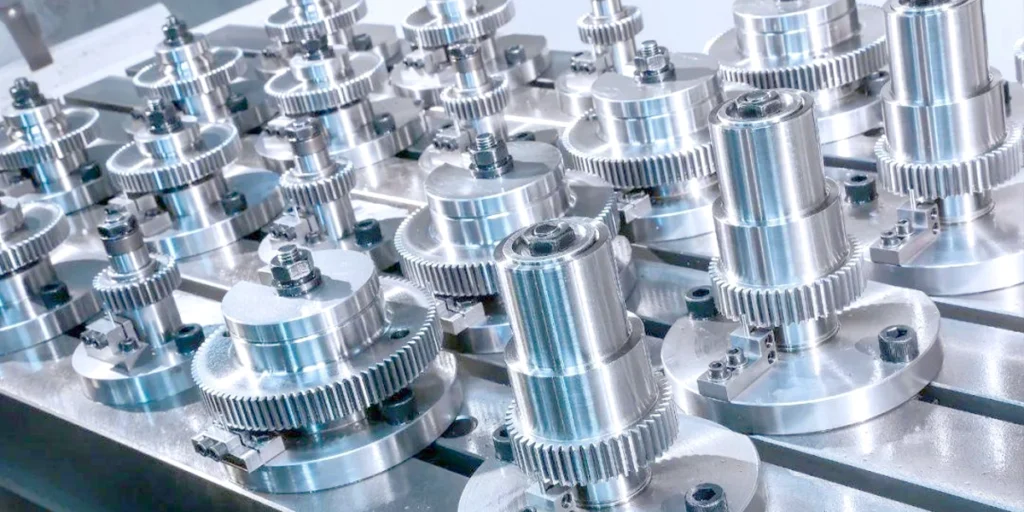
Working principle of CNC milling
In essence, CNC milling is not complicated: using a rotating tool, excess material is gradually “shaved away” until the target shape is formed. What truly makes it powerful is “who controls the process”.
In a CNC system, this “operator” is not a person, but a program (G-code). It precisely specifies:
- Where the knife goes (position)
- How fast to move (feed rate)
- How fast does it rotate (spindle speed)?
- How much to cut in each step (depth of cut)
In other words, the machining process is actually a series of action instructions that are digitally broken down: design drawings → converted into machining paths → automatically executed by the machine tool.
Compared to manual operation, the value of this method lies in:
- Each processing path can be repeated.
- Complex surfaces can be precisely decomposed and executed.
- Processing quality does not depend on personal experience, but on system control.
This is why CNC milling has become a standard process in the manufacture of high-precision parts.
The relationship between the movement of the cutting tool and the workpiece
To understand CNC milling, the key is to figure out one thing: what is moving? And how is it moving?
In a typical milling process:
- The cutting tool rotates (the main motion).
- The workpiece or worktable is moving (feed motion).
The two work together to create relative motion, thus completing the cutting process.
Common sports combinations
Depending on the equipment, several typical forms may occur:
3-axis milling
- The workpiece moves in the X / Y / Z directions
- The tool rotates in a fixed direction.
- Suitable for simple to moderately complex parts.
Multi-axis (4-axis/5-axis) milling
- The workpiece or tool can rotate
- Allows for contact with parts from multiple angles
- Suitable for complex curved surfaces and irregular structures.
Why is this kind of dynamic relationship important?
Because it directly determines:
- Can complex structures be processed?
- Is multiple clamping required?
- Is the accuracy stable?
- Is the cost high or low?
To illustrate with a practical example: a complex part might require multiple flipping and clamping operations if machined using 3-axis machining, but can be machined in one go using 5-axis machining. This difference is not only about efficiency, but also about the accumulation of errors.
Core logic in engineering
In real-world projects, engineers are more concerned with: “How to achieve the most complex shapes with the least amount of movement?”
This involves:
- Toolpath optimization
- Clamping strategy
- Processing sequence design
These factors often have a greater impact on the final result than the equipment itself.
If your part has a complex structure, or you are unsure whether multi-axis machining is required, you can submit your 3D drawings to receive machining path suggestions and process optimization solutions (including a determination of whether 3-axis or 5-axis machining is needed).
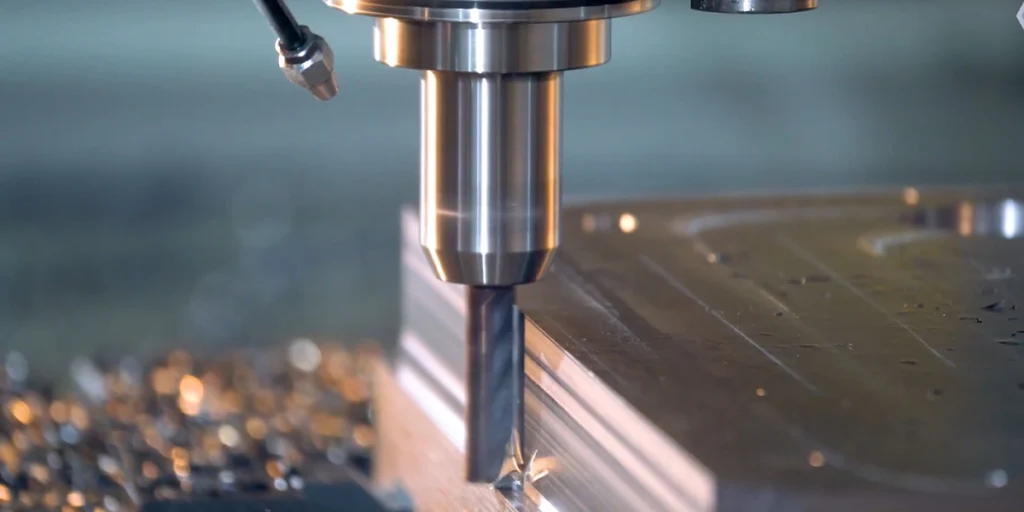
What is the function of a CNC milling machine?
The core role in manufacturing
If we were to summarize the function of a CNC milling machine in one sentence, its essence would be: to stably transform digital models into real parts. However, in actual manufacturing systems, its value goes far beyond simply “machining.”
In modern industry, CNC milling machines typically play three core roles:
1) A bridge from “design” to “physical entity”
The structure designed by engineers in CAD must ultimately be translated into usable parts. CNC milling is a key step in this transformation process.
Especially in these scenarios:
- Prototype verification in the early stages of product development
- Functional test pieces before injection molding/die casting
- Small-batch trial production
Without stable milling capabilities, it is difficult to iterate designs quickly.
2) Main manufacturing methods for complex parts
Many parts cannot be manufactured using other processes, or the cost is extremely high, for example:
- Irregularly shaped structural components
- Multi-faceted machined parts
- High-precision mating parts
In these scenarios, CNC milling is often the only feasible or optimal solution.
3) Core aspects of precision control
In demanding industries (such as medical, automated equipment, and precision assembly), parts not only need to be functional, but also:
- Dimensional stability
- Tolerances are controllable
- Consistent batch processing
These capabilities largely depend on the level of milling technology and equipment.
Differences from traditional processing methods
Many people confuse CNC milling with traditional milling, but the difference between the two is actually “generational”.
1) Control methods: Manual vs. Digital
- Traditional milling machines → Manual operation, relying on the operator’s experience
- CNC milling machines → Program-controlled, dependent on data and paths
turn out:
- Manual processing → Large fluctuations
- CNC machining → Reproducible and standardizable
2) Complexity capability
Traditional equipment can mostly do the following:
- Simple plane
- Basic outline
CNC can handle:
- Complex surfaces
- Multifaceted structure
- High-precision cavity
In particular, multi-axis machining has basically broken through the limitations of traditional machining.
3) Efficiency and cost structure
Intuitively, many people think: CNC is more advanced → it must be more expensive.
But the reality is often the opposite (especially with medium to complex parts):
- Reduce human intervention
- Reduce the number of clamping operations
- Reduce scrap rate
The end result is usually: lower overall cost, not higher cost.
4) Stability and scalability
The biggest problem with traditional processing is that the quality changes when the people involved change.
The advantages of CNC are:
- Fixed program
- The process is replicable
- High batch consistency
This is why all mass manufacturing eventually moves towards CNC machining.
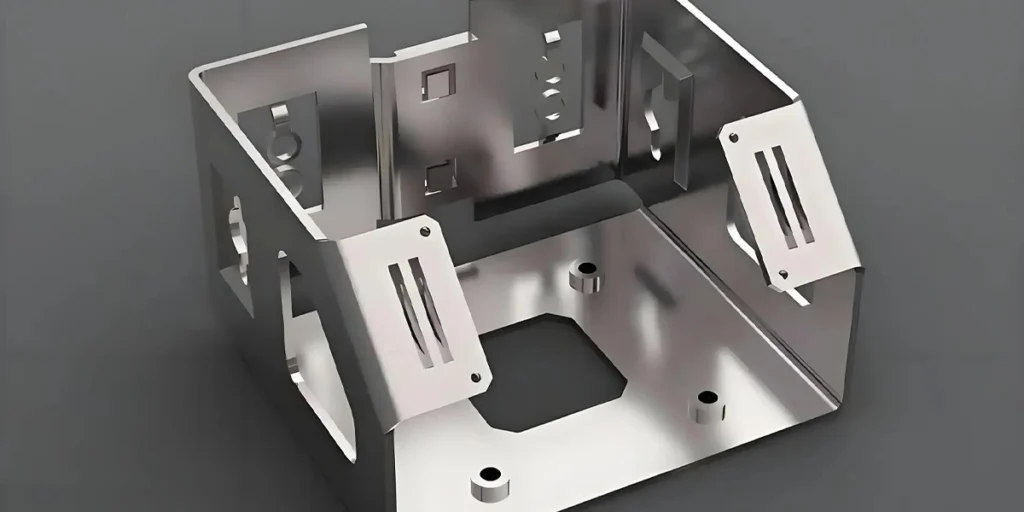
What can CNC milling process?
Typical part types
In terms of processing capabilities, CNC milling actually covers a very wide range, but a more accurate statement is that it is particularly good at processing parts that are “asymmetrical, structurally complex, and have assembly requirements”.
In actual projects, common milled parts can be roughly divided into several categories:
Structural components (most common)
These types of parts are typically used for support, fixation, or connection, for example:
- Equipment bracket
- Casing (aluminum casing, electronic casing)
- Frame-type parts
Its characteristics are: large size, regular shape but with local complex features.
Functional components (with higher precision requirements)
For actual operation or assembly, typical examples include:
- Connectors
- Mounting base
- Mating parts in moving components
These types of parts are often more sensitive to the following requirements:
- Hole position accuracy
- Flatness
- Tolerance
Complex geometric parts (high added value)
This is where CNC milling truly differentiates the two processes:
- Curved surface structural components
- Multi-faceted machined parts
- Complex internal cavity parts
Typically required:
- Multi-axis machining (4-axis/5-axis)
- Multiple path optimizations
This is also the part where customers are most likely to make mistakes (unreasonable design → soaring costs).
Prototypes and small batches of parts
CNC milling is commonly used during the product development phase for:
- Functional verification component
- Appearance test piece
- Small-batch trial production
The advantages are straightforward:
- No mold required.
- Quick to modify
- Delivery time is controllable
Applicable industries (robotics/medical/automotive)
CNC milling is not exclusive to any one industry, but is a fundamental process that “spans all high-end manufacturing fields.” However, the requirements for it vary greatly across different industries.
Robotics and Automation
Typical parts include:
- Robotic arm structural components
- Joint connectors
- Transmission component housing
Core requirements:
- Complex structure
- High assembly precision
- Strength and weight balance
Many parts require multi-faceted machining, and some even require 5-axis machining.
Medical devices
Common applications:
- Surgical instrument components
- Precision housing
- Customized components
The key point here is not just accuracy, but also:
- Surface quality
- Material stability
- Consistency control
Even the slightest error could affect safety during use.
Automotive industry
Mainly focused on:
- Functional test piece
- Modification parts
- Small batch structural parts
Demand characteristics:
- Cost sensitive
- High delivery time requirements
- Requires a certain level of precision but emphasizes efficiency.
Unsure if your part is suitable for CNC milling, or worried that an overly complex design will lead to excessive costs? Submit your drawings to receive a manufacturability analysis (DFM) and machining recommendations, including structural optimization and cost estimates.
Why Choose a Professional CNC Milling Service Provider
Equipment capacity (3-axis/5-axis)
More equipment is not necessarily better; rather, it should match the complexity of your parts.
- 3-axis: Suitable for planar surfaces, simple cavities, and conventional structural components, with more controllable costs.
- 3+2 axes (5-axis positioning): Reduces the need for flipping and clamping, balancing cost and complexity.
- 5-axis linkage: Machining complex curved surfaces and multiple surfaces in one operation, significantly reducing clamping errors.
The key is not whether it has 5 axes, but:
- Can the most suitable shaft type combination be selected based on the parts?
- Does it possess stable toolpath programming and simulation capabilities (to avoid interference and overcutting)?
- Can more processes be completed in a single setup?
The practical benefits are usually reflected in two aspects: fewer clamps → higher precision; shorter path → lower time cost.
Advantages in accuracy and delivery time
What the procurement side cares about most is not “theoretical accuracy”, but batch stability and delivery certainty.
In terms of accuracy (implementable metrics)
- Standard capability: ±0.02 mm (depending on structure and materials)
- Influencing factors: Number of clamping cycles, tool wear, thermal deformation, path strategy
- Safeguard measures: In-process inspection + final inspection (CMM/gauge), full inspection or sampling inspection of critical dimensions.
Delivery timeline (actually executable)
- Prototyping: The process typically begins and the first piece is completed within a few days.
- Small batch production: Parallel scheduling + process decomposition improves turnover.
- Risk control: Tool backup strategy, redundant equipment, standardized process cards
The conclusion is straightforward: accuracy is not a single-point capability, and delivery time is not just a slogan—both depend on systematic execution.
Our capabilities are embedded
Among similar suppliers, differences often lie in the combination of “scale × experience × execution capability.” This translates into tangible, perceptible results:
- Process matching: For the part structure, select the optimal path of 3-axis/3+2/5-axis to reduce unnecessary complexity and cost.
- Stable accuracy: Standard tolerances are controlled within ±0.02 mm, and critical dimensions are guaranteed to be consistent through standardized inspection procedures.
- Material coverage: Both metals and engineering plastics can be handled (from aluminum and stainless steel to POM, nylon, etc.), reducing the need to switch between multiple suppliers.
- Delivery timeline: Prototypes and small-batch production can be accelerated, shortening the cycle from design to verification.
- Scalability: Multi-device parallel processing supports a smooth transition from prototyping to mass production.
To put it another way: you’re not “buying processing,” but rather buying a set of predictable outcomes—certainty in terms of accuracy, time, and cost.