
With the development of AI servers, high-performance computing, 5G communication equipment and power electronic systems, thermal management has become an indispensable part of product design.
Whether it’s GPU modules, power semiconductors, data center equipment, or new energy vehicle electronic systems, excessively high operating temperatures will directly affect the performance, reliability, and lifespan of the equipment.
Among many heat dissipation materials, copper, with its excellent thermal conductivity, has become one of the most common materials in high-end thermal management systems.
As a professional CNC machining supplier that has long served customers in the consumer electronics , robotics automation , and industrial machinery industries , we often see our customers facing the same problems in the early stages of product development:
- Is copper better for heat dissipation than aluminum?
- What processing technology should be used for copper heat dissipation parts?
- Can complex cooling structures be achieved through CNC machining?
- How to balance heat dissipation performance and manufacturing cost?
This article will analyze the application value of copper in the field of thermal management from engineering and manufacturing perspectives.
Why is copper suitable for thermal management systems?
The core objective of a thermal management system is not simply to “cool down” the system, but to quickly transfer heat from the heat source to the heat dissipation area and maintain the system’s long-term stable operation.
A material’s thermal conductivity directly determines its heat transfer efficiency. This is why many high-power electronic devices ultimately choose copper as a key heat dissipation material.
High thermal conductivity
Copper’s most significant advantage is its extremely high thermal conductivity. The thermal conductivity of pure copper typically reaches approximately 390–400 W/m·K.
In comparison:
| Material | Thermal conductivity (W/m·K) |
| pure copper | 390–400 |
| aluminum alloy | 150–220 |
| Stainless steel | 15–25 |
| Titanium alloy | 7–22 |
This means that, under the same volume conditions, copper can transfer heat from the heat source to the heat dissipation area more quickly.
This is especially important for the following applications:
- AI server GPU module
- Power electronic devices
- High-frequency communication equipment
- Battery Management System
- Laser equipment
For example, in the field of AI servers, the continuous operation of a large number of GPUs will generate extremely high heat.
If heat cannot be transferred in time:
- Chip performance degraded
- Increased power consumption
- Reduced system stability
- Shortened hardware lifespan
Therefore, many high-end heat dissipation solutions use copper cold plates, copper heat exchangers, or copper-based heat dissipation structures.
Heat dissipation efficiency
High thermal conductivity is just one of copper’s advantages. For thermal management systems, the real key factor is overall heat dissipation efficiency.
The heat dissipation process typically involves three stages:
- Heat generation
- Heat conduction
- Heat release
Copper performed particularly well in the second phase.
Because heat can be rapidly diffused across the entire surface of the part, it is possible to:
- Reduce local hotspots
- Improve temperature uniformity
- Improve cooling system efficiency
- Reduce thermal stress concentration
This ability to dissipate heat evenly is very important for large power modules.
In actual projects, we often see clients adopting:
- Copper base plate + aluminum heat sink
- Copper cold plate + liquid cooling system
- Copper heat exchanger structure
To balance performance and cost.
Furthermore, as electronic devices continue to shrink in size, the heat generated per unit area continues to increase. Traditional heat dissipation structures are no longer sufficient to meet the demands. This is also one of the important reasons for the continued growth in demand for high-precision copper CNC machining in recent years.
Complex copper heat dissipation structures can provide a larger heat dissipation area within a limited space, thereby significantly improving the system’s thermal management capabilities.
Common thermal management copper parts
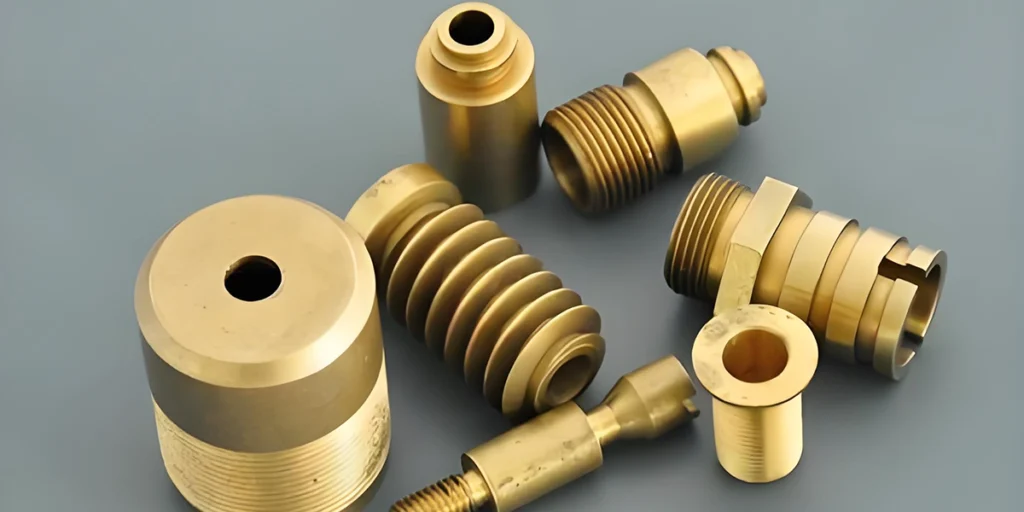
Copper is not just used in simple heat-conducting plates. As product structures become increasingly complex, more and more high-performance thermal management components need to be manufactured using precision CNC machining.
These parts typically have:
- Complex geometric structures
- Strict tolerance requirements
- High flatness requirements
- Excellent surface quality requirements
The following are some of the most common types of thermal management copper parts.
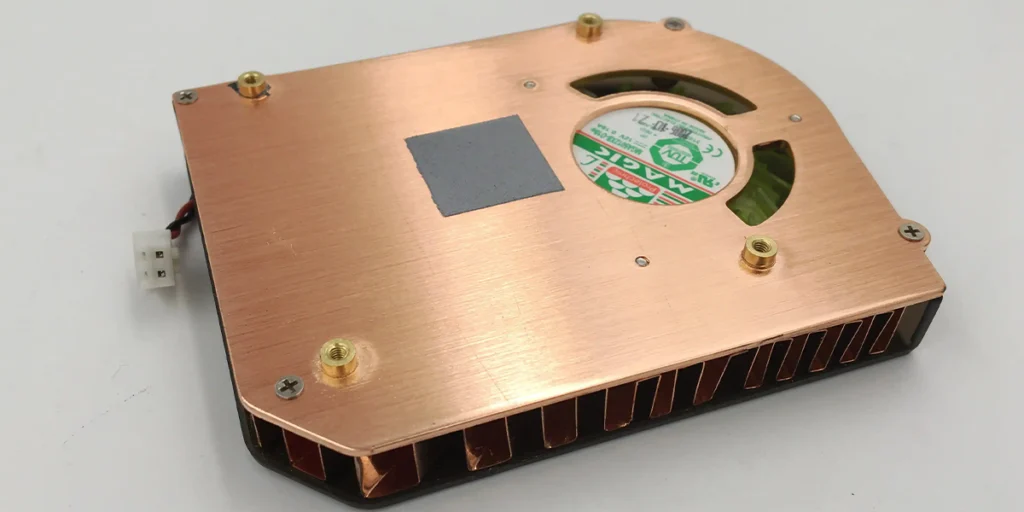
Heat sink
Heat sinks are one of the most common thermal management components. Their main function is to increase the surface area in contact with air, thereby improving heat dissipation efficiency.
Copper heat sinks are typically used in:
- CPU cooling system
- GPU module
- Power supply equipment
- Industrial control systems
Compared to aluminum heat sinks, copper heat sinks can transfer heat from the heat source to the entire heat dissipation structure more quickly. Therefore, their advantages are more pronounced in high-power devices.
However, copper also presents new processing challenges:
- The material is relatively heavy
- Higher processing costs
- Heat sink fins are prone to deformation
- Increased difficulty in fabricating microstructures
For high-density fin structures, the processing often requires:
- Small diameter cutting tools
- High-speed spindle
- Multi-axis linkage machining
This is necessary to ensure heat dissipation performance and structural integrity.
Cooling plate
With the development of liquid cooling technology, copper cooling plates have become an important component in data centers and AI hardware.
Cooling plates are typically installed on:
- GPU module
- ASIC chips
- Power Module
- Battery system
Its internal design incorporates complex flow channels, enabling the coolant to carry away heat.
Typical copper cold plates usually have the following characteristics:
- High flatness requirements
- Internal microchannel structure
- High sealing requirements
- Precision assembly interface
For these types of products, the processing difficulty often lies not in the appearance, but in the manufacturing of the internal flow channels.
Flow channel size deviations may directly affect:
- Cooling efficiency
- Liquid flow rate
- Pressure loss
- System lifespan
At Zhuohua Hardware, we combine 3-axis, 3+2-axis, and 5-axis machining capabilities to provide support for complex cold plate projects, from prototyping to mass production.
Heat exchanger
Heat exchangers are widely used in:
- Data Center
- Industrial equipment
- New energy system
- Communication equipment
Its core function is to achieve heat transfer between different media.
Compared to traditional structures, modern copper heat exchangers are increasingly trending towards:
- Miniaturization
- High power density
- Complex internal structure
This places higher demands on processing capabilities.
Many heat exchanger components need to simultaneously meet the following requirements:
- High thermal conductivity
- High dimensional accuracy
- Complex fluid channels
- Excellent sealing performance
For complex copper heat exchanger components, precision CNC machining can achieve geometric structures that are difficult to achieve with traditional processes, thereby helping customers improve overall thermal management performance.
Meanwhile, through reasonable DFM analysis and processing path optimization, processing costs can be reduced and batch production stability can be improved.
The demand for copper components in AI servers and electronic devices
In recent years, the development of AI infrastructure has been driving rapid growth in global copper processing demand. From large data centers to edge computing devices, from high-performance GPUs to power electronics modules, more and more devices face the same challenge: handling more heat in a smaller space.
As chip power continues to increase, traditional heat dissipation solutions are approaching their performance limits. For example:
- AI training server
- GPU cluster
- High-performance switches
- Liquid-cooled servers
- Power Management System
These devices typically need to operate continuously for 24 hours.
Insufficient thermal management capabilities may lead to:
- Degradation in computing performance
- Increased power consumption
- System failure rate increased
- Shortened equipment lifespan
Therefore, copper components are becoming a core part of many high-end thermal management systems.
Typical copper components in AI servers
Commonly used copper-machined parts in current AI servers include:
- Cold plate copper
- Copper heat sink base plate
- Microchannel cooling module
- Copper heat exchanger assembly
- High thermal conductivity copper connector
- Liquid cooling system copper manifold
Among them, the demand for cold-rolled steel sheets has increased particularly significantly.
As liquid cooling technology becomes more widespread, the internal flow channel structure of cooling plates is becoming increasingly complex.
Engineers need to consider not only:
- Thermal conductivity
- Fluid efficiency
Also need to be considered:
- Processing feasibility
- Sealing reliability
- Batch consistency
This is why more and more equipment manufacturers prefer to work with suppliers who have precision CNC machining capabilities rather than relying on traditional manufacturing methods.
Requirements for copper parts in electronic equipment
Besides AI servers, the electronics industry is also an important market for copper processing.
Common applications include:
- Power module heat sink
- IGBT cooling plate
- Power module baseboard
- Thermal components for radio frequency equipment
- Heat dissipation structure of communication equipment
Unlike ordinary mechanical parts, these products often require:
- High thermal conductivity
- High dimensional accuracy
- High flatness
- Excellent surface quality
For example, extremely high contact precision is typically required between the power module and the heatsink base plate. Insufficient flatness will increase contact thermal resistance, thus affecting overall heat dissipation efficiency.
Therefore, for this type of project, clients typically pay more attention to:
- Flatness control
- Surface roughness
- Batch consistency
- Detection capabilities
It’s not just about whether the parts have been finished.
Development Trends of Copper Heat Dissipation Components
In the next few years, the development direction of copper heat dissipation components will mainly focus on:
Higher power density
The continuous upgrading of AI chips and power electronic devices places higher demands on heat dissipation capabilities.
More complex internal structure
Traditional planar heat sinks are moving towards:
- Microchannel structure
- Topology optimization structure
- High-density heat dissipation fins
Developing in that direction.
Stricter tolerance requirements
As component sizes shrink, thermal management parts require higher machining precision.
Faster product iteration
More and more clients want things done quickly:
- Prototype verification
- Small batch testing
- Mass production
This places higher demands on the responsiveness of the supply chain.
For professional copper CNC machining suppliers, the core of future competition will not only be the number of equipment, but also engineering support capabilities, machining experience, and the stability of mass production.
How to achieve complex heat dissipation structures through CNC machining
As thermal management performance requirements continue to rise, many heat dissipation components are no longer simple flat plates or basic heat sinks. Modern cooling systems increasingly rely on complex geometries to improve heat exchange efficiency.
For example:
- Ultra-thin heat dissipation fins
- Deep cavity structure
- Microchannel cold plate
- Complex internal fluid channels
- Multi-faceted heat dissipation components
These structures often cannot be manufactured efficiently using traditional processing methods.
CNC machining, on the other hand, offers greater design freedom and precision control.
High-density heat dissipation fin processing
The performance of a heatsink largely depends on its surface area for heat dissipation. To increase the heat dissipation area, engineers typically design:
- Thinner fins
- Denseer arrangement
- Higher structural depth
However, as the size of the fins decreases, the processing difficulty also increases rapidly.
Common challenges include:
- Fin deformation
- Vibrating blade
- Burrs
- Tool breakage
Therefore, the following is required during the processing:
- High-speed spindle
- Small diameter cutting tools
- Stabilizing clamp system
- Precise toolpath planning
For high-density heat dissipation structures, multi-axis machining can often significantly improve machining quality and efficiency.
Microchannel cold plate processing
Microchannel cold plates are a key component in current liquid cooling systems. They typically contain a large number of tiny fluid channels.
These channels are responsible for:
- Increase heat exchange area
- Increase fluid disturbance
- Improve cooling efficiency
However, the processing difficulty is also much higher than that of ordinary structures.
Typical requirements include:
- Micrometer-level size control
- High flow channel consistency
- Excellent surface quality
- No risk of congestion
Any dimensional deviation can have an impact:
- Cooling effect
- Fluid pressure
- System stability
Therefore, microchannel structures typically require the involvement of experienced engineering teams in DFM evaluation and process development.
Multi-faceted complex structure processing
Many thermal management components need to be machined simultaneously in multiple directions. For example:
- Cooling interface
- Pipe connection area
- Installation structure
- Sealing surface
If traditional processing methods are used, multiple clamping operations are often required.
This will bring about:
- Cumulative error
- Decreased efficiency
- Increased costs
Therefore, more and more complex copper parts are beginning to adopt:
- 3+2 axis machining
- 5-axis machining
This reduces the number of clamping operations and improves dimensional consistency.
Manufacturing support from design to mass production
The success of complex thermal management components depends not only on the design itself, but also on the manufacturing process, which determines the final performance.
At Zhuohua Hardware, we typically assist clients with DFM analysis at the early stages of a project, including:
- Manufacturability assessment of heat dissipation structure
- Tool reachability analysis
- Optimization of flow channel processing
- Tolerance optimization suggestions
- Cost optimization plan
Leveraging our 3-axis, 3+2-axis, and 5-axis CNC machining capabilities, as well as extensive experience in copper material processing , we can support:
- Heat sink
- Copper cold plate
- Heat exchanger assembly
- AI server heat dissipation components
- High thermal conductivity electronic components
The complete manufacturing requirements from rapid prototyping to mass production.
For thermal management projects, a good processing supplier should not only be responsible for manufacturing parts, but also help customers find the best balance between performance, cost and manufacturability.