
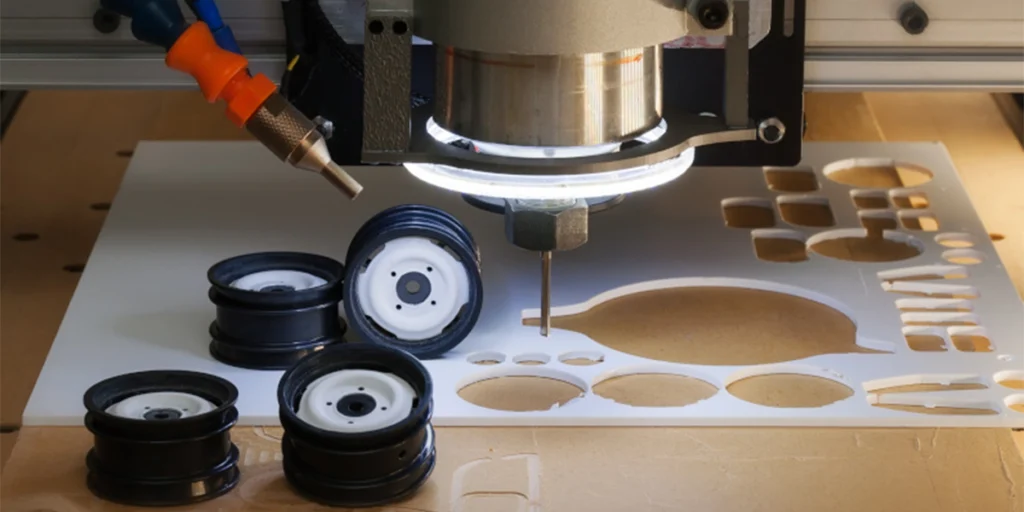
In the field of numerical control machining, “CNC machine tool” is not a single piece of equipment, but a general term for a class of machine tools that control machining movements through digital programs. Different types of CNC machine tools correspond to different structural features, machining methods, and applicable part shapes.
Choosing the wrong machine tool type can lead to low processing efficiency, unstable accuracy, and even a significant increase in costs. Therefore, when understanding CNC machining capabilities, it is essential to first identify common machine tool types and their applicable scenarios.
Below are the five most common types of CNC machine tools used in industrial manufacturing.
CNC lathe
CNC lathes are mainly used for machining rotating parts. Their core feature is that the workpiece rotates while the cutting tool moves axially or radially to perform cutting.
Typical processing content
- Machining of outer diameter and inner hole
- Thread machining
- End face processing
- Shaft and sleeve parts
Structural features
- High-speed spindle rotation
- Typically a 2-axis (X/Z) structure
- Expandable power turret enables milling functionality
Advantages
- Suitable for mass production of rotating parts
- Stable coaxiality control
- High processing efficiency
Limitations
- Not suitable for complex three-dimensional curved surfaces
- Poor adaptability to non-rotating parts
CNC lathes are core equipment in the production of automotive parts, hydraulic joints, connectors, and other products.
CNC milling machine
CNC milling machines are mainly used to machine flat, contoured, and complex geometrically shaped parts. Unlike lathes, milling machines typically involve rotating the cutting tool while keeping the workpiece stationary.
Typical processing content
- Planar machining
- Cavity machining
- Groove machining
- Surface machining
Structural form
- Vertical milling machine
- Horizontal milling machine
- Based on three-axis, expandable to four-axis or five-axis
Advantages
- Suitable for asymmetrical parts
- High processing flexibility
- Capable of creating complex curved surfaces
Limitations
- Machining efficiency for rotating bodies is lower than that for lathes.
- Multi-faceted machining requires repeated clamping (if not multi-axis)
CNC milling machines are widely used in mold processing, shell processing, and structural component manufacturing.
CNC machining center
CNC machining centers are highly integrated devices developed from CNC milling machines. Their core feature is the automatic tool changer (ATC) system, which enables multiple machining operations to be completed in a single setup.
Compared to ordinary CNC milling machines, machining centers place greater emphasis on process integration capabilities and production efficiency improvement.
Typical processing content
- Machining of polyhedral parts
- Machining of cavities and complex structures
- Drilling, tapping, and milling combined machining
- High-precision structural component machining
Structural features
- Automated tool magazine system
- Typically a three-axis structure, expandable to four-axis or five-axis
- Possesses high rigidity and stability
- Can be integrated with probe detection system
Advantages
- Multiple machining processes can be completed in a single setup, reducing the accumulation of errors.
- Automatic tool change improves machining efficiency.
- More suitable for stable mass production
- High accuracy and consistency
Limitations
- The equipment cost is higher than that of a regular milling machine.
- Higher requirements for programming and process planning
- The cost advantage may not be obvious for small batches of simple parts.
In modern manufacturing environments, machining centers have become the mainstream production equipment, especially suitable for parts with complex structures and high precision requirements.
CNC grinding machine
CNC grinding machines are mainly used in the high-precision finishing stage. Their machining method is different from turning and milling. They use grinding wheels for micro-cutting to obtain higher dimensional accuracy and surface finish.
Grinding is typically used for final dimensional control or surface quality improvement of parts.
Typical processing content
- External cylindrical grinding
- Internal hole grinding
- Surface grinding
- Precision shaft and mold parts machining
Structural features
- High-speed rotating grinding wheel
- High-precision spindle system
- Typically possesses extremely high positioning accuracy
- Suitable for fine-cut machining.
Advantages
- Enables higher dimensional accuracy
- Strong surface roughness control capability
- Suitable for machining hardened materials
Limitations
- Low material removal efficiency
- Usually used as a subsequent finishing process
- High requirements for operating environment and temperature control
In actual production, CNC grinding machines are often used in conjunction with turning or milling processes for the final precision control stage, and are especially suitable for high-precision shaft parts, mold components and parts made of high-hardness materials.
Multi-axis composite CNC machine tool
Multi-axis composite CNC machine tools are high-end CNC equipment that integrates turning, milling, drilling, and even grinding functions into a single machine. Their core features lie in their multi-axis linkage control capabilities and high degree of process integration.
Unlike traditional step-by-step machining (“turning + milling”), composite machine tools emphasize completing all machining processes for complex parts in a single setup.
Typical processing content
- Complex curved surface parts
- High-precision multi-faceted structural components
- Aerospace structural components
- Precision medical components
- Highly complex irregular-shaped parts
Structural features
- Five or more axes of linkage (X/Y/Z + A/B/C)
- Can achieve tilt angle machining
- Typically integrates a power turret or dual spindle system
- High-rigidity, high-stability fuselage structure
Advantages
- Significantly reduce the number of clamping operations
- Reduce the risk of error accumulation
- Improve the machining efficiency of complex parts
- Suitable for high value-added products
Limitations
- High equipment costs
- High programming complexity
- Requires high skill levels from operations and process engineers
Multi-axis composite CNC machine tools are typically used in high-tech industries, and their value lies in the integration of processing capabilities rather than simply pursuing processing speed.
Selection recommendations for different machine tools
Machine tool selection should not be based solely on the “advanced level” of the equipment, but should be based on a comprehensive judgment of the part structure, precision requirements, batch size, and cost control objectives.
1. Select according to the shape of the part
- Rotary parts → CNC lathes are preferred
- For planar or structural components → Select CNC milling machine
- Complex, multifaceted parts → Machining center
- High-precision surface treatment → CNC grinding machine
- Complex multi-axis curved surfaces or high-value-added parts → Multi-axis composite machine tools
2. Select according to accuracy requirements
- Standard structural components → Three-axis machining is sufficient
- High-precision parts → Select a high-rigidity machining center or grinding machine
- Multi-angle complex machining → Five-axis equipment has a greater advantage
3. Select based on batch size
- Small batch, high variety → Machining center or multi-functional machine tool
- Mass production of standard parts → Dedicated lathes or automated production lines
- Prototype verification → Three-axis or five-axis machining center
4. Based on cost and return on investment judgment
High-end equipment does not necessarily bring cost advantages. If the parts have a simple structure and are produced in large quantities, excessive use of multi-axis composite equipment may actually increase the cost per unit.
The core logic of selection should be: under the premise of meeting technical requirements, choose the solution that balances the best processing efficiency and cost.
Our understanding of CNC machine tools
As a professional CNC machining manufacturer, our understanding of CNC machine tools goes beyond the equipment model level; we focus on machining stability, process compatibility, and long-term controllability.
In actual production, we pay more attention to the following core factors:
- Machine tool rigidity and precision retention capability: Repeat positioning stability after long-term operation, not just factory parameters.
- The matching relationship between cutting tools and machine tools: Optimization of cutting parameters directly affects efficiency and surface quality.
- Clamping system design: A reasonable clamping scheme determines whether the error is controllable.
- Multi-process integration capability: Reduces the number of clamping operations and reduces error accumulation.
- Adaptation strategies for different materials: Aluminum alloys, stainless steel, and engineering plastics have significantly different cutting strategies.
We typically select the most suitable equipment and processing path based on the part’s structure, material properties, and tolerance requirements, rather than blindly pursuing high-end models. Reasonable process planning is often more critical than the equipment itself.
If you are evaluating whether a part is suitable for CNC machining, or are unsure which machining method to choose, please leave a message or submit your drawings. We will provide specific recommendations based on the structure, materials, and precision requirements.