
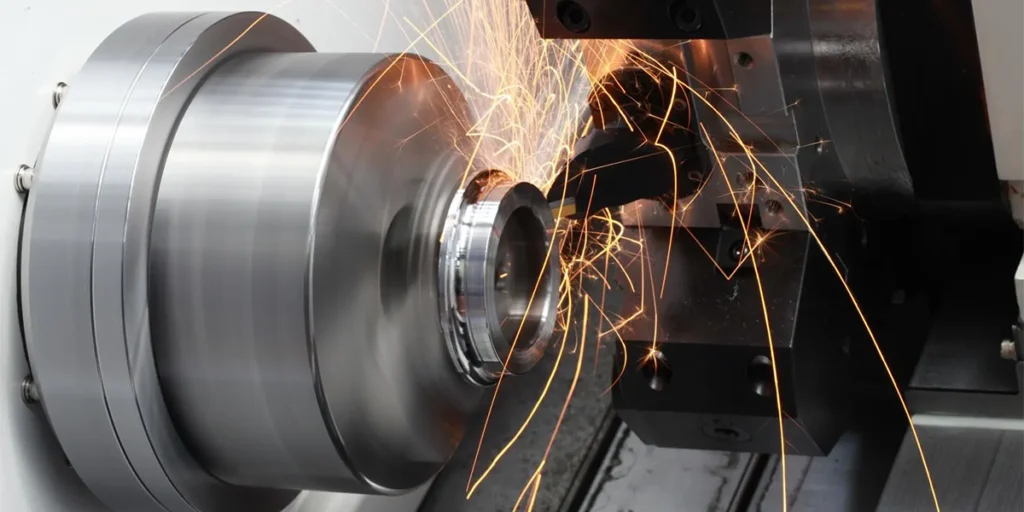
Numerical control machining (CNC) has become one of the fundamental technologies of modern manufacturing. However, it did not suddenly appear with the maturity of computer technology, but rather underwent a long process of technological evolution from mechanical control to digital control, and then to computer control.
Against the backdrop of rapidly growing demand in aerospace manufacturing, traditional machining methods have become insufficient to meet the precision requirements of complex curved surface parts, which has directly driven the birth of numerical control technology. From the earliest numerical control (NC) systems to today’s highly integrated computer numerical control (CNC) systems, the development of CNC machining has spanned almost the entire history of modern industrial automation.
Understanding the origins of CNC helps to gain a clearer understanding of its technological essence and future development direction.
Background of the Origin of CNC Machining
The concept of CNC machining can be traced back to the late 1940s, when the aerospace industry saw a surge in demand for machining complex curved surface parts (especially propeller and wing structural components). Traditional machine tools, which relied on manual operation, struggled to reliably achieve high-precision three-dimensional contour machining.
Against this backdrop, American engineer John T. Parsons proposed the idea of using digital coordinates to control the movement of machine tools. He used punched cards to store coordinate data, allowing the machine tool to automatically process complex curved surfaces according to a preset path, which became the core idea of CNC machining technology.
Subsequently, the technology received funding from the United States Air Force and collaborated with the Massachusetts Institute of Technology (MIT) on research. In 1952, MIT successfully developed the first experimental numerical control milling machine, marking the formal entry of numerical control (NC) technology into the engineering application stage.
Early NC systems had distinct characteristics:
- Control using analog electronic components
- Input the processing program via punched paper tape
- The program is complex to modify and has low flexibility.
Although the system at the time was still relatively primitive, it had achieved a key breakthrough — transforming machining control from manual experience to digital logic. This technological direction laid the foundation for the later birth of Computer Numerical Control (CNC).
From early NC to modern CNC
With the development of electronic and computer technologies, numerical control (NC) systems underwent a crucial turning point in the 1960s. Traditional NC systems mainly relied on hardware logic circuits for control, which made program modification difficult, limited system stability, and unable to meet the needs of complex manufacturing.
The introduction of computer technology has enabled numerical control systems to gradually evolve from NC (Numerical Control) to CNC (Computer Numerical Control).
The key changes during this phase include:
1. Computers replace hardware logic control
Early CNC systems required numerous electronic components for logic control, but with the development of industrial computers, control logic gradually shifted to the software level. Companies like IBM promoted the widespread adoption of industrial computing technology, enabling CNC systems to possess stronger data processing capabilities.
Software-based control offers significant advantages:
- Program modifiability has been greatly improved
- The processing path is more complex
- System stability is significantly improved
2. Standardization and Commercialization of CNC Systems
In the 1970s and 1980s, CNC systems began to move from laboratory technology to industrial mass production, and professional CNC system manufacturers gradually emerged.
For example:
- FANUC has driven the large-scale application of CNC systems in the machine tool industry.
- Siemens deeply integrates CNC with industrial automation.
During this period, CNC gradually became the standard configuration for modern machine tools.
3. Development of Multi-Axis Machining Technology
With the upgrade of servo systems and interpolation algorithms, three-axis machining has gradually expanded to:
- Four-axis machining
- Five-axis linkage machining
- Composite machining center
The emergence of multi-axis technology has significantly improved the ability to process complex curved surfaces, especially in the fields of aerospace and precision molds, where it has achieved key breakthroughs.
4. Integration of CAD/CAM technology and CNC
With the maturation of Computer-Aided Design (CAD) and Computer-Aided Manufacturing (CAM) technologies, CNC machining has entered a true digital manufacturing stage: design → programming → machining achieve a data closed loop, significantly reducing manual intervention. This also marks the upgrade of CNC from “automatic machine tool control technology” to “digital manufacturing execution system”.
The impact of technological evolution on manufacturing
The development of CNC technology has not only changed machine tools themselves, but has also profoundly affected the production mode, quality standards and industrial structure of the entire manufacturing system.
1. Overall improvement in machining accuracy standards
In the era of traditional machining, dimensional accuracy was highly dependent on the operator’s experience, but the emergence of CNC has gradually standardized accuracy control.
pass:
- High-precision ball screw
- Closed-loop servo control
- Digital compensation technology
Modern CNC machine tools can reliably achieve micron-level machining accuracy, which has driven the development of the precision manufacturing industry.
2. Significantly improved consistency in batch production.
One of the core advantages of CNC machining is that programs can be repeatedly executed. Compared to manual operation, CNC machining can ensure:
- Consistent dimensions of batch parts
- table processing
- Reduced quality fluctuations
This is especially important for industries such as automobiles and medical devices.
3. Manufacturing processes are gradually becoming digitalized.
CNC is driving the manufacturing process from “experience-driven” to “data-driven”:
- CAD Digital Design
- CAM Digital Process
- CNC Digital Execution
This change became the foundation for the subsequent development of intelligent manufacturing and industrial automation.
4. Small-batch customized production becomes possible.
Traditional manufacturing relies on molds, resulting in high costs associated with product changes. CNC technology, however, makes manufacturing more flexible.
- Production can be carried out without molds
- Suitable for multiple varieties and small batches
- Supports rapid prototyping
This directly propelled the transformation of modern manufacturing towards flexible production.
Key Development Stages of CNC Technology
CNC machining was not a sudden technological breakthrough, but rather a gradual maturation that occurred with the development of electronic technology, computer technology, and automation control technology. Overall, CNC technology has roughly gone through the following key stages:
1. Early NC phase (1950s – 1960s)
At this stage, CNC systems were still primarily based on hardware logic control, with programs mainly input via punched paper tape. The system functions were relatively simple, but it was already capable of basic trajectory control, addressing the initial needs for machining complex curved surfaces.
Features include:
- Difficulty in modifying the program
- Limited control stability
- Low level of automation
Although the technology was not yet mature, this stage laid the basic framework for digitally controlled machining.
2. The Computer Numerical Control (CNC) Stage (1970s –1990s)
With the development of industrial computers, numerical control systems have gradually become software-based, forming the prototype of modern CNC. Programs can be edited and stored via computers, significantly enhancing the control capabilities of machine tools.
Key changes during this phase included:
- Interpolation algorithm optimization
- Enhanced multi-axis control capabilities
- Digitalization of program management
At the same time, CAD/CAM technology began to enter industrial applications, and CNC machining gradually formed a complete digital manufacturing process.
3. Multi-axis and composite machining stage (after 2000)
Since the beginning of the 21st century, the demand for complex structural components in the manufacturing industry has continued to increase, and multi-axis machining technology has developed rapidly.
Typical changes include:
- Five-axis linkage machining becomes widespread
- Increased application of mill-turn machining centers
- Mature high-speed machining technology
Multi-axis technology significantly reduces the number of clamping operations, improving the machining efficiency and accuracy of complex parts.
4. The Intelligent and Automation Stage (Current Trend)
Currently, CNC technology is deeply integrated with intelligent manufacturing, mainly reflected in:
- Automated production unit
- Online detection and error compensation
- Data-driven process optimization
Numerical control equipment is transforming from a “machining execution tool” into a “smart manufacturing node” and becoming an important component of digital factories.
Professional CNC machining customization service provider
With the continuous development of CNC technology, when selecting machining suppliers, companies not only focus on equipment capabilities, but also attach great importance to process experience, quality control and delivery stability.
As a professional CNC machining customization service provider, we possess the following capabilities:
- Supports processing of various metals and engineering plastics.
- Provide complete solutions from prototyping to mass production
- Rigorous dimensional inspection and quality control processes
- Rapid response engineering support
If you are looking for a reliable CNC machining partner, please submit your drawings or requirements. Our engineering team can provide machining feasibility assessments and quotation suggestions based on the part structure and application scenario, helping to shorten the development cycle and reduce manufacturing risks.