
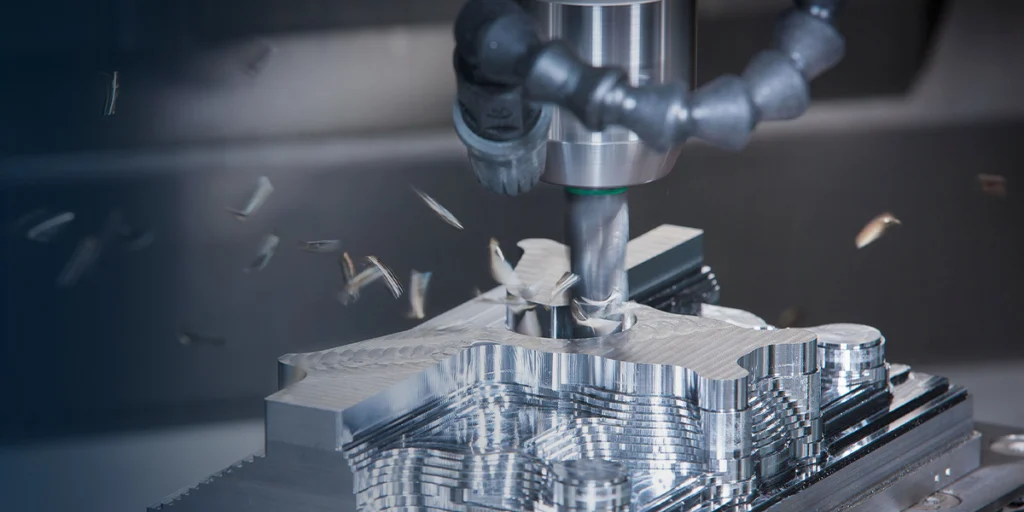
With the rapid development of artificial intelligence technology, more and more manufacturing companies are beginning to pay attention to a real-world question: Will AI replace traditional manufacturing processes, especially numerical control machining (CNC)?
From automated programming to intelligent scheduling, from tool life prediction to quality inspection, artificial intelligence is gradually entering the field of machining and changing some production methods. However, it’s important to clarify that AI is not a new machining process, but rather a tool to assist in decision-making and optimization. The core technology that truly completes material cutting and structural forming remains CNC machining.
For manufacturing scenarios requiring high-precision structural components, small-batch customized parts, or complex metal parts, CNC remains the most mature and stable machining method. The value of AI, however, lies more in improving efficiency, reducing error rates, and optimizing production processes.
From an industry perspective, the future development trend is not “AI replacing CNC”, but rather the deep integration of AI and CNC.
Practical Applications of AI in CNC
Currently, artificial intelligence has begun to be applied in multiple stages of CNC machining, but mainly in the auxiliary optimization layer, rather than directly replacing the machining itself.
1. Automated programming and machining path optimization
Traditional CAM programming relies on engineers’ experience, while AI can learn from historical machining data to achieve the following:
- Automatic identification of part features
- Recommended toolpath strategy
- Optimize cutting parameters
These technologies can significantly reduce programming time, especially for parts with complex structures. In actual production, intelligent programming can effectively improve efficiency for batch orders or repetitive structural parts, but for high-precision or special structural parts, process confirmation by experienced engineers is still required.
2. Tool life prediction and equipment condition monitoring
AI can analyze sensor data:
- Spindle vibration
- Changes in cutting force
- Temperature fluctuations
This allows for the prediction of tool wear and timely replacement, reducing downtime and machining errors. Such applications are increasingly being adopted by manufacturing companies to improve stability.
3. Automated quality inspection
By combining machine vision systems, AI can achieve:
- Surface defect identification
- Size inspection assists in judgment
- Batch quality trend analysis
Especially in mass production, AI can significantly improve inspection efficiency. However, for parts requiring micron-level precision, it is still necessary to combine it with high-precision inspection methods such as coordinate measuring machine (CMM).
4. Intelligent production scheduling and production dispatch
In a multi-variety, small-batch production model, AI can perform operations based on order data:
- Processing sequence optimization
- Equipment load balancing
- Delivery time forecast
These types of applications are more relevant to production management than to the processing itself.
What aspects can AI replace?
In CNC machining processes, artificial intelligence has already been able to play a substitute role in some standardized, data-driven processes, especially in processes that are highly repetitive, have clear rules, and rely on the accumulation of historical data.
1. Basic CAM Programming and Path Generation
For parts with relatively standard structures, AI can automatically generate machining strategies by recognizing geometric features, for example:
- Automatically identifies common structures such as holes, slots, and cavities.
- Recommended cutting tools and machining sequence
- Automatically generate roughing and semi-finishing paths
This type of automated programming has already been implemented in some CAM software, which can significantly reduce programming time. However, for complex surfaces or high-precision parts, engineers still need to make detailed adjustments.
2. Recommendation and optimization of processing parameters
AI can optimize the following parameters by analyzing historical processing data:
- Spindle speed
- Feed rate
- Depth of cut
- Tool usage strategy
This optimization is primarily based on statistical models and has a significant effect on improving efficiency and reducing tool wear. However, it should be noted that different material batches, equipment conditions, and fixture schemes can all affect the actual machining results; therefore, the parameters recommended by AI usually still need to be manually verified.
3. Equipment operation monitoring and predictive maintenance
Based on sensor data, AI can analyze in real time:
- Vibration signal
- Temperature change
- Spindle load
This enables early warning of equipment malfunctions and reduces unexpected downtime. The level of automation in this process is rapidly increasing, representing one of the most mature applications of AI in the manufacturing sector.
4. Production Scheduling and Order Management
In a multi-order production environment, AI can optimize through algorithms:
- Machine tool utilization rate
- Order priority
- Production cycle time arrangement
These types of applications are more common in manufacturing management, but they significantly improve overall delivery efficiency.
Core capabilities that AI cannot replace
Although artificial intelligence is changing manufacturing processes, in the field of CNC machining, there are still many key links that rely heavily on engineering experience and on-site judgment, which are difficult to be replaced by AI in the short term.
1. Process design capability
The core of CNC machining is not the “program,” but the “process.” For the same part, there can be multiple machining paths, but different approaches will directly affect the final result.
- cost
- Accuracy and stability
- Deformation risk
- Delivery cycle
For example:
- How to avoid deformation in thin-walled parts
- How to control the vibratory cutter in a deep cavity structure?
- How to allocate roughing and finishing processes for high-hardness materials?
These issues often require judgment based on actual processing experience, rather than simply relying on data models.
2. Manufacturing decisions for complex structural parts
When the structure of a part is complex, it involves:
- Multi-axis linkage strategy
- Clamping scheme design
- Process breakdown logic
AI currently struggles to fully understand variables in real-world processing environments, such as:
- Clamping rigidity
- Risk of tool interference
- Actual machine tool dynamic performance
Therefore, complex and precision parts still rely heavily on the experience of the engineering team.
3. On-site adjustment of material processing characteristics
Material variation is one of the most common uncertainties in CNC machining. Even with the same material, variations can occur between different batches.
- Hardness fluctuation
- Internal stress differences
- Changes in cutting stability
Field engineers typically need to quickly adjust parameters through trial cuts, but AI still has limitations in the absence of real-time physical feedback models.
4. Precision quality control and problem diagnosis
When dimensional deviations or surface anomalies occur, a systematic analysis is required, for example:
- Tool wear
- Fixture positioning error
- Effects of thermal deformation
- Program strategy issues
These types of problems are usually caused by a combination of factors, and currently, troubleshooting still relies on engineering experience.
Changes in the role of engineers
As artificial intelligence gradually enters the field of CNC machining, the job content of engineers is undergoing structural changes, but they are not being replaced; rather, they are shifting towards higher technical density and stronger comprehensive capabilities.
1. Shift from manual programming to process optimization
In traditional manufacturing processes, engineers need to invest a significant amount of time:
- Path writing
- Parameter settings
- Program debugging
With the development of intelligent CAM and AI-assisted tools, basic programming work is being handled by automation tools, and engineers are beginning to focus more on:
- Process route design
- Processing efficiency optimization
- Solutions for complex structures
In other words, the core value of engineers is shifting from the “operational level” to the “decision-making level”.
2. Higher requirements for understanding of equipment and processes
Modern CNC machining is no longer just about single-machine processing, but involves:
- Multi-axis linkage equipment
- Automated production line
- Online detection system
In actual production, common control systems come from industrial automation manufacturers such as FANUC and Siemens. Different systems differ in:
- Control Logic
- Processing strategy
- Parameter adjustment method
There are differences, which requires engineers to have a more systematic understanding of the equipment.
3. Data-driven capabilities are becoming a new requirement.
With the development of AI and digital manufacturing, processing data is becoming an important asset, for example:
- Tool life data
- Processing cycle time data
- Quality fluctuation data
In the future, engineers will not only need to have processing experience, but also the ability to analyze and optimize based on data.
Professional precision parts processing service provider
From the current manufacturing practice, artificial intelligence is improving the efficiency and stability of CNC machining, but the quality of parts and the reliability of delivery are still determined by mature machining systems and engineering experience.
For projects with complex structures, high precision requirements, or those needing rapid delivery, choosing a manufacturer with complete CNC machining capabilities is particularly crucial. For example:
- Stable multi-axis machining equipment
- Comprehensive material processing experience
- Rigorous quality inspection process
- Flexible support for small-batch and mass production
We have long focused on precision CNC component machining, and by combining standardized processes with a continuously optimized production management system, we can support a variety of manufacturing needs from prototype development to mass production.
If you are evaluating processing options or need a project quote, you can submit your drawings or technical requirements directly, and our engineering team will provide targeted processing suggestions and quick quote support.