
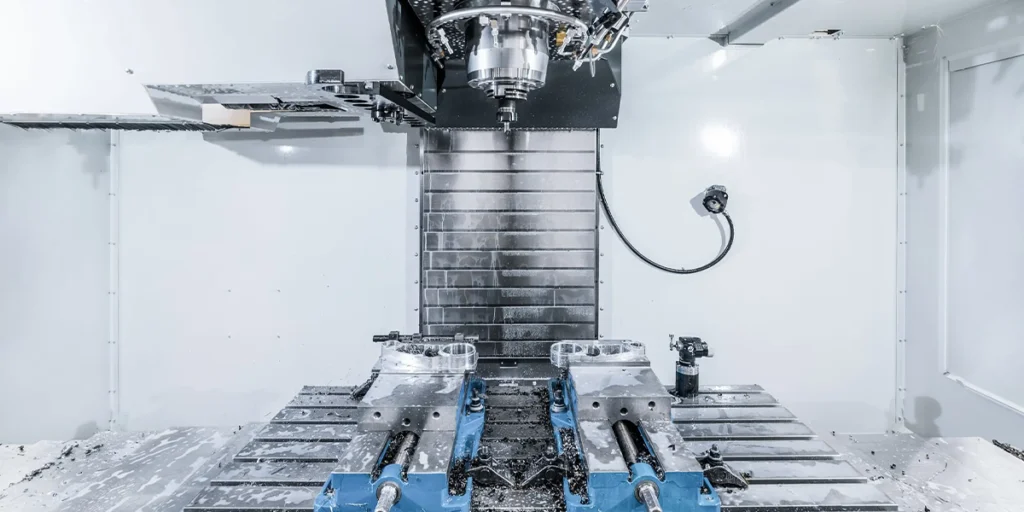
The reason why CNC machining can achieve high precision, stable repeatability, and complex contour machining lies not in “automatic machine operation,” but in the control logic behind it. The CNC system precisely controls the movement of each axis of the machine tool through digital programs, so that the tool cuts the material according to a preset path, thereby obtaining the target geometry.
Understanding the working principle of CNC machining is essentially about understanding a complete execution chain: how design data is converted into executable instructions and ultimately into physical cutting actions.
Execution logic from CAD to finished product
CNC machining does not begin cutting directly from the blueprint; rather, it involves a complete digital conversion process. The standard execution logic typically includes the following stages:
1. CAD Design Stage
Engineers use CAD software (such as SolidWorks, UG, AutoCAD, etc.) to create 3D models or 2D drawings. The model includes:
- Dimensions
- Tolerance information
- Geometric shapes
- Surface requirements
This stage defines the “final goal geometry”.
2. CAM Programming Stage
CAD models cannot directly drive machine tools. Machining paths must be generated using CAM software.
The CAM system will base its decisions on:
- Material type
- Tool selection
- Depth of cut
- Feed rate
- Spindle speed
Calculate a reasonable tool motion trajectory and generate G-code program to convert the geometry into executable motion path data.
3. CNC system analysis program
The generated G-code is imported into the CNC control system. The control system is responsible for:
- Parsing instructions
- Calculate the displacement of each axis
- Plan the sequence of movements
- Output control signal
At this point, the processing has shifted from “design logic” to “motion control logic”.
4. The machine tool performs cutting actions.
The control system is controlled by a servo drive device:
- Displacement along the X, Y, and Z axes
- Spindle rotation
- Tool feed
- Cooling system start/stop
The cutting tool cuts the material along a predetermined path, ultimately forming a solid part that matches the CAD model.
How the program drives the machine tool’s movements
The core of CNC machining lies in “program control”. Programs usually exist in the form of G-code and M-code.
1. The function of G-codes
G-code primarily controls the motion trajectory, for example:
- Linear interpolation
- Circular interpolation
- Quick location
- Coordinate setting
For example:
- G00: Fast Movement
- G01: Straight Line Cutting
- G02 / G03: Circular motion
Each instruction contains specific coordinate values.
2. The role of M-codes
M-codes control accessibility features, such as:
- Spindle start and stop
- Coolant switch
- Knife changing action
It does not control the trajectory of motion, but rather the processing environment.
3. Response mechanism of the servo system
Once the control system reads the program, it sends control signals to the servo driver. The servo system then executes the following commands:
- Precise angle rotation
- Precise displacement control
- Speed adjustment
Simultaneously, the actual position is monitored through a feedback device (such as an encoder), and deviations are corrected in real time. This mechanism ensures that the tool movement conforms to the program settings, rather than relying on the natural precision of the mechanical structure.
4. The key role of interpolation operations
In complex contour machining, the control system needs to calculate a smooth motion trajectory using interpolation algorithms.
The accuracy of interpolation operations directly affects:
- Surface smoothness
- Dimensional accuracy
- Processing stability
The differences between high-end CNC systems often lie in the optimization capabilities of their interpolation algorithms.
The difference between closed-loop and open-loop control
The control structure of a CNC system directly determines the stability and accuracy of machining. Based on whether it has a real-time feedback mechanism, CNC control methods are generally divided into open-loop control and closed-loop control.
1. Open-loop control system
The characteristics of open-loop control are:
- The control system issues commands
- The executing agency acts according to instructions.
- No real-time location feedback
A typical structure is: control command → drive device → actuator. In this system, the controller assumes that the action is performed exactly as instructed, but does not detect the actual motion.
advantage:
- Simple structure
- Lower cost
- Suitable for low-precision equipment
shortcoming:
- Unable to automatically correct errors
- Susceptible to load changes
- Errors may accumulate after prolonged operation.
Open-loop systems are typically used in low-end or early CNC equipment and are rarely used in high-precision manufacturing.
2. Closed-loop control system
The closed-loop control incorporates a real-time feedback mechanism during execution.
Its structure is as follows: control command → drive device → actuator → position detection → feedback correction
The core components include:
- Servo motor
- Encoder
- Position detection device
- Control algorithm system
When a machine tool’s axis moves, the encoder detects the actual position in real time and feeds the data back to the control system. If the actual displacement deviates from the theoretical value, the system will automatically correct it.
Advantages:
- Higher precision
- Strong anti-interference capability
- Errors can be compensated in real time.
- Significantly improved stability
Modern high-precision CNC equipment almost entirely adopts a closed-loop control structure.
3. Semi-closed-loop system
In practical applications, there is also a “semi-closed-loop” structure, namely:
- Feedback comes from the motor end.
- Rather than the actual location of the workbench
This method is less expensive than a fully closed-loop system, but errors may still exist due to lead screw backlash or thermal deformation.
4. The significance of control methods for actual processing
From a technical perspective:
- Open-loop systems rely on mechanical precision.
- Closed-loop systems depend on control accuracy.
In precision machining scenarios, closed-loop control is a basic requirement, not an optional configuration.
Impact of principles on accuracy
The accuracy of CNC machining is not solely determined by the machine tool structure; the control principle itself directly affects the final dimensional stability.
1. Interpolation accuracy affects contour accuracy.
Complex surface machining relies on interpolation calculations. If the interpolation algorithm has insufficient resolution or a low computation frequency, it can lead to:
- Surface discontinuity
- Micro vibration
- Surface roughness decreases
High-end CNC systems typically have higher interpolation accuracy and faster computing power, thus ensuring the quality of curved surfaces.
2. Feedback accuracy determines repeatability.
The higher the encoder resolution in a closed-loop system, the higher the theoretical positioning accuracy.
For example:
- Low-resolution encoders can cause micron-level errors.
- High-resolution systems enable more stable repeatability.
In mass production, repeatability is more critical than single-shot accuracy.
3. The response speed of the control system affects the stability of the machining process.
When the feed rate is high, if the control system response is delayed, it will lead to:
- Path offset
- Tool vibration
- Size fluctuation
Especially in high-speed machining or cutting of hard materials, controlling the response speed is an important factor affecting machining quality.
4. Thermal compensation and error correction mechanism
High-end CNC systems typically feature:
- Lead screw thermal compensation
- Backlash compensation
- Vibration suppression algorithm
These compensation mechanisms are essentially precision correction methods based on control principles.
Professional CNC machining manufacturer
CNC machining is not only a competition of equipment capabilities, but also a reflection of engineering understanding. Truly stable machining quality comes from comprehensive control over material properties, tool selection, cutting parameters, structural deformation control, and tolerance chain analysis.
We have an experienced engineering team that is deeply involved in the early assessment and process planning of every project.
- Provide manufacturability analysis (DFM) during the design phase.
- Optimize machining paths and tooling strategies
- Control critical dimensional tolerances and surface quality
- Develop appropriate processing plans for different materials.
Whether it’s prototype verification, small-batch production, or manufacturing high-precision complex parts, we drive production decisions with engineering logic, rather than simply executing drawings.
If you are looking for a reliable CNC machining partner, please feel free to contact us to discuss your specific needs. Professional competence is the foundation of stable delivery.