
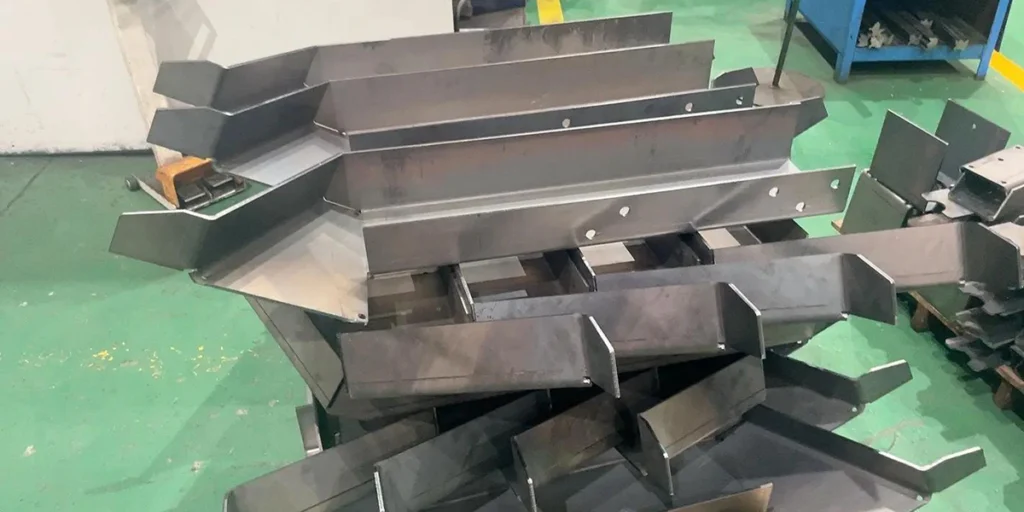
In sheet metal processing projects, many people focus on “whether the equipment is good enough” and “whether the processing precision is high enough”, but what truly determines whether a project goes smoothly is often whether the key decisions made in the early stages are correct.
In fact, many problems do not arise during the processing, but rather are the seeds of future problems sown from the very beginning.
This article will systematically review the most easily overlooked but crucial considerations in sheet metal processing, covering aspects such as pre-processing preparation, process selection, design coordination, and common errors.
Preparations before sheet metal processing
Before any processing begins, the first step is not to talk about equipment and processes, but to clarify the basic understanding.
Clearly define the purpose and positioning of the parts.
Before performing sheet metal processing, it is essential to understand the core purpose of the part.
- Structural components prioritize strength and stability.
- For exterior components, greater emphasis is placed on surface finish and consistency.
- For functional components, the emphasis is on assembly precision and reliability.
Different applications require completely different processing priorities. If the intended use is unclear, it’s easy to go astray in subsequent decision-making.
Confirm the usage environment of the parts
The environment in which the parts will be used directly affects the initial judgment.
Before processing, the following situations should be understood:
- Does it need to withstand loads or long-term vibration?
- Is it exposed to a humid or corrosive environment?
- Is there a high temperature or temperature difference?
These factors do not require technical calculations at this stage, but they must be considered in advance; otherwise, the room for subsequent adjustments will be very limited.
Define production quantity and phased goals
The processing quantity is one of the key pieces of information that must be clarified in the early stages.
- Is it a single sample or a small-batch trial production?
- Are there plans to ramp up production later?
- Is there a phased demand (validation before mass production)?
The quantity significantly impacts the overall processing strategy. Understanding this during the preparation phase will help to more rationally advance the processing plan later.
Are there explicit quality or industry requirements?
Before formal processing, it is also necessary to confirm whether there are any standards or requirements that must be followed.
For example:
- Are there specific dimensional, tolerance, or appearance requirements?
- Is it necessary to comply with certain industry standards?
- Are there acceptance criteria from clients or project owners?
If these requirements are not clearly defined in the early stages, problems often emerge during the delivery phase, increasing communication costs.
Points to note when selecting materials for sheet metal processing
In sheet metal processing, material selection is the first truly “hard decision.” Once the wrong material is selected, subsequent adjustments to the process and optimization of the design can often only stop the damage, but cannot fundamentally solve the problem.
Before processing begins, the following material-level judgments must be clearly considered.
Basic differences between common sheet metal materials
Different sheet metal materials exhibit significant differences in processing performance.
- Ordinary steel: Low cost and wide application, but highly dependent on corrosion protection and surface treatment.
- Stainless steel: Good corrosion resistance, but more difficult and costly to process.
- Aluminum and aluminum alloys: lightweight and formable, but with limited rigidity and wear resistance.
The problem often lies not in the “quality of the material,” but in whether it is suitable for the actual needs of the current part. Using overly high-performance materials may bring unnecessary processing and cost pressures; using overly low-performance materials will easily expose problems during the use phase.
Matching relationship between materials and processing technology
Not all materials are suitable for all sheet metal processing methods.
Some materials are stable when cut or bent, but are prone to problems during forming or joining; other materials, although of excellent performance, have high requirements for processing conditions, and slight improper processing can affect the quality of the finished product.
During the material selection phase, at least one point must be clear: whether the selected materials are “suitable for processing,” not just “suitable for use.”
The impact of material thickness on processing feasibility
Material thickness is often underestimated, but it has a very direct impact on the processing results.
- If the thickness is too thin, it is prone to deformation, warping, or affecting the structural strength.
- Excessive thickness significantly increases processing difficulty and cost.
If the thickness is not properly assessed in the early stages, it is easy to encounter a situation during the processing where “it can be made, but the effect is not good”.
Choosing between cost and performance
Material selection is essentially a balance between performance and cost.
- For components with high performance requirements, material costs are usually not compressible.
- For cost-sensitive projects, rational choices need to be made regarding material properties.
Many processing problems are not due to a lack of technical capabilities, but rather to unrealistic cost expectations in the early stages. Clearly defining the budget and performance boundaries during the materials phase makes subsequent decision-making much smoother.
Points to note when selecting sheet metal processing techniques
In sheet metal fabrication, process selection is the dividing line between cost and quality. The same part may look exactly the same, but if the wrong process is chosen, the result may be uncontrollable costs, unstable quality, or even the inability to produce smoothly.
Before processing, the following process-related judgments must be clearly considered in advance.
Points to note when selecting cutting processes
Cutting is often the first step in sheet metal processing, but a more “precise” cutting method is not necessarily the most suitable.
Some cutting methods are suitable for complex contours but not for high-efficiency production; some methods are low-cost but have limitations on edge quality and precision.
When choosing a cutting process, the key is not “whether it can be cut”, but rather: whether it is necessary to pay extra processing costs for the current part.
Feasibility assessment of forming processes
The forming process has a very direct impact on the structure of the part.
A forming method that seems feasible may present problems in actual processing:
- Deformation is difficult to control
- Poor dimensional consistency
- Insufficient stability of finished products
During the process selection stage, the focus should be on determining whether the part structure is suitable for the forming method, rather than forcing it to adapt to the process.
If the structure itself is not user-friendly, even the most mature forming process can only be used to make up for it.
Selection of mold process and non-mold process
Whether or not to use molds is a key dividing point in process selection.
- Mold making: High efficiency and good consistency, but requires large initial investment and has low flexibility.
- Non-mold manufacturing process: flexible and quick to adjust, but the cost per unit is usually higher.
The issue is not which process is “more advanced,” but whether it is worthwhile to invest the cost and time in the mold at the current stage.
Using molds too early in the sample or small-batch stage often limits the room for subsequent adjustments.
The impact of batch size on process selection
Production volume directly determines whether the process is reasonable.
- In the small-batch or trial production stage, flexibility and adjustability are of greater importance.
- Once production volume stabilizes, efficiency and unit cost become the focus.
If we plan according to large-scale processes before the quantity is clear, it is easy to waste resources; conversely, if we continue to use inefficient processes in projects with clear volume targets, it will also slow down the overall progress.
Design and manufacturing coordination issues
In sheet metal processing, many problems are not caused by the process or equipment, but by a lack of coordination between design and manufacturing. Some parts may look perfectly reasonable on the drawings, but in the actual manufacturing stage, rework, adjustments, or even production failures frequently occur.
Common conflicts between bending, hole positions and edge distances
In actual processing, the relationship between bending, hole position, and edge distance is one of the most easily overlooked issues.
Common situations include:
- The bend position is too close to the hole position.
- The hole or opening is located within the area affected by the bend.
- Insufficient margins lead to decreased processing stability.
These problems are often not obvious at the drawing stage, but once they enter the manufacturing process, they will directly affect the forming quality and dimensional consistency.
Problems caused by unreasonable tolerance settings
Tolerance is not necessarily “the smaller the better”.
In sheet metal fabrication, if tolerances are set too strictly, the following may occur:
- Increased process difficulty
- Increase unnecessary processing costs
- Reduced overall production efficiency
Conversely, if tolerance settings lack clear justification, problems can easily arise during assembly or use. Insufficient consideration of machining capabilities during the design phase is a major cause of frequent tolerance issues.
The design did not consider the impact of the processing sequence.
Many designs focus only on the final shape, ignoring how the parts are manufactured step by step.
In actual production, the processing sequence will affect:
- Will subsequent processes be interfered with?
- Are the processed parts easily damaged?
- Is the overall processing smooth?
If the design does not reserve reasonable processing space, it will often be adjusted continuously during the execution phase, increasing communication and rework costs.
Insufficient communication between design and manufacturing
The separation of design and manufacturing is a very common practice in sheet metal processing.
When designers are unaware of manufacturing limitations, and the manufacturing party is unable to participate in the initial discussions, the following problems are likely to occur:
- The drawings were revised repeatedly
- Processing plans are constantly being adjusted
- Project cycle was extended
These problems are not technical difficulties, but rather that information was not adequately communicated at the right stage.
Common sheet metal processing errors
In sheet metal fabrication projects, many problems are not technical difficulties, but rather recurring, typical errors. These errors may seem minor, but they often erupt later in the process, impacting costs, quality, and delivery time.
Choosing the wrong material can lead to part deformation or insufficient performance.
Improper material selection is one of the most common and most difficult problems to remedy.
Some parts deform, lack strength, or have reduced durability after processing. The root cause is often that the material is not suitable for the actual use scenario.
Once the processing stage begins, changing materials will significantly increase both costs and time.
Improper process selection leads to uncontrolled processing costs.
The cost of the same part can vary greatly depending on the processing method used.
Common situations include:
- High-investment processes were selected for small-batch projects.
- Overly complex processing methods were used for a simple structure.
These choices may seem “safer” in the early stages, but in reality they drive up the overall cost.
Poor design led to repeated rework.
The failure to fully consider manufacturing realities during the design phase is the main reason for frequent rework.
For example:
- Local structures are difficult to form
- Dimensions and tolerances are difficult to control consistently.
- The process requires continuous adjustments to the plan.
Every rework results in a waste of time and resources.
Insufficient communication in the early stages led to delivery delays.
Sheet metal processing often involves multiple steps.
If there is insufficient communication at the beginning of the project:
- Inconsistent understanding of component requirements
- Process and delivery expectations are unclear.
- The problems were concentrated in the later stages.
The end result is usually that the delivery time is constantly extended.
Problems often arise at the very beginning.
Looking back at the entire sheet metal processing flow, we can see that what truly determines success or failure is not a single process, but whether the initial judgment is correct.
If you think things through before processing, many problems will simply not arise.