
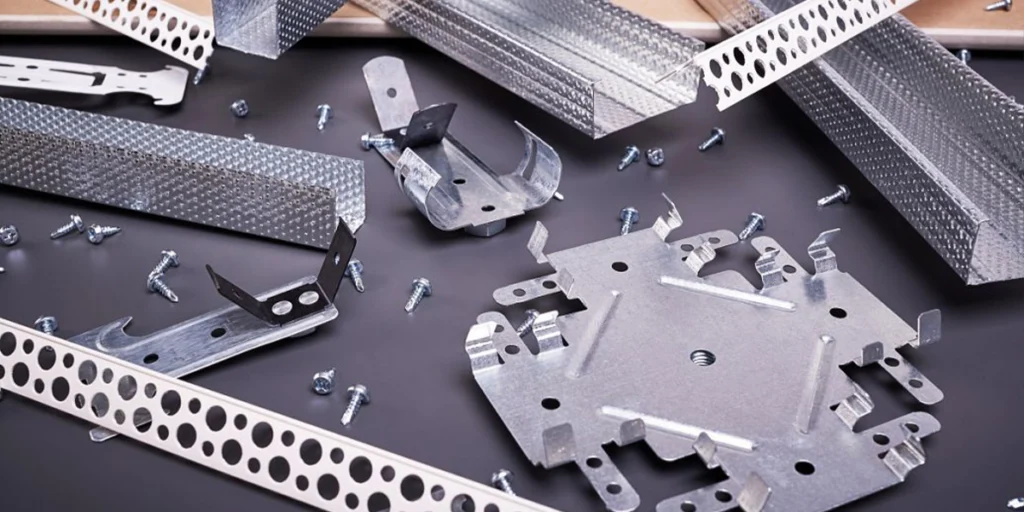
What is sheet metal stamping?
In sheet metal processing, embossing is a mold-based local forming method, mainly used to form specific concave and convex features on the surface of metal sheets, such as text, patterns, logos, or functional structures.
Unlike cutting and punching, sheet metal stamping typically does not cut the material. Instead, it uses external force to cause controlled plastic deformation in a localized area of the sheet metal, thus “pressing out” the desired shape. This deformation is purposeful and bounded, rather than random extrusion.
From a production perspective, whether sheet metal stamping is considered an independent process depends on the product design requirements.
However, in actual manufacturing, it often exists as a functional step in the stamping or forming process to accomplish specific purposes such as marking, strengthening or positioning, rather than simply changing the overall shape of the part.
It is important to distinguish that:
- Sheet metal stamping ≠ surface treatment
Imprinting occurs during the material forming stage and is essentially a physical deformation of the metal structure, rather than a post-processing step such as spraying, electroplating, or oxidation. - Sheet metal stamping ≠ purely decorative process
Although embossing can present text or patterns, in many industrial scenarios, it serves more as a structural reinforcement, identification marker, or functional aid.
Simply put, sheet metal stamping is not for “looks,” but for “usefulness.”
It is a processing method that performs precise local shaping of sheet metal without disrupting the continuity of the material, which is the core reason why it is frequently used in industrial sheet metal manufacturing.
The basic principle of sheet metal stamping
The reason why sheet metal embossing can form clear and stable concave and convex features on the metal surface is that the pressure of the mold causes the material to undergo controllable local plastic deformation.
In actual processing, stamping is usually accomplished by a set of cooperating upper and lower dies. The sheet metal is placed between the dies, and when the stamping equipment applies pressure, the upper die moves downward, forcing the material to be “pressed” into the die cavity within a defined area, thereby replicating the shape of the die surface.
Unlike cutting or punching, material is not sheared or removed during embossing. As long as the applied pressure is controlled within the material’s plastic deformation range, the metal will change shape but retain its overall continuity. This is why embossing is often used for marking, ribs, or forming local structures, rather than for separating material.
For this reason, sheet metal embossing places certain requirements on the ductility of the material. If the material is too hard or lacks sufficient ductility, it is prone to cracking, tearing, or springback under pressure, affecting the embossing effect and the quality of the finished product. Therefore, when designing the embossing process, it is usually necessary to consider the material type, sheet thickness, and deformability in advance.
Throughout the process, mold precision and pressure control are particularly critical:
- The precision of the mold determines the clarity and consistency of the embossed pattern;
- Pressure control directly affects the forming depth and whether it will damage the material.
Simply put, sheet metal embossing is not as simple as “pressing a pattern on,” but a forming process that achieves a balance between molds, materials, and pressure. It is this controllable local deformation mechanism that makes embossing both stable and efficient in sheet metal manufacturing.
Functions and uses of sheet metal stamping
In actual production, sheet metal embossing is rarely done “for aesthetic purposes”; it more often serves a clear and specific functional purpose. From the perspective of factories and designers, the role of embossing is mainly reflected in the following aspects.
Enhance structural rigidity and prevent localized deformation
The protrusions, grooves, or ribs formed by embossing can significantly improve the rigidity of sheet metal parts in specific areas.
This structural reinforcement method can reduce the risk of bending, sinking or vibration of sheet metal during use or assembly without increasing the material thickness, and is a common lightweighting method in sheet metal design.
To meet functional design requirements
Sheet metal stamping is often used to solve functional problems in practical applications, such as:
- Increase friction through textures or raised dots to achieve an anti-slip effect;
- Utilizing embossed structures of specific shapes to assist in positioning or limiting;
- Press out the necessary identification marks directly without any additional processing.
These functions typically need to be implemented at the structural level, rather than relying on subsequent assembly or additional parts.
Provide clear and durable labeling methods
Unlike labeling or printing, embossed logos, characters, or patterns are part of the material itself and are not easily worn, peeled off, or faded.
Therefore, embossing is a stable and reliable marking method for products that require durability and legibility.
Emphasis on early decision-making in the design phase
It is important to note that sheet metal stamping is often a process determined during the product design phase.
Once the structure and mold are finalized, adding or modifying the embossing details later often incurs additional costs and complexity. This is why embossing is usually considered “part of the structural design” rather than a post-processing addition.
Overall, the core value of sheet metal stamping lies not in decoration, but in enabling sheet metal parts to benefit simultaneously in terms of structure, function, and identification through localized forming. This is also an important reason why it is frequently used in industrial sheet metal manufacturing.
Application scenarios of sheet metal embossing
In actual manufacturing, sheet metal stamping is typically used on products with specific structural, functional, or identification requirements. It is not a mandatory process for all sheet metal parts, but rather plays a role in specific scenarios.
Industrial equipment housing
In the housings of various industrial equipment, sheet metal embossing is commonly used to create reinforcing ribs, positioning features, or permanent markings. These embossed structures can improve the stability of the housing without increasing the thickness of the sheet metal, while also facilitating subsequent assembly and maintenance.
Control Panel and User Interface
Control panels are one of the most common applications of sheet metal embossing. Embossing creates text, symbols, or functional areas that provide clear, durable identification, preventing blurring or detachment of markings over time.
Architectural hardware products
In door and window frames, ventilation components, or other building hardware, embossing is often used for structural reinforcement, specification marking, or functional zoning. These applications emphasize durability and stability; embossed structures can maintain their shape for a long time without relying on additional attached materials.
Home appliance casings and enclosures
In home appliance casings, enclosures, or cabinets, embossing is often used for brand logos, functional indications, or localized structural reinforcement. Compared to labeling or printing, embossing offers advantages in terms of appearance consistency and lifespan.
Custom sheet metal parts
In custom sheet metal fabrication, embossing is often closely integrated with product design to meet specific functional or identification requirements. For large-volume custom projects, embossing can improve production efficiency while ensuring consistency; however, in small-volume scenarios, a comprehensive evaluation based on mold investment and product requirements is necessary.
Generally speaking, sheet metal stamping is typically used in products that require structural reliability, clear functionality, and long-term stability. Whether or not to use this process often depends on the product’s intended use and the overall planning during the design phase.
The difference between sheet metal stamping and embossing processes
In actual communication, many people understand sheet metal stamping and embossing as the same process, but they are not exactly the same in terms of processing purpose and application scenarios.
Understanding the difference between these two will help you avoid detours when selecting a process.
Below is a direct comparison from several key dimensions.
1. Different process purposes
Sheet metal stamping: The main purpose is to form clear, stable and meaningful structures or markings on sheet metal parts, such as text, symbols, positioning marks, reinforcing ribs, etc.
Sheet metal embossing: The focus is on improving the visual effect and tactile feel of the surface, making the product look more textured and more designed.
2. Differences in pattern depth and three-dimensionality
Embossing: The pattern is usually clearer, the boundaries are more defined, and the raised texture is relatively obvious, making it easier to identify and for long-term use.
Embossing: The deformation depth is shallower, and the overall effect is more focused on texture, without emphasizing a strong three-dimensional structure.
3. Does it emphasize functionality?
Imprinting: often has a clear functional attribute, such as:
- Identify the direction, model, or installation location.
- Provides positioning or anti-slip effect
- Replaces labeling, printing, and other post-processing methods
Embossing: It has weaker functionality and is more about enhancing the appearance and brand visual appeal.
4. Comparison of Common Application Products
Imprinting is commonly used in :
- Industrial equipment enclosures
- control Panel
- Chassis and rack
- Custom sheet metal parts
- Products requiring durable labeling
Embossing is commonly found in :
- Appliance panels
- Consumer electronics casing
- Architectural decorative sheet metal
- Product surfaces with high appearance requirements
5. Differences in cost and mold complexity
Embossing
- Higher requirements are placed on mold precision and pressure control.
- Molds are usually more structural molds, which have relatively controllable costs but place greater emphasis on stability.
Embossing
- Molds place greater emphasis on surface texture and detail.
- For complex patterns or custom designs, mold design costs may be higher.
Limitations and precautions of sheet metal embossing process
Sheet metal stamping is a mature and stable processing method, but it is not a “one-size-fits-all” process. Understanding its limitations and points to note during the design and selection phases is often more important than rework afterward.
1. Certain requirements are placed on the materials themselves.
Sheet metal stamping relies on controlled plastic deformation of the material under pressure, therefore it is not suitable for all materials:
- Materials with insufficient ductility are prone to cracking and tearing in the embossing area, resulting in unstable pattern formation.
- Materials with excessively high hardness require more sophisticated equipment and molds, have a narrower forming window, and increase process risks.
- Materials that are too soft: may spring back, resulting in an unclear embossed outline.
This is why it is necessary to assess whether the material properties are suitable for embossing during the design phase.
2. Molds have certain upfront costs.
Embossing is a mold-dependent process.
- Each pattern or structure basically requires a corresponding mold.
- The more intricate the pattern, the higher the precision required for mold processing.
- In small-batch, one-off projects, the cost of molds will account for a larger proportion of the overall cost.
Therefore, in scenarios with low production volumes and frequent design changes, it is necessary to carefully evaluate whether to use embossing.
3. Not all designs are suitable for embossing.
The following design situations are generally not suitable for direct sheet metal stamping:
- The pattern is too dark or the edges are too sharp.
- Located on complex curved surfaces or in spatially confined areas
- Too close to the bend line or welding position
- Functional areas that are extremely sensitive to dimensional tolerances
If forced to use it, it will often lead to poor molding or assembly problems.
4. May affect subsequent processing techniques.
Although embossing is a surface-forming process, it can still affect subsequent processes, for example:
- Localized changes in rigidity during bending may affect the consistency of the forming process.
- Before surface spraying or electroplating, attention should be paid to the coverage effect of the imprinted area.
- When overlapping with welding or assembly areas, it is necessary to avoid or adjust the design in advance.
Therefore, embossing is more suitable for planning in advance in the overall process chain, rather than being added on the spot.
At last
In summary, sheet metal embossing is not a surface treatment that can be omitted, but rather a forming method that needs to be carefully considered during the product design phase. It functions simultaneously at the structural, functional, and identification levels through localized plastic deformation without cutting the material, making it one of the key details for achieving stability and consistency in many industrial sheet metal products.
Whether or not to use embossing does not depend on whether it “can be done,” but on whether it truly solves the product’s problems. Whether the material properties are suitable, whether the structural position is reasonable, whether the batch size is appropriate, and whether subsequent processes allow it are often more important than the pattern itself.
When embossing is placed in the right position and guided by the right design, it can often bring long-term, stable and irreplaceable value to a product without increasing complexity.
This is why sheet metal stamping has long existed in industrial manufacturing and is difficult to completely replace.