
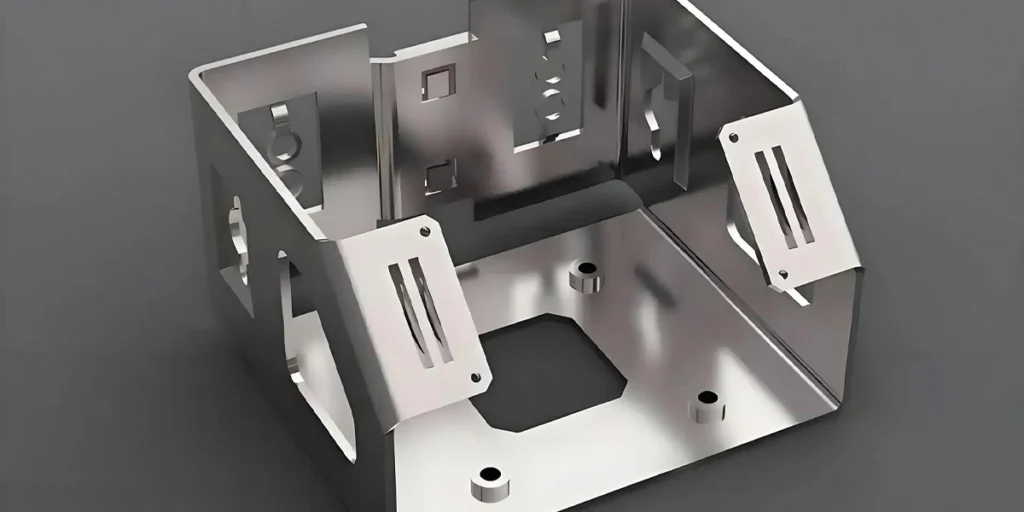
What is sheet metal processing technology?
Sheet metal processing technology refers to the manufacturing process that uses thin metal sheets as raw materials and processes them into metal parts or products with specific shapes, sizes and functions through a series of cold working methods.
Generally speaking, sheet metal processing is mainly for thin metal sheets (usually less than 6mm). The overall properties of the material are not altered during processing; instead, the structure is shaped through cutting, forming, and joining. This processing method is widely used in industrial manufacturing and is a crucial part of modern manufacturing.
In terms of results, the goal of sheet metal processing is not simply “cutting” or “bending”, but to transform a flat metal sheet into functional parts that can be used or assembled directly, such as housings, brackets, frames or structural components.
The difference between sheet metal processing and other metal processing methods
To better understand sheet metal processing, it is necessary to simply distinguish it from other common metal processing methods:
- Sheet metal fabrication: Based on sheet metal, it involves cold forming, emphasizing structural manufacturing and shape control.
- Machining: Primarily involves machining bulk metal, where dimensional accuracy is achieved by removing material through cutting.
- Casting or forging: altering the internal structure of metals through high temperatures or impact.
In contrast, sheet metal processing is more suitable for thin-walled structures, mass production, and structural parts, and has significant advantages in cost control, processing efficiency, and design flexibility.
Core characteristics of sheet metal processing technology
Overall, sheet metal processing technology has the following significant characteristics:
- The main processing object is thin metal sheets.
- The processing mainly involves cold working.
- Flexible process combinations, adjustable to meet specific needs.
- Suitable for both small-batch customization and mass production.
Because of these characteristics, sheet metal processing is widely used in many industries and has become an indispensable basic process in the manufacturing of many products.
Basic manufacturing process of sheet metal processing
Sheet metal fabrication is not a single process, but rather a series of interconnected steps. From a sheet of metal to a usable part, it typically involves the following basic steps. While the specific order and combination of processes may vary between products, the overall process logic remains largely the same.
1. Design and Drawing Preparation
Sheet metal fabrication typically begins in the design phase. Based on the product’s usage requirements, the structural design and drawings of the parts are completed first, clarifying their dimensions, shapes, and assembly relationships.
At this stage, the manufacturability of the design is crucial, as it directly affects the smoothness of subsequent processing and the final cost control.
2. Material Selection
Before proceeding with actual processing, it is necessary to select appropriate metal sheets based on the product’s strength requirements, usage environment, and cost budget.
Common sheet metal materials include steel plates, stainless steel plates, and aluminum plates. Different materials have their own characteristics in terms of processing methods, forming effects, and application scenarios.
3. Material preparation and cutting
Blanking is the initial processing step in sheet metal fabrication. Its main purpose is to cut the entire sheet of material into the required basic shape and size.
This stage determines the external shape of the part, laying the foundation for subsequent forming and assembly. The specific method used usually depends on the complexity of the part and the production volume.
4. Forming and Deformation Processing
After the material is cut, the flat sheet needs to be transformed into a three-dimensional structure through forming processing.
This process is the core stage of sheet metal processing, which involves bending, stretching, or locally deforming the material in different ways to form the desired structural shape.
5. Hole Machining and Connection Preparation
After forming, the parts usually need to be machined for holes or pre-treated for connection parts to meet assembly and functional requirements.
These steps prepare the ground for subsequent parts connection, fixing, or assembly.
6. Connection and Assembly
When a product is composed of multiple sheet metal parts, the parts need to be connected and assembled to form a complete structure.
This stage focuses on structural stability and overall compatibility, and is a crucial step in moving from “parts” to “finished products”.
7. Surface treatment
Depending on the product’s usage environment and appearance requirements, sheet metal parts are usually surface treated to improve corrosion resistance, durability, or appearance.
Surface treatment does not change the basic structure of the parts, but it has a significant impact on the product’s lifespan and visual appearance.
8. Quality Inspection and Delivery
After all processing is completed, the finished product needs to undergo basic quality checks to ensure that the dimensions, appearance and structure meet the design requirements.
Qualified products are then packaged and delivered, completing the entire sheet metal processing process.
This entire process constitutes the basic manufacturing logic of sheet metal processing. In actual production, different products may adjust or simplify the process according to requirements, but the main line of “design → processing → forming → joining → surface treatment” remains unchanged.
What are some commonly used techniques in sheet metal processing?
In sheet metal processing, multiple processing techniques are usually combined according to the structural requirements of the parts.
From a functional perspective, the commonly used techniques in sheet metal processing can be roughly divided into the following categories.
1. Cutting and blanking technologies
Cutting techniques are mainly used to process a whole sheet of metal into the required basic shape, and are the starting point of sheet metal processing.
Cut
It is suitable for blanking straight lines or simple shapes, with high processing efficiency and low cost, and is often used for parts with relatively simple structures.
Punching/Breaking
Using molds to punch through sheet metal can achieve high dimensional consistency, making it suitable for mass production.
Laser cutting
Non-contact cutting using a laser beam is suitable for parts with complex contours or high precision requirements, offering great flexibility.
2. Forming and Deformation Technologies
Forming technology is used to process flat sheet metal into parts with three-dimensional structures, and it is one of the core technologies of sheet metal processing.
Bending
Using equipment and molds to change the angle of sheet metal is one of the most common sheet metal forming methods.
Curling and bending
It is mainly used to form arc or curved surface structures, and is commonly found in tubular or cylindrical parts.
Stretching and forming processes
Used to manufacture parts with concave and convex structures, enabling sheet metal to produce more complex spatial shapes.
3. Connection and Assembly Technologies
When a product consists of multiple sheet metal parts, it needs to be assembled into a whole structure through connection technology.
Welding
Suitable for connecting parts that require high structural strength or sealing performance.
Riveting
It uses rivets or fasteners for connection, has a stable structure, and is suitable for a variety of material combinations.
Threaded connection
The connection can be made detachable by screws or nuts, which facilitates later maintenance and replacement.
4. Surface treatment related technologies
Surface treatment technology is mainly used to improve the durability and appearance of sheet metal parts, and is usually carried out after the structural processing is completed.
Spray coating
A protective coating is formed on the surface, enhancing corrosion resistance and aesthetics.
Oxidation and chemical treatment
It is commonly used in aluminum and its alloys to improve corrosion resistance and surface hardness.
5. Auxiliary processing technologies
In addition to the main processing technology, sheet metal processing also incorporates some auxiliary technologies to ensure part quality and assembly effect.
Leveling and shaping
Improving the flatness of parts
Drilling and tapping
To meet assembly and fixing requirements
Sheet metal processing is not completed by relying on a single technology, but by combining different processing technologies in a reasonable way according to product requirements to form a complete manufacturing solution.
Which industries are suitable for sheet metal processing?
Sheet metal fabrication is widely used across various industries due to its significant advantages in structural forming, processing efficiency, and design flexibility. While product forms differ across sectors, the requirements for structural stability, dimensional consistency, and mass production capabilities are highly similar, which is precisely where sheet metal fabrication’s strength lies.
Automotive and transportation manufacturing industry
In the manufacturing of automobiles and related transportation equipment, a large number of structural components and body panels need to have good strength and forming precision.
Sheet metal processing enables the manufacture of complex structures while maintaining efficiency and consistency, and is therefore widely used in the production of vehicle-related parts.
Electronic equipment and home appliance industry
Electronic devices and home appliances typically require metal casings or internal support structures to provide protection, heat dissipation, and structural stability.
Sheet metal processing can not only meet structural requirements, but also improve the overall appearance and durability of products through subsequent processing.
Aerospace industry
The aerospace industry has extremely high requirements for the lightweight, precision and reliability of parts.
Sheet metal processing has advantages in the manufacturing of thin-walled structures, and can meet complex structures and strict quality requirements, making it one of the important manufacturing methods in this field.
Medical equipment industry
Medical devices have high requirements for structural stability, surface quality, and cleanability.
Sheet metal processing is often used in the manufacture of housings and structural components for medical equipment, which can ensure structural strength and facilitate daily maintenance and cleaning.
Construction and Engineering Industry
In the fields of architecture and engineering, metal components not only need to meet structural requirements, but also need to take into account installation accuracy and aesthetic appearance.
Sheet metal processing can be flexibly customized according to design requirements, and is suitable for a variety of building and engineering applications.
New energy and energy storage industry
With the development of the new energy industry, related equipment has higher requirements for protection, heat dissipation and structural reliability.
Sheet metal processing can adapt to different sizes and structural designs, and is a common processing method in the manufacturing of new energy equipment.
Industrial equipment and automation industry
In industrial equipment and automation systems, many components require good structural support and assembly precision.
Sheet metal processing ensures structural stability while also facilitating later maintenance and modular design.
Communication and Information Equipment Industry
Communication equipment typically requires a stable structure, protective capabilities, and good heat dissipation.
Sheet metal processing can meet these comprehensive requirements, and is therefore widely used in the manufacturing of communication and information equipment.
Sheet metal fabrication is almost always a mature and reliable manufacturing option for products that involve metal structural components, shells, or functional support parts.
From a sheet of metal to a truly usable product
Regardless of the industry in which it is applied, the essence of sheet metal processing remains unchanged. —— It is a manufacturing method that transforms flat metal sheets into products with practical functions and structural value through reasonable design and process combinations.
From initial design to cutting, forming, and joining, and then to surface treatment and finished product delivery, sheet metal processing is not a single step, but a complete systematic process centered around “structural manufacturing.” It is precisely this highly flexible, combinable, and easily scalable nature that makes it occupy an irreplaceable position in modern manufacturing.