
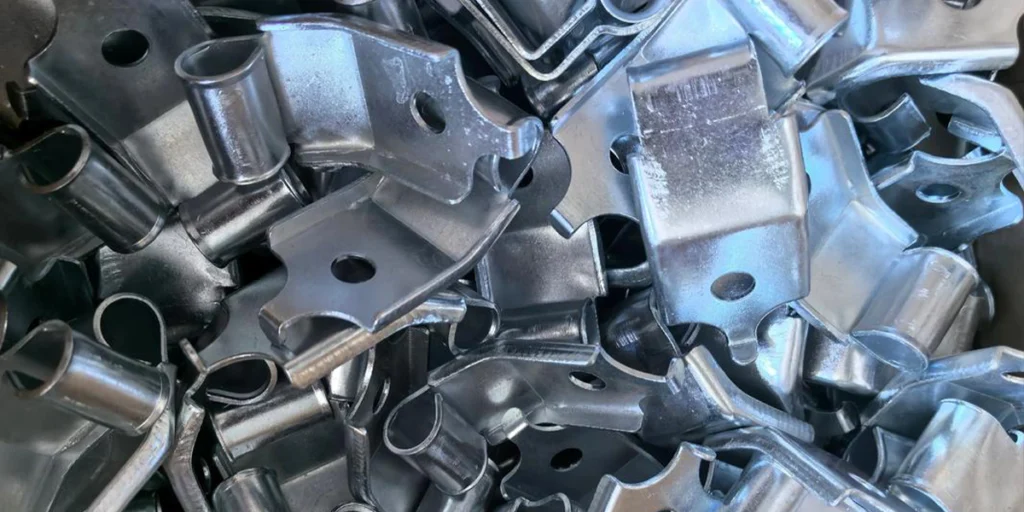
What is the sheet metal punching process?
Sheet metal punching is a basic processing method in sheet metal processing. It refers to the process of punching out the required holes in a metal sheet in one go using a punch press and a die.
Simply put, its core purpose is to efficiently and reliably “make holes” on sheet metal parts.
In actual production, many people confuse punching, drilling, and piercing, but they are not exactly the same.
- Punching: The process of forming a hole using a punch press and a die, utilizing instantaneous pressure.
- Drilling: Creating holes by cutting material with a rotating cutting tool.
- Drilling: A more colloquial term, usually referring to various methods of making holes.
In the sheet metal processing industry, “punching” usually refers to the standard die-cutting process.
To which category of sheet metal processing does punching belong?
From a process classification perspective, sheet metal punching is a cutting/stamping process.
It does not remove material through continuous cutting, but rather uses the cooperation between the punch and the die to cause the sheet metal to shear and fracture under pressure, thereby forming a hole.
This processing method has distinct characteristics:
- Fast forming speed
- Good hole pattern consistency
- Ideal for mass production
The relationship between punching and sheet metal stamping
In actual production, punching is usually a specific step in sheet metal stamping. In other words, stamping is a process system, and punching is one of the most common and basic operations within it.
Besides punching, stamping may also include blanking, forming, flanging and other processes, but punching is often the first and most common step.
The position of punching in the sheet metal manufacturing process
In a complete sheet metal manufacturing process, punching typically occurs before forming or bending. Completing the hole machining before subsequent bending, joining, or assembly effectively ensures the positional accuracy of the holes and overall processing efficiency.
For this reason, sheet metal punching is often regarded as a fundamental step in sheet metal processing, and its processing quality directly affects the smooth progress of subsequent processes.
Sheet metal punching processing method
In actual production, there is no single fixed method for punching sheet metal. Depending on the part structure, production volume, and cost requirements, factories usually choose different punching methods.
From an application perspective, the most common methods of sheet metal punching are as follows.
Punching with a punch press (traditional punching method)
Punching is the most classic and common method of sheet metal punching. Using a punch press and a die, the hole is formed in a single punching motion.
The characteristics of this method are:
- High processing efficiency
- Good consistency in hole position and size
- Low processing cost per piece (in batch processing)
More suitable situations:
- The product structure is relatively fixed
- Large production batches
- Parts requiring high machining stability
CNC punching (CNC punching machine punching)
CNC punching is an upgrade from traditional punching, which completes the processing by controlling the punching position and sequence through a program.
The characteristics of this method are:
- Greater flexibility
- Different hole positions can be quickly adjusted via the program.
- Suitable for multi-variety, small to medium batch production.
More suitable situations:
- Product specifications vary considerably
- Do not want to frequently change complex molds
- Sheet metal parts that require a balance between efficiency and flexibility
Dense-hole punching (for structures with dense holes)
When a large number of regularly arranged holes need to be machined on sheet metal parts, a dense hole punching method is usually used.
The characteristics of this method are:
- Can complete the machining of multiple holes at once
- Processing efficiency has been significantly improved
- Better hole spacing consistency
More suitable situations:
- Sheet metal parts for ventilation and heat dissipation
- Regular, repeating hole pattern
Other auxiliary processing methods
In certain special cases, laser cutting or other methods may be used to complete the “hole making” requirement, but these methods are not typical sheet metal punching processes and are more often used for prototyping, small batches, or special structural parts.
Common hole types for sheet metal punching
In sheet metal punching, the choice of hole shape is not arbitrary. Different hole shapes not only affect the appearance, but also directly relate to functionality, strength, and processing difficulty.
In practical applications, the most common hole types in sheet metal punching are mainly concentrated in the following categories.
Round hole
Round holes are the most common and easiest type of hole to process in sheet metal punching.
Typical applications:
- Ventilation and heat dissipation
- Bolt and rivet mounting holes
- Decorative openings
Round holes have uniform stress distribution, good processing stability, and minimal impact on materials, making them the preferred hole type for most sheet metal parts.
Square hole
Square holes have distinct right-angled edges and a regular appearance.
Typical applications:
- Frame structure
- Panel opening
- Functional connectors
Compared to round holes, square holes require slightly higher precision in mold making and machining, but they are very common when a regular structure is needed or when matching square parts.
Oblong hole (slender hole)
The oblong hole is between a round hole and a square hole, balancing the opening size and structural strength.
Typical applications:
- Mounting adjustment hole
- Sliding structure
- Locations requiring a certain installation margin
This type of hole is very practical in structural design, as it facilitates assembly and does not easily weaken the strength of the sheet metal.
Irregular holes
Irregular holes typically refer to holes with non-standard geometric shapes, which can be customized according to product requirements.
Typical applications:
- Special functional structure
- Sheet metal parts with high requirements for appearance design
- Location or identification purposes
It should be noted that irregularly shaped holes are usually more difficult to process, and the requirements for mold design and processing stability are also more stringent.
A brief explanation of hole type and machining difficulty
Generally speaking:
- The more regular the hole shape, the easier it is to process.
- The more complex the shape, the higher the requirements for the process and mold.
Therefore, under the premise of meeting functional requirements, prioritizing simple and regular hole shapes helps to improve processing stability and control costs.
Application areas of sheet metal punching
The reason why sheet metal punching technology is widely used is that it can meet the structural and functional requirements while also taking into account efficiency and consistency.
In actual products, punching is often not “for the sake of processing”, but directly serves a specific purpose.
The following are the most common and typical application scenarios for sheet metal punching.
Chassis, cabinet and equipment enclosure
In chassis and cabinet products, sheet metal punching is almost an essential process.
Common uses include:
- Equipment heat dissipation holes
- Cable perforation
- Mounting holes
These types of products typically require high consistency in hole positions and uniformity in appearance. The punching process can maintain good structural stability while ensuring efficiency.
Ventilation and heat dissipation structure
Ventilation and heat dissipation are among the most intuitive and common applications of sheet metal punching.
Typical scenarios include:
- Ventilation hood
- Heat dissipation panel
- Air duct structural components
By using appropriate hole shapes and arrangements, punching can not only allow airflow but also control noise and structural strength to a certain extent, which is a standard practice in many industrial equipment.
Installation and connection structure
In various sheet metal parts, punching is often used for subsequent assembly and fixing.
Common features include:
- Bolt and screw mounting holes
- Riveting holes
- Positioning holes
This type of punching is usually used in conjunction with bending and joining processes, and is a key step in ensuring assembly efficiency and consistency.
Applications that combine functionality and aesthetics
In some products, punching not only serves a functional purpose but also affects the overall appearance.
Common purposes include:
Reduce the weight of parts
Enhance visual hierarchy
Achieve a regular decorative effect
Without compromising strength, the proper use of perforation structures can achieve a balance between functionality and aesthetics in sheet metal parts.
Disadvantages of sheet metal punching process
In actual product selection, whether to adopt sheet metal punching technology often depends on a core issue: whether it is “more suitable” under the current product conditions.
Below, we’ll discuss the advantages and limitations to help you quickly determine whether it’s worth using.
Main advantages of sheet metal punching process
1. High processing efficiency, suitable for mass production.
The punching process can complete the hole formation in one operation, and it has a stable cycle time and outstanding efficiency in mass production, making it particularly suitable for parts with high repetition.
2. Good hole alignment and stable assembly.
Processing with molds or CNC punches ensures high consistency in hole position and size, which is beneficial for subsequent assembly, riveting, or bolting.
3. Significant cost advantage under batch production conditions
In medium to large-volume production, the low cost of processing a single piece makes it a common choice for controlling overall manufacturing costs.
Limitations of sheet metal punching process
1. There are certain limitations on materials and thickness.
If the material is too thin, it is easy to deform; if it is too thick, it will require more sophisticated equipment and molds, and is not suitable for all sheet material conditions.
2. High dependence on molds
When non-standard hole shapes or frequent design changes are made, the cost of mold investment and adjustment will increase significantly.
3. Relatively limited design flexibility
Once the hole shape and layout are determined, later modifications are not as convenient as some flexible processing methods, making them more suitable for products with already finalized designs.
At last
In summary, sheet metal punching is a mature, stable, and highly practical sheet metal processing method. It is particularly suitable for sheet metal parts with regular hole shapes, relatively fixed structures, and requirements for processing consistency and efficiency.
During the product design phase, if a part requires a large number of repetitive holes and is subsequently involved in assembly, connection, or heat dissipation structures, then punching is often a more balanced option in terms of efficiency and cost.
However, it is also necessary to make a comprehensive judgment based on the material thickness, hole complexity, and production volume to avoid increasing subsequent adjustment costs due to improper process selection.
Understanding the characteristics and applicable scope of sheet metal punching technology helps in making more reasonable decisions that are more in line with actual production conditions when formulating sheet metal processing plans.