
What is the sheet metal shearing process?
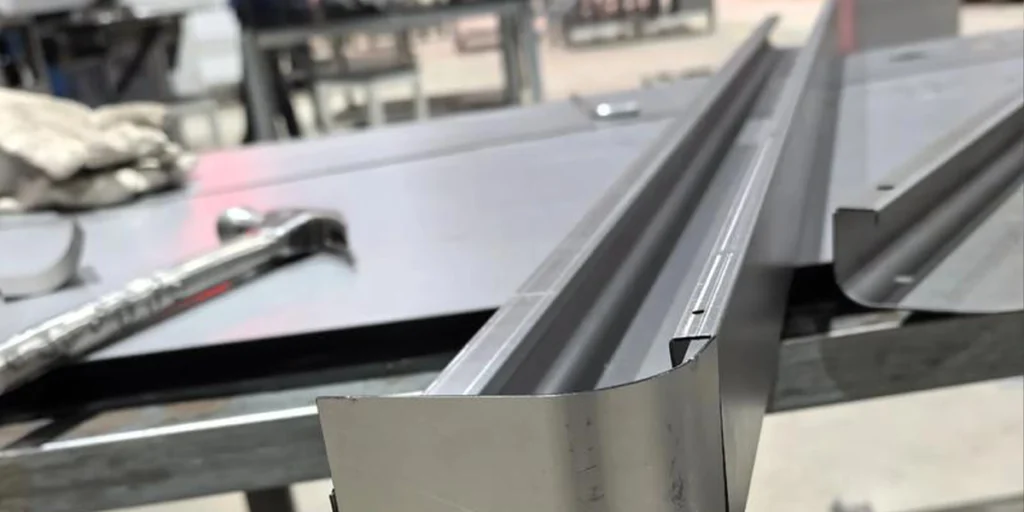
Sheet metal cutting is the most basic and common cutting process in sheet metal processing. Its core function is singular: to cut a whole sheet of metal into sheets of a specified size or shape as needed.
From a processing perspective, sheet metal shearing is a “separation-type processing method” that does not change the thickness or structure of the sheet metal, but only cuts, separates, and segments the material.
In the entire sheet metal processing flow, shearing is usually the first step. Before bending, stamping, forming, or assembling, sheet metal often needs to be sheared to be processed into basic parts of appropriate size that are easy to process later.
You can think of sheet metal cutting as follows: just like cutting a whole piece of fabric into the appropriate size before cutting it into pieces, cutting is responsible for “preparing the material” rather than “finishing the product”.
You only need to remember one sentence: Sheet metal cutting is the first step in cutting and separating metal sheets to lay the foundation for subsequent processing.
Basic principles of sheet metal shearing
Sheet metal shearing is able to cut metal sheets because the material breaks at a localized location when subjected to strong shearing force.
During the shearing process, the metal sheet is clamped between two relatively moving blades. As external force is gradually applied, the blades exert opposite pressure on the same location of the sheet, causing that area to experience concentrated shearing action.
Initially, the sheet metal is only compressed and squeezed, causing slight changes in shape, but it still maintains its overall continuity. As the shear force continues to increase, the stress inside the sheet metal gradually concentrates at the point of contact with the blade, and the material begins to deform noticeably. When the localized stress exceeds the metal’s own tolerance, tiny cracks will appear near the blade.
As the upper and lower blades continue to move, these cracks will expand along the direction of force and eventually connect with each other, thus completely separating the metal sheet at that location and completing the shearing process.
Because shearing achieves separation through compression and fracture, the sheared edges typically exhibit certain characteristics, such as being uneven or slightly deformed. These phenomena do not indicate processing errors but are natural results of the shearing process itself. Whether further processing is required depends on the specific processing requirements.
Suitable materials and thicknesses for sheet metal cutting
Sheet metal shearing is not suitable for all metal materials and sheet metal conditions. The material type and sheet thickness are the two most important factors to consider before deciding whether to use shearing.
Common metal materials suitable for shearing
From a practical application perspective, shearing is more suitable for metal sheets with moderate strength and good ductility, such as:
Carbon steel plates
With stable shearing properties, it is one of the most common materials in sheet metal processing and is widely used in structural parts and general-purpose parts.
Stainless steel sheet
Although it has high strength, it can still be sheared under reasonable conditions, which is common in products that require corrosion resistance.
Aluminum and aluminum alloy sheets
The material is relatively soft and lightweight, and the cutting process is relatively smooth. It is often used for lightweight parts or shell products.
Copper and copper alloy plates
It has good ductility and can be sheared, but requires relatively higher processing control.
Simply put: as long as the material is not too hard or too brittle, cutting can usually be a viable method for cutting.
Why does thickness become a limiting factor?
During the shearing process, the sheet material is separated by breaking after being subjected to concentrated force.
As the thickness of the sheet material increases, the shear force it needs to withstand also increases significantly, which has several direct effects:
- Shearing becomes more difficult, requiring more stringent processing conditions.
- Sheet metal is more prone to noticeable deformation at the cut edges.
- It is more difficult to maintain consistent cut quality.
Therefore, shearing is generally more suitable for thin or medium-thickness boards. When the board is too thick, shearing is no longer the most economical, nor necessarily the most suitable, option.
What happens if the material is too thick or too hard?
If the material is too thick or too strong, the following may occur during the shearing process:
- The cut edges are obviously deformed
- Uneven stress on the sheet metal affects subsequent processing.
- Shearing quality is difficult to control
This is why, in actual production, shearing is not used for all sheet metal parts, but has a clearly defined scope of application.
Why is shearing unsuitable for high-precision contours?
Sheet metal shearing is better suited for performing straight, regular separation operations. For parts with complex contours and high precision requirements, shearing has inherent limitations in edge control and shape freedom.
Therefore, shearing is more suitable for “cutting the material” rather than “making the shape right the first time”.
Application scenarios of sheet metal shearing process
In actual production, sheet metal shearing is most commonly used in the blanking and cutting stages of sheet metal. When a whole sheet of metal needs to be divided into several pieces of regular size, shearing is often the most direct and efficient choice.
As a common application in the blanking process
In most sheet metal factories, shearing is usually the first step in the processing.
For example, large metal sheets can be cut into strips, rectangles, or standard-sized sheets to facilitate further processing. This application is very common in production scenarios that require a large amount of basic sheet material.
Real-world application scenarios in common industries
Sheet metal shearing has wide applications in many industries, such as:
Home appliance manufacturing
The outer shell or inner panel of products such as refrigerators, washing machines, and air conditioners are often first obtained by shearing to obtain the base material, and then bent and punched.
Automobiles and auto parts
Components such as the inner door panel and support panel are often cut to approximate dimensions before entering the stamping or forming process.
Building and structural components
Metal roofing panels, wall panels, and some structural components are often made by cutting to obtain standard lengths or widths of sheet material.
Enclosures of electronic and electrical equipment
Chassis, control cabinet, communication equipment housing, etc., are cut to quickly prepare regular sheet materials, which facilitates subsequent drilling and bending.
Machinery and hardware products
In products such as brackets, boxes, shelves, and tool cabinets, cutting is a common way to obtain the basic shape of parts.
Used in conjunction with other sheet metal processes
Shearing is usually not used alone to complete the entire product, but rather in conjunction with other processes. After shearing, the sheet material often goes through processes such as bending, punching, stamping, or welding to gradually form the final structure and function.
When is cutting the “most appropriate first step”?
When processing requirements have the following characteristics, shearing is often the most suitable option:
- Need to quickly obtain sheet metal of regular dimensions
- The product structure is mainly based on straight edges.
- There are several more forming or assembly processes following.
In these situations, shearing can efficiently complete the step of “preparing the material”, creating a stable and controllable starting point for subsequent processing.
Advantages and disadvantages of sheet metal shearing
Sheet metal shearing has persisted in factories not because it is “advanced,” but because it is sufficient, stable, and cost-effective in suitable scenarios. However, it also has very clear limitations.
Advantages of sheet metal shearing
1. Low cost and low barrier to entry
Shearing equipment has a relatively simple structure, low equipment investment and maintenance costs, and low technical requirements for operators. This gives shearing a significant cost advantage in basic processing and mass production.
2. High processing efficiency
For straight-line cutting of sheet metal of regular dimensions, shearing can be completed quickly, and the shape can be formed in one cut, which is especially suitable for the cutting needs of a large number of repetitive specifications.
3. Stable operation and clear rhythm
The shearing process is simple and highly controllable. When the production rhythm requirements are clear and the processing objectives are well-defined, stability is its most important value.
4. Suitable for those who need to “prepare the materials in advance”.
When the goal is simply to obtain sheet metal of the right size in preparation for subsequent bending, stamping, or welding, shearing is an efficient and practical option.
Disadvantages of sheet metal shearing
1. Limited accuracy capability
Shearing is mainly used for rough machining or preparation of semi-finished products. For parts with high dimensional accuracy requirements, shearing alone is often insufficient to meet the requirements.
2. Limitations exist in edge quality.
The cut edges may have burrs, deformation, or uneven surfaces, especially on thicker or harder materials, and usually require additional processing.
3. Insufficient shape flexibility
Shearing is more suitable for straight lines and simple contours. It is not suitable for curves, complex holes, or irregular shapes, and other processing methods need to be used.
4. The application scenarios have clear boundaries.
When the requirements for product appearance, precision, or structural complexity increase, shearing is often only used as a preliminary process, rather than the final forming method.
At last
In summary, sheet metal shearing is not a processing method that pursues precision or complex shapes, but rather a basic process that emphasizes efficiency, stability, and cost control. Its significance lies not in making the product “perfect in one go,” but in providing a suitable and controllable starting point for subsequent processing.
When the processing target is a regular size, straight separation, and there are subsequent bending, stamping or assembly processes, shearing is often the most rational and practical choice; however, when the product begins to have higher requirements for precision, edge quality or contour complexity, the boundaries of shearing will also become apparent.
Understanding the role and scope of sheet metal shearing is more important than simply judging whether it’s “good” or “bad.” This is the real reason why it has always existed as a fundamental process in sheet metal processing.