
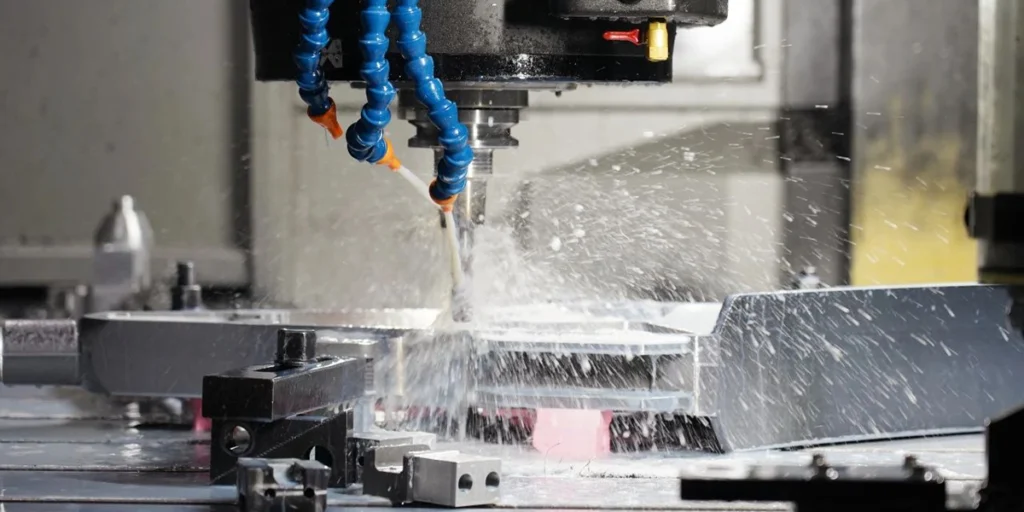
What is a CNC machine tool?
A CNC (Computer Numerical Control) machine tool is an automated machine tool that uses computer programs to control the machining process.
Unlike traditional machine tools that rely on manual operation, CNC machine tools rely on digital instructions to precisely control the machine tool’s motion trajectory, processing sequence, and cutting actions, thereby completing the machining of parts.
Simply put:
Instead of directly “operating the machine tool,” people first “tell the machine tool how to do it,” and then the machine tool automatically completes the processing according to the instructions.
Core features of CNC machine tools
Digital control
CNC machine tools are centered around programs, using pre-set digital instructions to control the movement and processing of the machine tool, thus avoiding the instability caused by manual operation.
High and stable machining accuracy
Because the motion and cutting process are controlled uniformly by the system, CNC machine tools can maintain stable machining accuracy over a long period of time, making them particularly suitable for parts with high requirements for dimensional consistency.
Adapt to complex processing requirements
By simply changing or adjusting the machining program, the same CNC machine tool can process parts of different shapes and structures, making it far more flexible than traditional machine tools.
High degree of automation
The processing can be carried out continuously, reducing manual intervention, which not only improves efficiency but also reduces reliance on operational experience.
What are the components of a CNC machine tool?
Overall, CNC machine tools mainly consist of the following parts working together:
- CNC system: Responsible for receiving and executing machining instructions, it is the control core of the machine tool.
- Drive and actuator mechanism: Performs the movement of each axis and cutting actions according to instructions.
- Machine tool main structure: Provides a stable and precise mechanical foundation for the machining process.
- Auxiliary systems: Used to support the normal operation of the processing.
This article only provides a conceptual introduction; the specific structure and working method will be elaborated in subsequent chapters.
Why are CNC machine tools so important?
With the increasing demands for precision, efficiency, and consistency in the manufacturing industry, CNC machine tools have become an indispensable basic equipment in modern manufacturing systems.
It not only changed the way parts are processed, but also profoundly affected product design, production efficiency, and manufacturing quality.
What do CNC machine tools do?
The core function of a CNC machine tool is only one thing: to precisely process raw materials according to a preset program and ultimately manufacture parts that meet the requirements.
It doesn’t “think” about how to design a product, but rather strictly executes processing instructions, step by step processing metal or other materials into parts of specified shapes and sizes.
For precision machining of parts
CNC machine tools are often used to process raw materials into parts with specific structural, dimensional and precision requirements.
Various basic manufacturing tasks can be accomplished through different processing methods, such as:
- Cutting and shaping the material
- Machining holes, slots, or contours on parts
- Achieve precise control over the shape and structure of parts.
These parts are widely used in mechanical equipment, industrial products, and various manufacturing systems.
Processing requirements for complex structures
When the structure of a part becomes complex and manual operation becomes difficult to complete stably, the advantages of CNC machine tools become apparent.
It can process parts with complex shapes and fine structures through continuous and controlled motion, while maintaining the consistency of the processing results.
This type of processing is particularly common in manufacturing scenarios involving high precision or high complexity.
Suitable for both mass production and customized processing
CNC machine tools are suitable for both repetitive production of parts of the same specifications and handling diverse processing needs.
- Ensure consistent part dimensions and quality during mass production.
- In custom manufacturing, the program is adjusted to adapt to different parts.
This allows CNC machine tools to achieve a good balance between production efficiency and flexibility.
Improve production efficiency and stability
Because the machining process is controlled by a unified system, CNC machine tools can operate stably for a long time, reducing errors caused by human intervention.
While ensuring processing quality, it also helps companies improve overall production efficiency.
Which industry does CNC machining belong to?
CNC machining belongs to the manufacturing industry, and more specifically, it is a core component of the machining field within the manufacturing industry.
It uses computer numerical control technology to precisely process various materials, and is an indispensable basic capability in modern industrial production.
In the manufacturing system, CNC machining does not serve a single industry, but rather serves as a general manufacturing technology that provides machining support for key components and structural parts for multiple industries.
The role of CNC machining in manufacturing
CNC machining connects the two stages of product design and physical manufacturing.
Whether a design can be accurately and reliably transformed into an actual part largely depends on the capabilities and skill level of CNC machining.
As the manufacturing industry moves towards automation and digitalization, CNC machining is gradually becoming an important foundation for advanced manufacturing and high-end equipment manufacturing.
Main application areas of CNC machining
Due to its high precision, strong stability, and wide adaptability, CNC machining is widely used in many sub-sectors of manufacturing, including but not limited to:
- Automobile manufacturing: Machining of various structural and functional parts
- Aerospace: Meeting the manufacturing needs of components with extremely high precision and consistency requirements
- Electronics and consumer products: Supports the machining of precision casings and structural components.
- Medical devices: Used for the production of high-requirement, low-tolerance parts
- Mold and machinery manufacturing: providing basic processing capabilities for various industrial products.
The Development History of CNC Machine Tools
CNC machine tools are not a new technology that suddenly appeared, but rather a technology that has gradually evolved from traditional machine tools with the development of automation and computer technology.
Understanding its development history helps explain why CNC machine tools occupy such an important position in the manufacturing industry today.
From manual operation to the birth of numerical control concepts
In the mid-20th century, with the development of the aviation industry, the requirements for machining accuracy of complex parts continued to increase, and traditional machine tools that relied on manual operation could no longer reliably meet the demands.
Against this backdrop, the idea of controlling machine tool motion digitally was proposed, and the basic concept of CNC machine tools was thus formed.
From early numerical control to computer numerical control (CNC)
Early CNC machine tools relied mainly on electronic systems for simple control, with limited functionality.
With the development of computer technology, computer control systems were gradually introduced into machine tools, enabling more complex and precise motion control. This stage also marked the emergence and popularization of computer numerical control (CNC) machine tools.
The rapid development and widespread application of CNC machine tools
In the late 20th century, CNC systems matured, and machine tool structures and control capabilities continued to improve.
CNC machine tools are now widely used in industrial production, no longer limited to a few high-end fields, but gradually becoming standard equipment for manufacturing enterprises.
Evolving towards higher precision and intelligence
With the upgrading of the manufacturing industry, CNC machine tools continue to develop towards higher precision, higher efficiency and intelligence.
The emergence of multi-axis linkage, composite machining, and intelligent control technologies has enabled CNC machine tools to cope with more complex and stringent machining requirements, becoming an important support for modern manufacturing systems.
Working principle of CNC machine tools
The working principle of CNC machine tools can be summarized in one sentence: pre-set machining instructions are converted into the actual movements of the machine tool, thereby completing the machining of parts.
The entire process is not carried out manually in real time, but is coordinated and executed automatically by the CNC system.
Generation and input of processing instructions
Before processing begins, a set of processing instructions needs to be generated based on the design requirements of the part.
These instructions describe how the cutting tool moves and how it processes the workpiece during the machining process.
Once the instructions are input into the CNC system, the machine tool can execute the machining process in a predetermined sequence.
Command parsing and motion control
The CNC system parses the input instructions and converts them into control signals that the machine tool can execute.
These signals are used to control the movement and rhythm of the machine tool’s various moving parts, ensuring that the machining process proceeds along the set path.
During this process, the movement of the machine tool is not random, but precisely controlled and coordinated.
Perform machining and form parts
Under the control signal, the machine tool’s spindle and moving parts begin to work, and the cutting tool cuts or shapes the workpiece according to the instructions.
Excess material is gradually removed, and the shape and size of the parts are gradually formed during the processing.
Feedback and Stable Operation
During the machining process, the machine tool continuously monitors its operating status and makes adjustments as needed to ensure the stability of the movement and the consistency of the machining results.
This feedback mechanism enables CNC machine tools to maintain reliable machining performance over a longer period of time.
What materials can CNC machine tools process?
One of the core advantages of CNC machine tools is their wide range of material adaptability.
From common metals to engineering plastics, and even some special materials, all can be shaped using CNC machining.
Common metal materials
Metal is the most important material type in CNC machining and is also the most widely used material in manufacturing.
- Steel products: carbon steel, alloy steel, stainless steel, cast iron
It is commonly used in mechanical parts, structural components, molds, equipment parts, etc., where high strength and durability are required. - Non-ferrous metals: aluminum alloys, copper alloys, titanium alloys, magnesium alloys
These materials are very common in lightweight, corrosion-resistant, or high-strength applications and are widely used in aerospace, automotive, electronics, and medical fields. - Special metals: high-temperature alloys, hard alloys, etc.
They are often used in extreme working conditions or high-end manufacturing scenarios, such as aircraft engines and wear-resistant parts.
Non-metallic materials
In addition to metals, CNC machine tools can also process a variety of non-metallic materials.
- Engineering plastics: ABS, PC, nylon, PP, etc.
Suitable for use in housings, structural components, and functional parts, commonly found in the fields of electronics, electrical appliances, and automotive parts. - Composite materials: carbon fiber, glass fiber
It features high strength and lightweight characteristics, and is often used in high-performance structural components. - Other materials: wood, acrylic, rubber, stone, etc.
Commonly used in decoration, display, model or custom processing scenarios.
Special Purpose Materials
In some industries, CNC machine tools are also used for machining:
- Ceramic materials (high temperature resistant, insulating)
- Graphite (electrodes, molds)
- Engineered wood panels such as wood substitutes and bakelite
These materials are typically used in functional or auxiliary processing scenarios.
CNC machine tools are not limited to a single material, but rather cover a wide range of processing objects, from metals to non-metals, according to industry needs. This is one of the key reasons why CNC can be popularized in many manufacturing fields.
Application areas of CNC machine tools
Due to their high precision, high consistency and strong adaptability, CNC machine tools have become an indispensable basic equipment in modern manufacturing and are widely used in many industries.
Automobile manufacturing industry
CNC machine tools are widely used in the processing of core automotive components, including:
- Engine parts (cylinder block, crankshaft, connecting rods, etc.)
- Body structural components and chassis components
- Battery trays, motor housings, and electronic control housings for new energy vehicles, etc.
These parts have extremely high requirements for dimensional accuracy and batch stability, making CNC machining the mainstream choice.
Aerospace
Aerospace applications demand extremely high precision, strength, and reliability in parts; therefore, CNC machine tools are primarily used for:
- Machining of aero-engine blades and key structural components
- Manufacturing of large structural components such as aircraft fuselages and wings
- Precision machining of spacecraft components
Multi-axis CNC machine tools are particularly important in this field.
Mold manufacturing industry
Mold manufacturing is highly dependent on CNC machining capabilities, and common applications include:
- Machining of plastic mold cavities and cores
- Machining of key components for die casting molds and stamping molds
CNC machine tools can stably process complex surfaces, which directly affects the precision of molds and the quality of products.
Mechanical manufacturing and automation equipment
In the field of general machinery and automation equipment, CNC machine tools are used for:
- General-purpose mechanical parts such as shafts, housings, and discs
- Machine tool body and core structural components
- Key components for automated equipment and industrial robots
This is one of the most widely used fundamental areas of CNC applications.
Medical device industry
The medical industry has extremely high requirements for precision and safety, and CNC machine tools are mainly used for:
- Fabrication of orthopedic implants and dental prostheses
- Manufacturing of precision internal components for medical devices
High precision and stability are core requirements in this field.
Electronics and consumer electronics
In the electronics industry, CNC machine tools are commonly used for:
- Processing of casings for mobile phones, computers, and other products
- Precision electronic structural components and brackets
- Circuit board drilling and precision cutting
It meets both appearance requirements and ensures assembly precision.
Energy, rail transportation and shipbuilding
In the field of large-scale equipment manufacturing, CNC machine tools are widely used in:
- Power generation equipment and new energy equipment components
- Rail transit structural components and key parts
- Ship structural components and power system parts
It primarily serves the manufacturing needs of high strength, large size, and high reliability.
Art and Customization
Besides industrial manufacturing, CNC machine tools are also used for:
- Processing of artworks and decorative items
- Architectural model and custom product manufacturing
It meets the processing needs of small batches, high complexity, and personalization.
CNC machine tools cover almost all major industrial fields, from basic manufacturing to high-end equipment, and from mass production to customized processing. They are general-purpose core equipment in the modern manufacturing system.
The main advantages of CNC machine tools
The core reason why CNC machine tools have become the mainstream equipment in modern manufacturing is that they have unparalleled advantages in terms of precision, efficiency and stability compared to traditional machine tools.
High machining precision
CNC machine tools can achieve stable, high-precision machining by precisely controlling the movement of each axis through a program.
In the production of precision parts and complex structural components, it can maintain dimensional consistency over a long period of time and meet high-standard manufacturing requirements.
Stable and consistent processing quality
The processing is controlled by a program, reducing human error.
The processing trajectories of parts in the same batch are completely consistent, making it very suitable for mass production where product consistency is a high priority.
Production efficiency significantly improved
CNC machine tools support high-speed cutting and have the ability to automatically change tools and perform multi-process continuous machining.
In the machining of complex parts, it can significantly shorten the machining time and increase the output per unit time.
Highly adaptable and flexible
By simply modifying the machining program, production of different parts can be switched quickly.
It is especially suitable for small-batch, multi-variety, customized processing and new product prototyping stages.
High degree of automation, reducing reliance on manual labor
CNC machine tools can achieve automatic machining, automatic tool changing, and machining process control, while operators play more of a monitoring and management role.
This not only reduces labor intensity but also decreases reliance on highly experienced operators.
Concentrated processes reduce clamping errors
CNC machining centers can complete multiple processes in a single setup.
This reduces errors caused by repeated clamping, while improving processing efficiency and finished product accuracy.
It is conducive to digital and modern production management
The CNC machine tool machining process can be managed with data, which facilitates time assessment, cost control and production scheduling.
It can also interface with CAD/CAM systems, laying the foundation for intelligent manufacturing and automated production.
Strong capability to process complex parts
For complex parts such as curved surfaces and irregularly shaped structures, CNC machine tools can easily complete the process through multi-axis linkage.
This is an important capability that traditional machine tools cannot achieve.
CNC machine tools not only “process more accurately”, but also “do faster, more stably and more flexibly”, making them key equipment for manufacturing to achieve high-quality and high-efficiency production.
Summarize
Numerical control machine tools (CNC) are indispensable core equipment in modern manufacturing. Through digital program control, they achieve high-precision, high-efficiency, and high-stability machining capabilities. Whether in metal processing, precision parts manufacturing, or in industries such as automotive, aerospace, and medical, CNC machine tools play a crucial role. As manufacturing moves towards automation and intelligence, the application scope and importance of CNC machine tools continue to expand.