


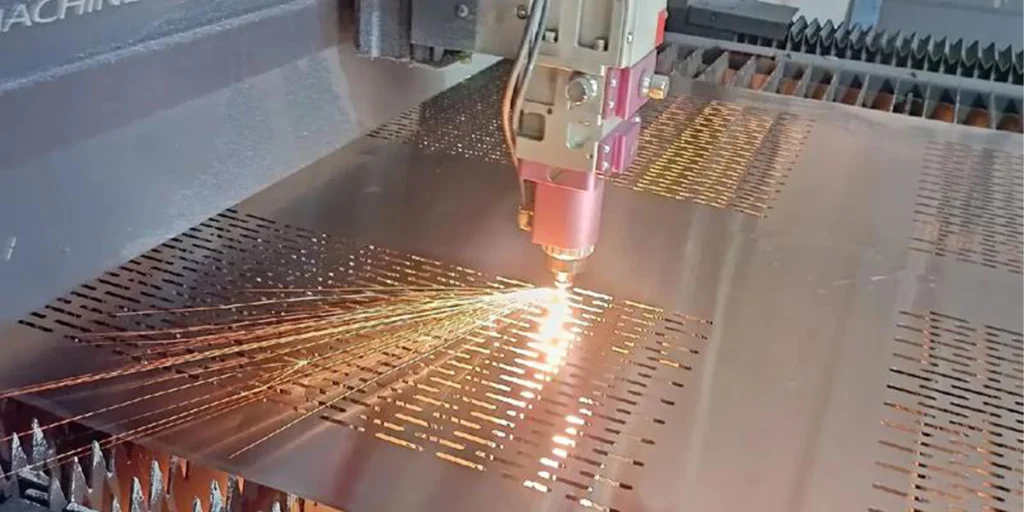
What is CNC machining?
Numerical control machining, usually referring to CNC machining, is a manufacturing method that uses computer programs to control machine tools to automatically complete machining tasks.
Simply put, it means that instead of relying on manual operation of the machine tool, the program will direct the machine tool “how to move, how much to move, and when to stop”.
In CNC machining, the dimensions, shape, machining path, and cutting parameters of the part are all pre-programmed. During machining, the machine tool only needs to follow these instructions to stably and accurately complete operations such as cutting, drilling, and milling.
Core concepts of CNC machining
There are three key points in CNC machining:
- Program control : The processing is controlled by digital instructions, rather than by real-time judgment and operation by operators.
- Automatic machine tool execution : The machine tool automatically completes the processing actions according to the program, reducing human intervention.
- Repeatable processing results : The same procedure can be used repeatedly to ensure consistency of each part.
For this reason, CNC machining is widely used in manufacturing scenarios that require high precision, stability and consistency, and is a very basic and important machining method in modern manufacturing.
You can understand CNC machining as: “Turning experience and operation into a program in advance, so that the machine tool works according to the rules.”
Basic process of CNC machining
The core characteristic of CNC machining is “plan first, then process”.
Before the machine tool starts operating, each step of the machining process has actually been determined in advance. The overall process can be summarized into the following key stages.
From design to manufacturing process
CNC machining usually begins with product design.
Engineers will design the dimensions, structure, and precision of the parts based on their functional requirements, and then convert this information into a digital model that can be recognized by a computer.
Based on this, a machining program is generated using specialized software, allowing the machine tool to clearly define:
- How should the tool be moved?
- How should the processing sequence be arranged?
- To what extent should each step be completed?
The purpose of this step is to figure out “how to process” in advance.
Machine tool preparation and machining execution
Before formal processing, basic preparatory work needs to be done on the machine tool, including:
- Install the appropriate cutting tools
- Fix the material to be processed
- Confirm the machining reference position
- Import and check the machining program.
Once these preparations are complete, the CNC machine tool will automatically run according to the program instructions to complete machining operations such as cutting, drilling, and milling. Throughout the process, the machine tool executes actions according to a predetermined path, rather than relying on real-time manual operation.
Processing completion and result confirmation
After the parts are machined, necessary dimensional and visual inspections will be carried out to confirm whether the machining results meet the design requirements.
If a deviation is found, it can be corrected by adjusting the program or parameters without redesigning the entire processing plan.
The difference between CNC machining and traditional machining
The essential difference between CNC machining and traditional machining is not whether or not a machine is used, but who is in charge of the machining process.
Simply put: traditional machining relies on people, while CNC machining relies on programs.
Let’s look at the differences between them from some of the most intuitive aspects that most easily affect the processing results.
Different control methods
Traditional machining relies mainly on operators manually controlling machine tools, and the speed, feed rate, and depth of cut during the machining process depend to a large extent on personal experience.
CNC machining involves pre-setting the machining path and parameters through a program, with the CNC system controlling the machine tool’s movements. During machining, the machine tool operates according to predetermined instructions, with manual intervention serving only a monitoring and assistance role.
Different processing precision and consistency
In traditional machining, machining accuracy is easily affected by human factors; different operators and different machining times may result in different outcomes.
The precision of CNC machining is determined by the program and the machine tool itself. The same program can be used repeatedly to keep the parts highly consistent in size and shape, making it more suitable for production tasks with high stability requirements.
Different adaptability to complex parts
Traditional machining often requires multiple clamping and manual adjustments when dealing with parts with complex structures or many curved surfaces, making the process cumbersome and difficult to guarantee consistency.
CNC machining can complete multi-directional and multi-angle machining in one go through multi-axis linkage, making it easier to achieve precise forming of complex structures.
Different production methods and efficiencies
Traditional processing is mainly manual, with a relatively slow processing pace and efficiency greatly affected by the operator’s condition.
CNC machining has a high degree of automation, and the machine tool can run continuously according to the program. In batch production or repetitive processing, it has advantages in efficiency and stability.
The degree of reliance on personnel experience varies.
Traditional processing requires a high level of experience and skill from operators, and there is a significant difference in processing results between novices and skilled workers.
CNC machining incorporates experience into the program, reducing reliance on individual skill levels and facilitating standardized production.
These differences demonstrate that CNC machining does not simply replace traditional machining; rather, it alters the control methods and production logic. Understanding this helps in determining which machining method is more suitable for actual production.
Advantages of CNC machining
The reason why CNC machining is widely used in modern manufacturing is not because it is “new technology”, but because it performs well in terms of stability, efficiency and controllability, and can solve the problems that repeatedly occur in traditional machining.
More stable machining accuracy
CNC machining controls the movement of machine tools through programs, so machining accuracy does not depend on human touch. The same program can be reused multiple times, keeping the size and shape of parts highly consistent, making it particularly suitable for machining parts with high precision requirements.
Higher production efficiency
In CNC machining, multiple processes can be completed in a single setup, reducing the time consumed by frequent changes of equipment and repetitive positioning. The automatic operation of the machine tool according to the program also makes the machining process more seamless and efficient.
It is easier to process complex structures
For parts with complex structures and numerous curved surfaces, CNC machining can achieve continuous cutting through multi-axis motion, avoiding errors caused by repeated clamping. This is especially evident in the manufacturing of complex parts.
Better product consistency
CNC machining pre-programs machining requirements, reducing human error. In mass production, each part is machined according to the same rules, which is more conducive to quality control and standardized production.
More flexible adjustment and switching
When the object being processed changes, the new processing task can be completed simply by adjusting the program, without requiring significant modifications to the machine tool structure or processing method. This flexibility is especially important in multi-variety production.
Overall, the advantage of CNC machining lies in making the machining process more controllable and stable, which is the fundamental reason why it has become an important machining method in modern manufacturing.
Suitable scenarios for CNC machining
Not all parts need to be machined using CNC, but in certain specific situations, CNC machining is often a more suitable and stable choice. The following scenarios are particularly suitable for CNC machining.
Parts with high requirements for precision and consistency
When parts have specific requirements for dimensions, tolerances, and assembly accuracy, CNC machining is more likely to maintain stable machining results.
In mass production, program control can ensure that each part is processed according to the same standards, reducing the uncertainty caused by human error.
Parts with complex structures or multi-faceted machining
For parts with complex contours, curved surfaces, or requiring machining from multiple angles, CNC machining can complete multi-face machining in one operation through multi-axis motion, avoiding the accumulation of errors caused by repeated clamping.
Projects requiring batch or repetitive production
When similar parts need to be processed repeatedly, CNC machining can improve production efficiency by reusing machining programs, while ensuring product consistency and stability.
Frequent design adjustments or product updates
When product design needs to be modified, the new processing task can be completed simply by adjusting the processing program, without having to redesign the entire processing flow, making it more suitable for the production needs of multiple varieties and small batches.
Projects with high requirements for process controllability
In projects with stringent requirements for quality, delivery time, and processing, CNC machining makes process management and quality control easier, reducing uncertainties and risks.
In general, when parts have specific requirements for precision, complexity, or consistency, CNC machining is often a more reliable choice. Understanding these applicable scenarios helps in making more appropriate judgments about machining methods in actual production.
Summarize
CNC machining uses program-controlled machine tool operation, making the machining process more stable, precise, and repeatable. Compared to traditional machining methods, it has greater advantages in precision control, machining complex parts, and mass production.
When there are specific requirements for the consistency, structural complexity, or production efficiency of parts, CNC machining is often a more reliable choice.
Understanding the basic concepts and applicable scenarios of CNC machining can help in selecting a more suitable machining method during actual manufacturing or procurement processes.