


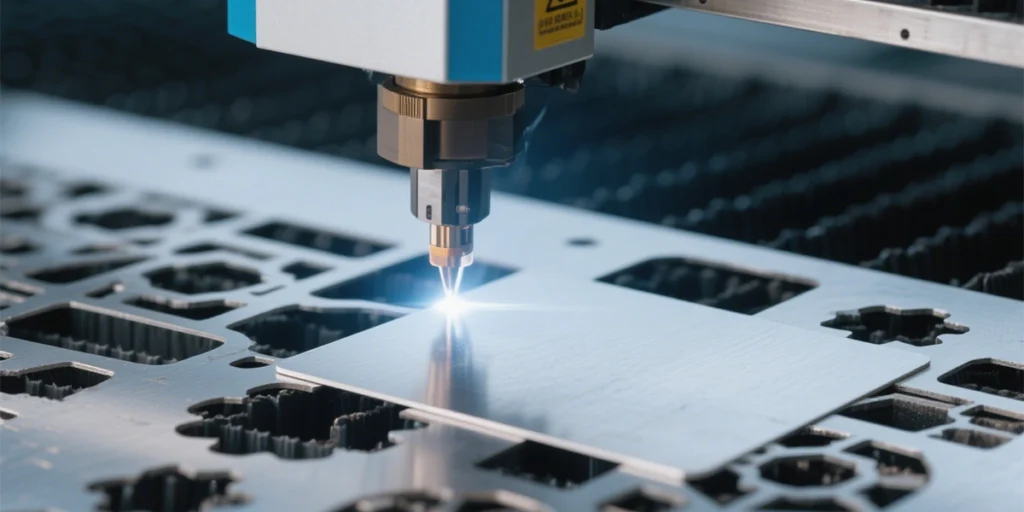
Working principle of CNC machine tools
The working principle of CNC machine tools can essentially be summarized in one sentence:
The machining program is converted into precise mechanical motion through a computer control system, thereby automatically completing the machining of parts.
Unlike traditional machine tools that rely on manual operation, CNC machine tools do not “rely on experience to guide the cutting,” but strictly follow pre-set program instructions to execute every action, including position, speed, and machining sequence.
From an overall perspective, the working process of a CNC machine tool can be understood as the following continuous steps:
1. The program serves as the basis for processing.
Before machining begins, all information related to the part (shape, size, machining method) is compiled into a CNC program. This program is equivalent to the machine tool’s “operation instructions,” clearly specifying what to do and in what order during machining.
2. Unified command of the control system
After the program is input into the CNC system, the control system is responsible for reading, judging, and issuing instructions. It does not directly participate in cutting, but acts as a “command center,” coordinating the operation of various moving parts according to predetermined rules.
3. The machine tool components move according to the instructions.
Under the command of the control system, the machine tool’s spindle, worktable, and feed mechanism begin to move. A relative displacement occurs between the tool and the workpiece, and the material is gradually removed, thus initiating the machining process.
4. Motion and processing are completed simultaneously.
Throughout the entire machining process, every movement of the machine tool and every cut is completed under program control. This continuous and repeatable motion mode enables CNC machine tools to stably produce parts with consistent dimensions and reliable precision.
Simply put, CNC machine tools are not something you do “think and do at the same time,” but rather something you “plan first, then execute.”
This working method, with programs at its core and control systems at its center, forms the basis for the high automation and consistency of CNC machine tools.
How to run a CNC program
A CNC program is not an instruction that “directly drives the tool,” but rather a machining plan that needs to be executed step by step by the machine tool.
From program preparation to the actual cutting process, a series of standardized and clear steps must be followed.
1. The program is confirmed before processing.
Before running the program, the operator needs to confirm that the program itself is executable, including whether the machining path is reasonable and whether the cutting tools and machining sequence are matched. Through simulation or inspection, obvious risks can be identified in advance, avoiding direct trial and error on the machine tool.
2. The program is loaded into the CNC system.
Once the program is confirmed to be correct, it will be imported into the CNC system via methods supported by the machine tool, such as machine tool memory, external storage devices, or network transmission. At this point, the program is only “stored” and has not yet actually begun to control the machine tool’s movements.
3. Program parameters correspond to actual processing conditions.
Before running the program, it is necessary to ensure that the key settings in the program are consistent with the current machining conditions, such as the tool, workpiece reference, and machining method. By verifying the tool settings and parameters, a correspondence is established between the coordinates in the program and the actual position of the machine tool.
4. The program begins execution and controls the movement.
Once the program starts, the CNC system reads the instructions in a predetermined order and converts them into motion commands that the machine tool can execute. The various components of the machine tool then move sequentially, and the machining process begins.
5. The processing is monitored in real time.
During program execution, operators can observe the machine tool status and processing conditions. If any abnormalities are detected, the program can be paused for adjustments to ensure stable processing.
6. The program execution is complete and the processing ends.
Once all instructions in the program have been executed, the machine tool stops processing, and a complete processing cycle ends. The finished product can then be inspected and prepared for the next processing cycle.
In short, the execution of a CNC program is a continuous process from “confirmation – loading – correspondence – execution – completion”.
This clear and controllable operating mode enables CNC machine tools to efficiently complete repetitive and complex machining tasks while ensuring safety and accuracy.
Composition of CNC system
The CNC system is the core control part of a CNC machine tool, which can be understood as the central hub connecting the program and the machine tool’s actions.
Although different brands and models may have different configurations, their basic components are relatively fixed.
Overall, a CNC system mainly consists of the following parts:
1. Core control unit
The core control unit is the “command center” of the CNC system, responsible for receiving and processing the CNC program. It parses and calculates the instructions in the program, and then converts the results into control signals that the machine tool can execute.
Simply put, it determines when the machine tool moves, how much it moves, and in what order.
2. Drive system
The drive system is responsible for converting control signals into actual mechanical motion.
When the control unit issues a command, the drive system will drive the machine tool’s spindle and each feed axis to run, so that the tool and the workpiece will produce relative motion according to the program requirements. It is the direct executor of the machining action.
3. Feedback and Detection Unit
To ensure the stability of the machining process, CNC systems are usually equipped with feedback devices to monitor the machine tool’s motion status.
This feedback information is sent back to the control unit to determine whether the machine tool is operating according to the instructions, providing a basis for subsequent adjustments.
4. Human-computer interaction and input/output section
The human-machine interface is the window through which operators communicate with the CNC system, including the operation panel, display interface, and program input interface.
These devices allow operators to call up programs, check status, and perform basic control operations.
5. Machine tool body and auxiliary systems
The CNC system does not operate independently; it needs to work in conjunction with the machine tool body and auxiliary systems such as cooling and lubrication. These components provide the physical basis and operational support for the CNC system’s command execution.
Overall, a CNC system is not a single component, but a collaborative control system.
It connects the machining program, control commands, and machine tool actions together, laying the foundation for subsequent coordinate control and precise motion.
Coordinate system and motion control of CNC machine tools
To ensure that CNC machine tools can accurately process data according to the program, two problems must first be solved:
- Where is it processed?
- How do I move there?
This is precisely the significance of coordinate systems and motion control.
Coordinate system
CNC machine tools use a coordinate system to determine the positions of the cutting tool and the workpiece. The machine tool itself has a fixed reference coordinate system, but in actual machining, corresponding machining coordinates are also established based on the position of the workpiece.
With a clear coordinate reference, the machine tool can determine the direction, distance, and endpoint of each movement.
Motion control
Based on a coordinate system, the CNC system controls each motion axis to operate according to instructions. The movement of each axis is the result of calculation and coordination, ensuring that the tool moves along a predetermined path, rather than changing direction arbitrarily.
Multi-axis collaboration
When machining requires simultaneous movement in multiple directions, the CNC system coordinates the movement of each axis to ensure synchronous operation. Through this coordinated control, the machine tool can complete the machining of complex shapes such as curved surfaces and inclined planes.
Continuous motion and stability
The movement of a CNC machine tool is not a “step-forward-stop-forward” process, but rather a continuous and smooth one. The system controls speed changes throughout the entire movement, reducing impact and vibration, thereby ensuring the stability of the machining process.
Coordination between coordinates and motion
This can be understood as:
- The coordinate system is responsible for telling the machine tool “where the target is”.
- Motion control is responsible for deciding “how to get there”.
The two work together to enable CNC machine tools to maintain correct orientation and accurate path during machining, providing a fundamental guarantee for subsequent cutting and precision control.
How do the cutting tools and workpieces of a CNC machine tool work together?
In CNC machining, the actual cutting action is accomplished through the direct contact between the tool and the workpiece.
Only when the two work together properly can the processing be carried out stably and accurately.
Knife selection
Different machining tasks require different cutting tools.
When machining shapes, holes, planes, or curved surfaces, the type, size, and structure of the cutting tool must be matched to the machining content. At the same time, the workpiece material also affects the choice of cutting tool—hard materials emphasize wear resistance, while soft materials prioritize sharpness and chip removal.
Simply put: the more expensive the knife, the better; the more suitable the knife, the better.
Workpiece clamping
The workpiece must remain stable during processing; otherwise, even the most precise program cannot guarantee the result.
By using appropriate fixtures, the workpiece is firmly fixed on the machine tool, and a clear clamping reference is selected to ensure that the position of the workpiece in the machine tool coordinate system remains consistent.
The core objective of clamping is singular: during the machining process, the workpiece must not move, deviate, or vibrate.
Tool setting and compensation
Before machining begins, the position of the tool relative to the workpiece needs to be confirmed.
By performing tool setting, the CNC system can “know” the relationship between the tool tip and the workpiece reference point, thereby correctly executing the dimensional instructions in the program.
When using multiple cutting tools, the system will automatically correct the differences in length and position between different cutting tools through the tool compensation function, so as to ensure the continuity and consistency of machining between each process.
Machining parameters
The cooperation between the cutting tool and the workpiece is reflected not only in their positions, but also in the cutting process.
Reasonable cutting speed, feed rate and depth of cut can allow the tool to cut the workpiece smoothly, reduce vibration and wear, and ensure the quality of the machined surface.
The principle of parameter setting is to neither overwork the cutting tool nor waste the machine tool’s capacity.
Brief summary
In CNC machine tools:
- The cutting tool determines the cutting method.
- The workpiece provides the object to be processed.
- Clamping, tool setting, and parameter settings are responsible for ensuring accurate coordination between the two.
When these steps are coordinated effectively, CNC machining can be completed stably and efficiently, laying the foundation for the subsequent full machining process.
Example of a complete machining process for CNC machine tools
To more intuitively understand how CNC machine tools turn “programs” into “finished products,” we will quickly walk through the complete process using a typical CNC machining flow.
1 : Prepare the processing procedure
Engineers write or generate CNC machining programs based on part drawings.
The program clearly defines the machining path, coordinate position, tool call, and basic machining parameters, providing clear execution instructions for the machine tool.
This step addresses what needs to be processed and how to process it.
2 : Clamp the workpiece and set the reference.
Fix the workpiece on the machine tool table or fixture to ensure a stable and reliable position.
Subsequently, through tool setting operations, a workpiece coordinate system is established, allowing the CNC system to accurately identify the actual position of the workpiece in the machine tool.
The core of this step is to map the coordinates in the program to the actual workpiece.
3 : Install the cutting tools and check their condition.
Install the corresponding cutting tool according to the procedure requirements, and confirm that the tool model, length and condition are normal.
If multiple cutting tools are required for machining, tool compensation settings should be completed in advance to avoid dimensional deviations during machining.
This step determines whether the cutting process is safe and stable.
4 : Trial operation and formal processing
Before the actual cutting, a dry run or single-step check is usually performed to confirm that the tool path and direction of movement are correct.
After confirming that everything is correct, the machine tool begins to run automatically according to the program, completing material removal and shape processing.
At this time, the CNC system will continuously control the movement of each axis to ensure that the machining process proceeds as expected.
5 : Processing Completion and Inspection
After processing, the workpiece is removed and its dimensions and appearance are inspected to confirm whether it meets the design requirements.
If deviations are found, they can be corrected by adjusting the program or parameters, providing a basis for the next processing optimization.
Brief summary
A complete CNC machining process typically follows this sequence: programming → clamping → tool setting → trial run → formal machining → inspection.
Understanding this process helps beginners quickly develop an overall understanding of how CNC machine tools work, and also lays the foundation for a deeper understanding of precision control, machining optimization, and other related topics.