


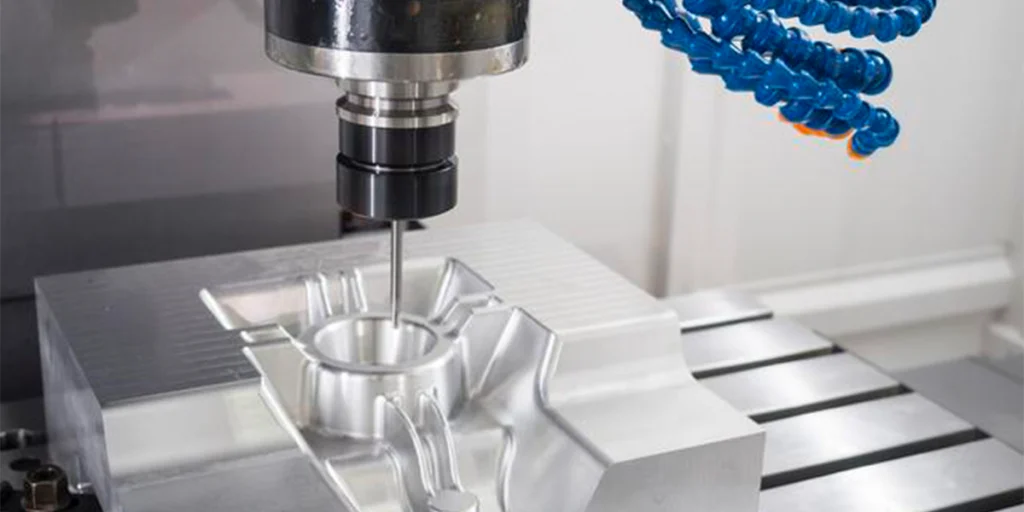
What is a two-axis CNC machine tool?
A two-axis CNC machine tool is a type of machine tool that has only two motion axes and is controlled by a computer numerical control system.
The term “two-axis” here does not refer to the size or performance of the machine tool, but rather that the machine tool can only perform controlled movements in two directions during the machining process.
In CNC machining, an “axis” represents the direction in which a machine tool or cutting tool can move.
When a machine tool can only move in two axes, it is called a two-axis CNC machine tool.
Typically, these two axes are:
- X-axis: Linear motion in the horizontal direction
- Y-axis or Z-axis: Another mutually perpendicular straight line direction
By coordinating these two axes, the machine tool can control the position of the cutting tool relative to the workpiece, thereby completing machining operations on basic, planar, or linear features.
It should be noted that two-axis CNC machine tools are the most basic type of CNC machining.
It can meet the processing needs of specific types of parts, but it also has natural limitations in terms of processing capacity and flexibility, which is why three-axis, four-axis and even five-axis CNC machine tools have emerged.
Structural Description of a Two-Axis CNC Machine Tool
The overall structure of a two-axis CNC machine tool is based on simplicity, stability, and ease of control. Its design purpose is to enable the machine tool to achieve controllable, repeatable, and precise linear motion in two directions.
Structurally, a two-axis CNC machine tool typically consists of the following parts.
Machine tool foundation structure
The basic components of a machine tool mainly include the bed and support structure, which are used to bear the weight of the entire machine and absorb the cutting forces generated during the machining process.
The bed is generally made of cast iron or high-strength steel. The focus is not on complex structure, but on rigidity and stability. A stable foundation is the prerequisite for ensuring smooth operation of the two motion axes.
Two motion axis systems
The core of a two-axis CNC machine tool is two mutually perpendicular motion axes, commonly combined as follows:
- X-axis: Linear motion in the horizontal direction
- Y-axis or Z-axis: Linear motion in another vertical direction
These two axes, through guide rails and transmission mechanisms, enable the movement of the worktable or tool within a plane.
Machine tools can only move in these two directions, so the machining path is limited to a two-dimensional or linear range.
Spindle and tool mounting section
The spindle is used to mount the cutting tools and provide rotary cutting power.
In two-axis CNC machine tools, the spindle structure is usually more straightforward, focusing on speed stability and basic rigidity rather than complex multi-angle adjustment capabilities.
The cutting tool is fixed by a chuck or a simple clamping device to meet basic machining requirements.
CNC control and drive system
A two-axis CNC machine tool controls the movement of two axes through a numerical control system.
The control system coordinates the movement sequence, speed, and position of the two axes according to the machining program to achieve the preset machining trajectory.
The drive mechanism is usually accomplished by a motor in conjunction with transmission components, which has a relatively simple structure and is easy to operate and maintain.
Support System (brief)
To ensure the normal operation of the machine tool, basic auxiliary systems will also be provided, such as:
- Cooling device to reduce the temperature of the cutting zone
- Lubrication system to reduce wear on moving parts
These systems are designed to meet basic processing needs and do not pursue complex configurations.
Overall, the structural characteristics of a two-axis CNC machine tool can be summarized as follows: clear structure, well-defined motion path, and functions focused on precise control in two directions.
Because of this structural characteristic, it is more suitable for completing specific types of machining tasks, rather than for machining complex three-dimensional parts.
Types of parts that can be machined by a two-axis CNC machine tool
Because two-axis CNC machine tools can only perform controlled movements in two directions, their machining capabilities are mainly concentrated on parts with simple structures and regular geometric features. These machine tools are more suitable for machining basic shapes rather than complex three-dimensional structures.
Based on the characteristics of the parts, two-axis CNC machine tools are generally suitable for the following categories.
Shaft parts
For shaft-type parts with regular structures and primarily rotational symmetry, two-axis CNC machine tools can perform basic machining operations, such as:
- External diameter machining
- End face processing
- Simple slot or thread feature
These types of parts share the common characteristic of having clear machining paths, primarily relying on linear and circumferential movements.
Disc-shaped parts
Disc-shaped parts typically have flat end faces and regular contour shapes.
Under two-axis control conditions, the following can be accomplished:
- End face processing
- Circular contour machining
- Drilling or simple grooving
Two-axis CNC machine tools can handle any task as long as the geometry of the part does not involve complex spatial angles.
planar parts
For parts whose primary feature is a flat surface, such as plate-like or frame-like structures, two-axis CNC machine tools can be used for:
- Plane milling
- Step processing
- Machining of basic holes
The machining process is completed within a single plane, making motion control requirements relatively simple.
Simple outline parts
When a part’s shape consists of straight lines or simple arcs, a two-axis CNC machine tool can complete the basic contour machining through axial linkage. These parts typically do not contain complex curved surfaces or multi-directional features.
In general, the parts that two-axis CNC machine tools are suitable for machining have a common characteristic: regular shape, simple structure, and machining path mainly concentrated in two dimensions.
When the structure of a part begins to involve multiple angles, multiple planes, or complex spatial curved surfaces, a CNC machine tool with a higher number of axes is required to complete the task. This is why the number of axes in CNC machining is constantly being upgraded.
Application scenarios of two-axis CNC machine tools
Two-axis CNC machine tools are mainly used in production scenarios where the machining content is clear and the structure is relatively simple.
Two-axis CNC machine tools still have practical value when machining tasks are concentrated on a plane or basic contour and the requirements for multi-angle linkage are not high.
Common application scenarios mainly focus on the following areas.
Basic mechanical parts processing
In mechanical manufacturing, two-axis CNC machine tools are often used to machine parts with regular structures, such as:
- Basic shape machining of shaft parts
- Machining of end faces and holes in disc-shaped parts
- Machining of planes, steps, or holes in plate-type parts
These parts share the common characteristics of having clear machining paths and high repeatability, making them suitable for production using relatively simple CNC equipment.
Simple mold and standard parts processing
For mold components with simple structures, two-axis CNC machine tools can be used for:
- Machining of standard mold parts
- Preliminary machining of simple cavities or cores
In these scenarios, two-axis CNC machine tools primarily perform basic machining or preliminary machining.
Electronic and light industrial parts processing
Two-axis CNC machine tools are commonly used for machining electronic equipment and light industrial products.
- Flat parts such as housings and covers
- Basic features such as mounting holes and fixing structures
The processing focuses on items with stable dimensions and simple structures.
Teaching and Trial Production Application
In teaching and research environments, two-axis CNC machine tools are often used for:
- Basic CNC Machining Teaching
- Processing of prototypes or trial parts for new products
Its structure is clear and its operation is relatively simple, making it easy to understand the basic logic of CNC machining.
Overall, two-axis CNC machine tools are more suitable for applications with clear machining requirements and low complexity. When machining tasks involve multiple angles, complex contours, or three-dimensional structures, CNC machine tools with more axes are usually chosen to complete the task.
Summarize
A two-axis CNC machine tool is a relatively simple numerical control device with two-way motion as its core, mainly used to complete machining tasks on planes or basic contours. It can meet the machining requirements of specific types of parts and still has practical value in basic manufacturing, teaching, and prototyping scenarios.
As the structure of machined parts becomes increasingly complex, the number of axes of CNC machine tools is also constantly increasing. However, two-axis CNC machine tools remain an important starting point for understanding CNC machining and the concept of the number of axes.