


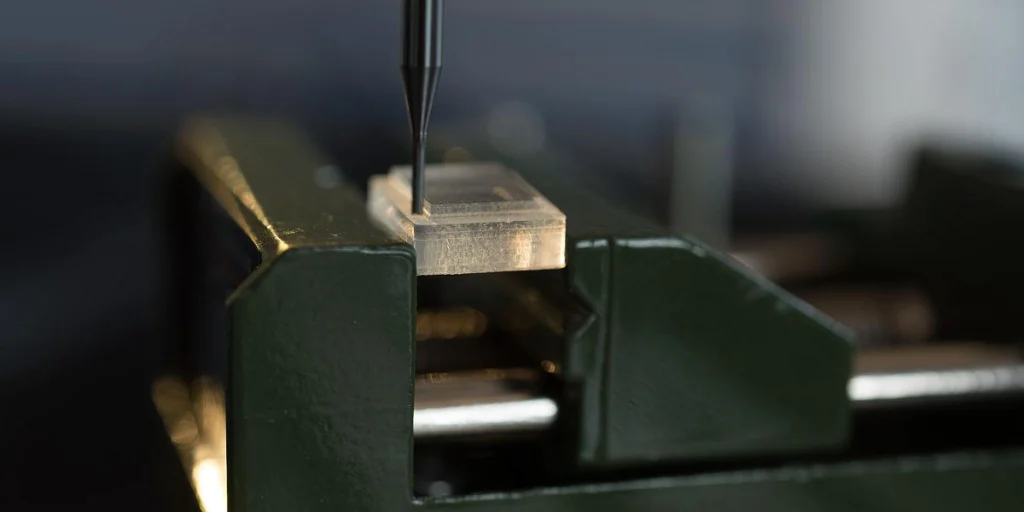
What is a three-axis CNC machine tool?
A three-axis CNC machine tool is a CNC machine tool in which the tool or workpiece moves along three mutually perpendicular linear axes. These three axes are usually called the X-axis, Y-axis, and Z-axis, and are the most basic and common axial structure in CNC machining.
Simply put, a three-axis CNC machine tool can perform positional movement and cutting operations in three-dimensional space. Through program control, the tool follows a set path to precisely machine the workpiece. Because of its clear structure and intuitive control logic, three-axis CNC is widely used in the manufacturing of various conventional parts.
The basic meaning of the three axes of motion
In a three-axis CNC machine tool, each axis is responsible for linear motion in one direction:
- X-axis: Typically the horizontal movement, used to control the lateral position of the tool or workpiece.
- Y-axis: Generally represents horizontal forward and backward movement, perpendicular to the X-axis, used to control vertical position.
- Z-axis: Vertical movement, mainly used to control the cutting depth or machining height of the tool.
These three axes work together to enable the cutting tool to be positioned, moved and cut on the workpiece surface, thereby completing machining operations such as milling, drilling and grooving.
Basic working mode of three-axis CNC
In actual machining, a three-axis CNC machine tool reads the machining program through a numerical control system (CNC) and converts the instructions in the program into motion signals for each axis. Servo motors or stepper motors drive the lead screw and guide rails, enabling the tool to move precisely in the X, Y, and Z directions according to the set coordinate path.
It is important to note that in three-axis CNC machine tools:
- Only linear motion is involved in the processing.
- The workpiece is usually kept fixed.
- The cutting tool completes the machining process by moving up and down, forward and backward, and left and right.
This is also the core meaning of the name “tri-axis”.
At this point, readers only need to remember one thing: a three-axis CNC machine tool is a CNC machining equipment based on three linear axes: X, Y, and Z. It is the most basic and widely used form of CNC machining.
Three-axis motion modes of a three-axis CNC machine tool
The machining capability of a three-axis CNC machine tool comes from the coordinated motion of its three linear axes: X, Y, and Z. Each of these three axes is responsible for position control in a different direction, and together they determine the tool’s movement path on the workpiece.
During the machining process, the cutting tool does not move arbitrarily, but moves precisely and repeatably on three axes according to the coordinate positions set by the program.
X-axis: Horizontal movement in the left and right direction
The X-axis typically controls the left and right movement of the tool in the horizontal direction, used to determine the lateral position of the machining range.
In actual machining, the X-axis is mainly responsible for:
- Lateral positioning in straight-line cutting and contour machining
- Works in conjunction with the Y-axis to complete planar contour and two-dimensional path machining.
This can be understood as the X-axis determining the position of the tool “left or right”.
Y-axis: Horizontal movement in the forward/backward direction
The Y-axis is perpendicular to the X-axis and controls the forward and backward movement of the tool in the horizontal direction.
Its main function is reflected in:
- Determine the longitudinal position of the workpiece in the horizontal plane.
- Together with the X-axis, it determines the length and width of the machined graphic.
- Path control for plane machining, groove machining, and pattern engraving.
The X-axis and Y-axis, when combined, form the basis of planar motion in three-axis CNC machining.
Z-axis: Vertical movement in the up-down direction
The Z-axis is responsible for the up-and-down movement of the tool and is the key axis for controlling the depth of cut.
During the machining process, the Z-axis is mainly used for:
- Control the tool’s entry and exit from the workpiece
- Determine the depth of each cut
- Enables layered machining and 3D contour forming by coordinating with the X and Y axes.
It can be said that without the Z-axis, true three-dimensional machining is impossible.
The core characteristics of triaxial coordinated motion
In three-axis CNC machine tools:
- All three axes perform linear motion only.
- The workpiece is usually kept fixed.
- The cutting tool completes machining by moving in combination along the X, Y, and Z axes.
It is precisely this clear structure and intuitive motion logic that makes three-axis CNC the most basic and easiest type of CNC machine tool to understand.
Advantages of three-axis CNC machine tools
The reason why three-axis CNC machine tools are widely used in manufacturing is not because they are the most complex in function, but because they achieve a good balance between cost, operation, and stability. For a large number of routine machining needs, three-axis CNC is often the most practical choice.
Relatively low cost
Compared to multi-axis CNC machine tools, three-axis CNC machines have a simpler structure, lacking complex rotary axes and linkage mechanisms. Therefore:
- Lower equipment purchase costs
- Operating and maintenance costs are more controllable
For companies with limited budgets or production scenarios that mainly involve machining conventional parts, three-axis CNC can effectively reduce the pressure of initial investment.
Easy to operate and learn
The operation logic of a three-axis CNC is clear, involving only linear motion in the X, Y, and Z directions:
- The programming logic is intuitive
- The debugging process is relatively simple.
- Operators can learn to use it more easily and quickly.
This makes three-axis CNC particularly suitable for workshop environments with high personnel turnover, and it can also reduce training costs.
More flexible programming and adjustments
In actual production, the machining procedure for three-axis CNC is as follows:
- Low writing difficulty
- Fast modification and adjustment speed
- Suitable for processing multiple varieties in small batches.
When the structure of a part changes, the switch can often be completed by simply adjusting some program parameters.
Good processing stability and high consistency
Because the number of axes involved in the motion is relatively small, a three-axis CNC machine, during operation:
- Structural stability
- The sources of error are relatively controllable
- Good consistency in repeated processing
It can maintain stable machining quality over a long period of time in plane machining, hole machining, and regular contour machining.
Low maintenance and long-term use costs
The mechanical structure and control system of three-axis CNC are relatively mature.
- Low daily maintenance workload
- Common faults are easier to troubleshoot
- Lower cost of parts replacement
From a long-term usage perspective, the overall cost of ownership is low, making it suitable for continuous and stable production.
Commonly machined parts for three-axis CNC machine tools
Since three-axis CNC machine tools primarily move along the X, Y, and Z linear axes, they excel at machining parts with relatively regular structures and primarily planar and linear features. In actual production, three-axis CNC can cover a significant portion of the demand for conventional parts.
The following are some of the more common types of parts that are machined on three-axis CNC machine tools.
Plate parts
Plate-type parts are among the most typical machining targets in three-axis CNC machining, such as equipment housings, mounting bases, and cover plates. These parts typically require the following machining operations:
- Plane milling
- Outer contour processing
- Drilling and tapping
The machining focus is on flatness, hole accuracy, and dimensional consistency. Three-axis CNC is highly efficient and stable in these types of tasks.
Box-type parts
Box-type parts typically have multiple mounting surfaces and hole systems, such as frame components and housing parts. Three-axis CNC machine tools can be used to complete:
- Milling of each machined surface
- Machining of hole systems and mounting holes
- Rough machining of simple cavities
When the multi-faceted machining requirements are not complex, a three-axis CNC can meet most basic machining requirements.
Shaft and disc parts
For relatively simple shaft or disc-shaped parts, three-axis CNC machining can complete tasks such as face machining, keyway machining, and hole machining. These parts typically:
- Size rules
- High repeatability
- Certain requirements are placed on dimensional and positional accuracy.
Suitable for stable batch processing.
Mold base parts
In mold manufacturing, three-axis CNC is commonly used for:
- Machining of mold reference surfaces
- Parting surface milling
- Roughing or semi-finishing of simple cavities
These processes lay the foundation for subsequent processes with higher precision or more complex operations.
Simple three-dimensional parts
For 3D parts with simple surface variations and smooth transitions, three-axis CNC machining can also be performed using layered cutting. These parts are typically used for:
- Functional structural components
- Components with simple shape requirements
As can be seen from the above introduction, as long as the parts are mainly planes, straight lines and simple contours, three-axis CNC machine tools can usually handle them; however, when the parts involve complex curved surfaces or multi-angle machining, equipment with a higher number of axes needs to be considered.
Application industries of three-axis CNC machine tools
Because three-axis CNC machine tools achieve a good balance between cost, operational difficulty, and machining capabilities, they are widely used in manufacturing fields that require machining stability and efficiency but have relatively controllable structural complexity.
The following are some of the more common application industries for three-axis CNC machine tools.
Home appliance manufacturing industry
In home appliance manufacturing, three-axis CNC machining is commonly used to process housings, brackets, and internal structural components, such as door panels and mounting plates. These parts mainly involve planar machining and hole machining, and three-axis CNC can meet the needs of mass production while ensuring consistency.
General Machinery Manufacturing
The general machinery industry contains a large number of structurally regular parts, such as housings, supports, and transmission components. Three-axis CNC machine tools can efficiently complete planar milling, hole machining, and simple contour machining, making them a frequently used basic piece of equipment in this industry.
Mold manufacturing (basic machining stage)
In the mold manufacturing process, three-axis CNC usually undertakes the tasks of template processing, parting surface milling, and rough or semi-finishing of the cavity, providing a foundation for subsequent higher precision or more complex processing procedures.
Automotive parts manufacturing
Automobile manufacturing involves a large number of structurally standardized parts, such as housings, brackets, and mounting components. Three-axis CNC can reliably complete drilling, tapping, and planar machining, making it suitable for mass production tasks with high repetition rates.
Electronics and electrical appliance industry
Electronic and electrical products have certain requirements for dimensional consistency and assembly precision. Three-axis CNC machining is commonly used to process housings, mounting brackets, and functional structural components, meeting the basic machining needs for lightweight and precision assembly.
Home furnishing and building materials related industries
In fields such as doors and windows, furniture, and bathroom fixtures, three-axis CNC can be used to process profiles and structural components, enabling grooving, drilling, and contour machining, thereby improving production efficiency and product consistency.
Summarize
Three-axis CNC machine tools, based on the X, Y, and Z linear axes, have a clear structure and intuitive operation, making them the most basic and widely used form of CNC machining. They can reliably complete plane machining, hole machining, and the manufacture of relatively simple parts, achieving a good balance between cost, efficiency, and reliability.
Because of these characteristics, three-axis CNC machine tools are widely used in various general manufacturing industries and have become the preferred equipment for many companies to carry out CNC machining.