


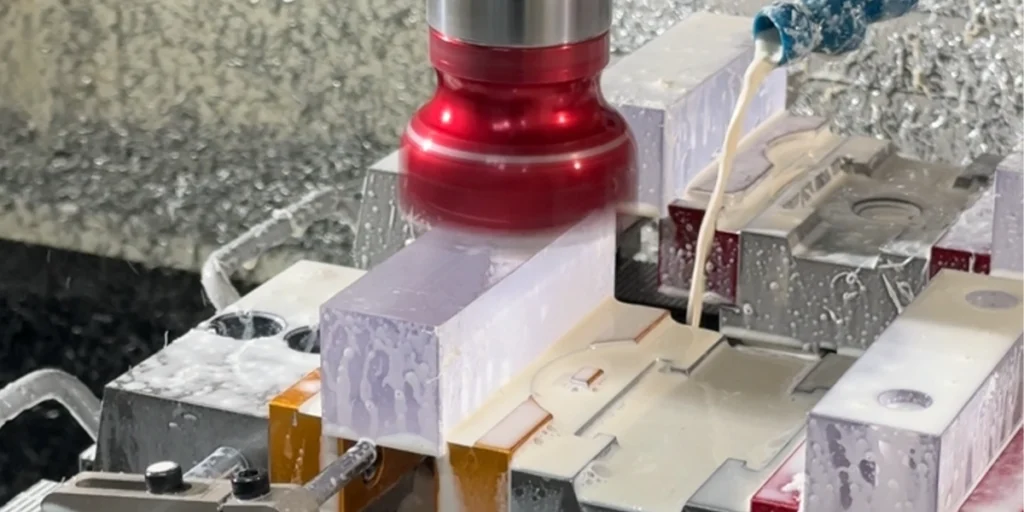
What is a four-axis CNC machine tool?
A four-axis CNC machine tool is a CNC machining device that adds a rotary motion axis to the traditional three-axis CNC machine tool.
This means that, in addition to the three common linear motion directions of X, Y, and Z, machine tools can also make the workpiece or fixture rotate around a certain axis during the machining process.
In short:
- Three-axis CNC = the cutting tool can only move in straight lines.
- Four-axis CNC = Workpiece can be machined while rotating.
This newly added rotary axis, usually referred to as the fourth axis (A-axis or B-axis), is not intended to make the machine tool “more complicated,” but rather to solve the problem of repeated clamping and flipping required in three-axis machining.
With four-axis control, the machine tool can process multiple sides or angles of a workpiece in a single clamping state, thereby:
- Reduce the number of times workpieces are manually flipped.
- Improve the consistency of multi-faceted processing
- Reduce errors caused by repeated clamping
It is important to note that four-axis CNC is not the same as five-axis CNC.
Four-axis machining typically operates around a fixed direction of rotation, emphasizing “multi-faceted machining efficiency” rather than performing complex spatial linkage machining simultaneously.
From a positioning perspective, a four-axis CNC machine tool is a type of:
- Machining capability is significantly stronger than that of a three-axis machine.
- Lower complexity and cost than five-axis
- A solution ideal for machining moderately complex parts.
It falls perfectly between three-axis and five-axis, making it a very cost-effective option for many industrial processing scenarios.
Description of the four-axis structure of a four-axis CNC machine tool
The core structure of a four-axis CNC machine tool consists of three linear motion axes (X, Y, Z) and one rotary axis (usually called the fourth axis).
The first three axes are responsible for spatial position control, and the fourth axis is responsible for rotation angle control. The four axes work together to complete more flexible machining operations.
X-axis: Linear motion in the left and right direction
The X-axis is a linear motion axis in the horizontal direction, mainly responsible for controlling the positional changes of the tool or workpiece in the left and right directions.
During the machining process, the X-axis typically bears the following responsibilities:
- Lateral feed motion
- Lateral positioning of the machining contour
- Works with the Y-axis to complete planar machining
It is one of the most basic and frequently used motion axes in all CNC machine tools.
Y-axis: Linear motion in the forward and backward direction
The Y-axis is also a horizontal linear motion axis, used to control the movement of the tool or workpiece in the forward and backward direction.
Through the coordinated movement of the X and Y axes, the machine tool can complete tasks within the same plane:
- Plane milling
- Contour processing
- Hole arrangement
In a four-axis CNC machine tool, the Y-axis has the same function as that of a three-axis machine tool, mainly responsible for positioning and movement in a two-dimensional plane.
Z-axis: Linear motion in the vertical direction
The Z-axis is a vertical linear motion axis responsible for controlling the height and depth of cut of the tool or workpiece.
Its main functions include:
- Control the depth of cut
- Enables vertical feed during drilling, milling, and other machining operations.
- Works at different heights by working with a rotary axis.
The stability of the Z-axis directly affects machining accuracy and surface quality.
Rotary axis: Enables the rotation of the workpiece or fixture.
The most critical structural difference in four-axis CNC machine tools comes from the addition of the fourth axis.
The fourth axis is usually a rotary axis, used to rotate the workpiece or fixture around a fixed axis during the machining process.
In common cases, this rotary axis is called the A-axis, but it may also rotate in different directions depending on the machine tool’s structural design.
The core function of the rotating shaft is:
- Allows the workpiece to change machining angles without reclamping.
- Supports machining of multi-sided, beveled, or angular features.
- Improve the consistency and stability of multi-faceted processing
It is important to note that in four-axis CNC machine tools, the rotary axes are usually controlled in a single direction, with the focus on auxiliary positioning and multi-faceted machining rather than complex spatial linkages.
Differences between four-axis CNC machine tools and three-axis machine tools
Four-axis CNC machine tools are not a complete replacement for three-axis machine tools, but rather an effective supplement to the machining capabilities of three-axis machine tools under specific machining requirements. There are significant differences between the two in terms of structure, machining methods, and operating costs.
The motion mode and the degree of freedom of processing are different
Three-axis CNC machine tools only have three linear motion axes: X, Y, and Z. The cutting tool can only move in three mutually perpendicular directions, and the machining process is mainly based on planes and simple contours.
A four-axis CNC machine tool adds a rotary axis to this design.
This change allows the workpiece or fixture to change angles during machining, giving the machine tool greater machining freedom.
Simply put:
- Three-axis: positional changes
- Quad-axis: Position change + Angle change
Different processing capabilities and applicable parts
Three-axis CNC machine tools are more suitable for:
- Flat-shaped parts
- Simple outline parts
- Structure that does not require multi-angle machining
When a part involves multiple sides, inclined surfaces, or needs to be machined around a certain axis, three-axis machining often requires multiple clamping or manual flipping to complete the process.
Four-axis CNC machine tools can complete the machining of more surfaces in a single setup, making them particularly suitable for:
- Parts symmetrical about a single axis of rotation
- Multi-sided structural parts
- Processing tasks that require maintaining positional consistency
Differences in machining accuracy and stability
In machining processes that require multiple clamping operations, three-axis machine tools are more prone to cumulative errors, placing higher demands on precision control.
Four-axis CNC machine tools reduce the number of clamping operations, making the machining process more continuous, which helps to:
- Improve the consistency of multi-faceted processing
- Reduce the impact of clamping errors
- Improve overall processing stability
Programming and operation have different complexities.
The programming logic of three-axis CNC machine tools is relatively intuitive, mainly revolving around linear interpolation and basic machining paths, making it easy to learn.
When programming a four-axis CNC machine tool, the angles and mating relationships of the rotary axes need to be considered in addition to the programming, which requires a higher level of technical understanding and experience from the operator, but it is not an uncontrollable level of complexity.
Different costs and different barriers to entry
From an investment perspective:
- Three-axis CNC machine tools have a simple structure and lower equipment and maintenance costs.
- Four-axis CNC machine tools have higher equipment costs and maintenance requirements due to the addition of rotary axes and related mechanisms.
Therefore, three-axis machining is more suitable for simple machining and budget-constrained scenarios, while four-axis machining is more suitable for projects with clear requirements for efficiency, precision, and multi-faceted machining.
Suitable machining scenarios for four-axis CNC machine tools
Four-axis CNC machine tools are not designed for all parts. Their advantages are mainly reflected in scenarios with specific requirements for machining angles, multi-faceted features, and efficiency. The following types of machining needs are typically well-suited for use with four-axis CNC machine tools.
Machining of multi-faceted feature parts
When parts need to be machined on multiple sides, the advantages of a four-axis CNC machine tool are very obvious.
With the help of the rotary axis, the machine tool can complete the machining of multiple surfaces in a single clamping state, reducing the time waste and accuracy errors caused by frequent flipping and repositioning.
This type of scenario is common in:
- Box-type parts
- Structural components
- Parts with multiple side holes or slots
Machining tasks requiring a fixed rotation direction
For parts that are machined around a single axis of rotation, four-axis CNC is a very suitable choice.
A rotary axis allows the workpiece to rotate at a set angle during machining, ensuring that the cutting tool is always in the appropriate cutting direction, effectively improving machining continuity and stability.
In this scenario, a four-axis machine can significantly improve machining efficiency without adding too much complexity.
Machining projects sensitive to the number of clamping cycles
In some machining tasks, the number of clamping operations themselves is a source of accuracy risk.
Four-axis CNC machine tools are more advantageous by reducing clamping and manual intervention:
- Maintain dimensional consistency
- Reduce cumulative error
- Improve overall processing stability
This type of requirement typically arises in the machining of parts where high consistency is required.
Efficient machining of moderately complex parts
When the structure of a part exceeds the efficient machining range of three axes, but the complex linkage capability of five axes is not required, four-axis CNC machine tools are often a more cost-effective solution.
It can meet the needs of angle and multi-faceted processing, while keeping costs and operational difficulty relatively controllable.
Stable processing requirements in mass production
In mass production scenarios, four-axis CNC machine tools can complete more processes in a single setup, thereby:
- Reduce processing time per piece
- Improve processing consistency
- Reduce overall production costs
This is especially important for parts that require long-term, stable, and repeated processing.
Summarize
Four-axis CNC machine tools represent a key upgrade from three-axis machining. By adding rotary axes, they offer greater machining flexibility and multi-faceted machining capabilities. They effectively reduce the number of setups and improve machining consistency, making them particularly suitable for the efficient machining of moderately complex parts with multiple angles or sides.
When three-axis machining is inefficient and five-axis machining is too expensive, four-axis CNC machine tools are often the ideal choice to balance performance and cost.