


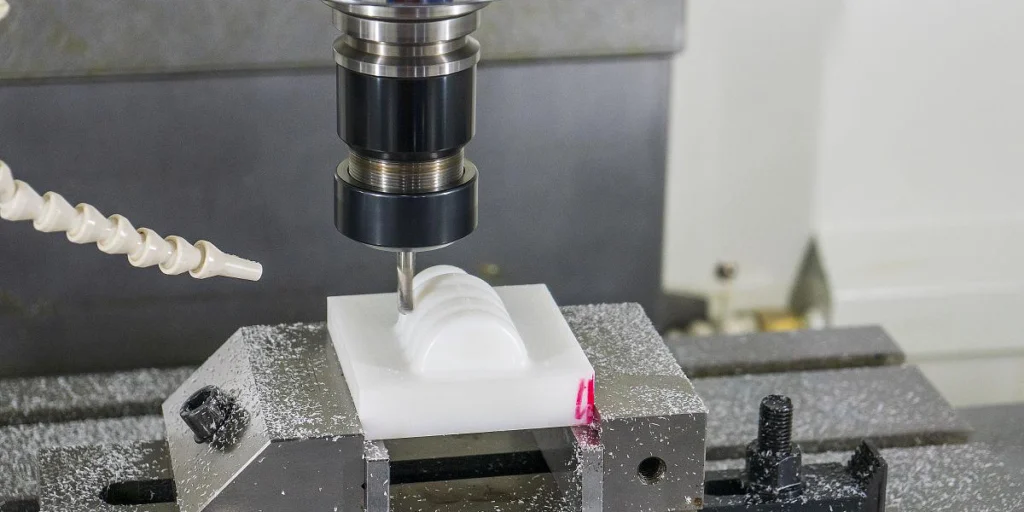
What is a five-axis CNC machine tool?
A five-axis CNC machine tool is a type of CNC machine tool with five linkage motion axes, used to process parts with complex structures, variable angles, and high precision requirements.
Based on the traditional three-axis CNC machine tool, the five-axis CNC adds two rotary axes, enabling the tool or workpiece to not only move linearly during the machining process, but also change its angle and posture in space.
What does “axis” mean in 5-axis CNC?
Five-axis CNC typically includes:
Three linear axes:
- X-axis (left and right)
- Y-axis (front and back)
- Z-axis (top and bottom)
Two axes of rotation:
- Usually any two of the A, B, and C axes.
- Used to control the rotation angle of the tool or workpiece
These five axes can move simultaneously and in coordination under the control of the CNC system, which is the origin of the name “five-axis linkage”.
Core features of five-axis CNC
The essential difference between a five-axis CNC machine tool and a three-axis CNC machine tool lies not in having “more axes,” but in:
- The cutting tool can approach the workpiece from multiple angles.
- The cutting direction can be dynamically adjusted during the machining process.
- Capable of performing machining postures that are difficult or impossible to achieve with three-axis machine tools.
Simply put, a five-axis CNC machine is a device designed to solve machining problems involving complex geometries.
If three-axis CNC is more suitable for “regular, planar, and linear structures”, then five-axis CNC is specifically used for machining parts with “many curved surfaces, complex angles, and complex structures”.
The working mode of a five-axis CNC machine tool
The core of a five-axis CNC machine tool lies in how the five axes move in coordination. Depending on how the rotary axes participate in the machining process, the working mode of a five-axis CNC can generally be divided into two types.
Five-axis linkage machining (synchronous motion mode)
In five-axis linkage machining, all five axes participate in the movement simultaneously:
- The X, Y, and Z linear axes are responsible for the spatial position of the tool.
- Two rotary axes are used to adjust the angle of the tool or workpiece.
During the machining process, the position and angle of the cutting tool are continuously changed, ensuring that it always contacts the workpiece surface in a suitable posture.
This working method is often used in:
- Parts with continuously changing curved surfaces
- Complex structures with multiple angles and directions
- Scenarios where multi-faceted machining needs to be completed in a single setup.
The essence of five-axis linkage is to allow the tool to “walk, rotate, and cut simultaneously” during the machining process, thereby completing spatial cutting paths that are difficult to achieve with three-axis machine tools.
Five-axis orientation machining (indexing/positioning method)
In five-axis orientation machining, the main function of the rotary axis is positioning:
- First, adjust the tool or workpiece to the specified angle using the rotating axis.
- Then the cutting is completed by the three linear axes X, Y, and Z.
- During the cutting process, the rotating shaft remains fixed and does not participate in the linkage motion.
When it is necessary to process areas at different angles, the rotation axis angle is readjusted and the processing process is repeated.
The characteristics of this method are:
- Machining logic is close to that of three-axis CNC.
- Low requirements for surface variations
- The operation and programming are relatively intuitive.
Implementation methods of machine tools with different structures
Five-axis CNC machine tools with different structural forms, for example:
- Double-swing head type
- Dual-turntable
- One swing and one turn
While there may be some differences in how five-axis operation is implemented, the core objective remains the same: to allow the tool or workpiece to gain more degrees of freedom in space through the cooperation of linear and rotary axes, thereby completing the machining of complex parts.
Advantages of 5-axis CNC machine tools
The core advantage of five-axis CNC machine tools lies in the flexibility of their machining posture, and the resulting improvements in precision, efficiency, and stability. These advantages are not derived from the “more axes” themselves, but rather from the five-axis simultaneous machining method.
Always maintain the appropriate cutting angle
During the machining process, the five-axis CNC machine tool can adjust the tool’s posture in real time through the rotary axis, so that the tool always contacts the workpiece surface at a more suitable angle.
This ability is used in processing:
- Irregular curved surfaces
- Inclined surface
- Space curve structure
Timing is particularly important, as it can effectively avoid problems such as decreased cutting efficiency or unstable surface quality caused by an unsatisfactory cutting angle.
Reduce tool interference and improve machining stability
When faced with parts with complex structures and limited space, five-axis CNC machine tools can flexibly avoid interference areas by adjusting the angle of the tool or workpiece.
This allows for the following during the processing:
- Use shorter, more rigid cutting tools
- Reduce tool vibration and risk of tool breakage
- Improve the stability and controllability of the overall processing.
Multi-face machining completed in one clamping
Five-axis CNC machine tools can complete the machining of multiple surfaces and angles in a single setup, reducing the need for repeated disassembly and repositioning.
The direct result of this is:
- Clamping error is significantly reduced
- Higher consistency in machining accuracy
- The production process is more seamless
Improve overall processing efficiency
Through five-axis linkage machining, the cutting tool can adopt a more reasonable cutting path and cutting method, reducing unnecessary step-by-step machining and intermediate processes.
Especially in machining complex structures, five-axis CNC can often:
- Shorten the processing cycle of individual parts
- Reduce subsequent trimming or rework steps
- Improve overall production pace
Improve the quality of machined surfaces
Five-axis CNC machine tools can avoid the tool being in an unfavorable cutting state during machining, which helps to:
- Reduce surface ripples and tool marks
- Improve surface uniformity
- Reduce the need for subsequent finishing or polishing
Five-axis CNC machine tools are suitable for machining complex parts.
Five-axis CNC machine tools are not designed to replace three-axis machining, but are specifically designed to solve the machining problems of parts with complex structures, variable angles, and limited machining postures. Parts with the following characteristics are generally more suitable for machining using five-axis CNC.
Complex curved surface parts
When the surface of a part contains continuously changing spatial curved surfaces, cutting in a single direction often makes it difficult to guarantee accuracy and surface quality.
Five-axis CNC machine tools can adjust the tool angle to ensure the tool always stays in contact with the curved surface during cutting, making them suitable for machining:
- Continuous freeform surface parts
- Outer contour with a slanted or twisted shape
- Molded structures with high requirements for surface consistency
Irregularly shaped parts with multiple angles and features
Some parts exist simultaneously on the same workpiece:
- Holes in different directions
- Multiple inclined surfaces or inclined holes
- Asymmetric structural features
Using a five-axis CNC machine, multi-angle machining can be completed in a single setup, avoiding the accumulation of errors caused by multiple flipping and positioning, making it more suitable for irregularly shaped parts with complex overall structures.
Deep cavity and space-constrained structural parts
For parts with deep cavities, concave or enclosed areas, traditional three-axis machining often requires the use of long cutting tools, which can easily cause vibration and accuracy problems.
Five-axis CNC machine tools can enter the machining area with tilting tools, and complete cutting with shorter, more stable tools, making them suitable for machining:
- Deep cavity structural components
- Components with limited internal space
- Multi-layered inner contour structure
Polyhedral and high-precision assembly parts
When parts need to maintain high positional accuracy and fit on multiple surfaces, multiple clamping can easily affect overall consistency.
Five-axis CNC machine tools can complete multi-face machining in a single setup, and are suitable for:
- Multi-planar precision parts
- Structural components that require strict relative positional accuracy
- Functional parts requiring high assembly precision
High-precision, small-batch or customized parts
In small-batch or customized processing scenarios, parts are often complex in structure and require high precision, and it is not suitable to design complex tooling for a single part.
Five-axis CNC machine tools offer high machining flexibility, enabling the machining of complex structures with minimal tooling intervention, making them more suitable for the production needs of high-precision, small-batch parts.
Typical application industries of five-axis CNC machine tools
Because of its significant advantages in machining complex structures, high precision, and multi-angle machining, five-axis CNC machine tools are typically used in manufacturing fields with high requirements for machining quality and consistency, especially in the following industries.
Aerospace industry
Aerospace components are generally characterized by complex structures, high material strength, and extremely stringent precision requirements, while also emphasizing lightweight design.
Five-axis CNC machine tools can complete multi-angle and complex surface machining in a single setup, effectively reducing error accumulation, and are therefore widely used in:
- Aircraft structural component machining
- Manufacturing of key components for aero engines
The automotive manufacturing industry (especially in the new energy sector)
As automobiles become increasingly lightweight and structurally integrated, the shapes of parts are becoming more complex, placing higher demands on processing consistency and efficiency.
Five-axis CNC machine tools have significant advantages in machining complex shells, curved surfaces, and parts with multiple holes, and are commonly used for:
- Key structural components for new energy vehicles
- High-precision power system related parts
Mold manufacturing industry
Mold processing typically involves a large number of complex cavities, curved surfaces, and transition fillets, requiring extremely high surface quality and overall precision.
Five-axis CNC machine tools can reduce disassembly and repetitive positioning, improving mold consistency and forming accuracy. Therefore, in:
- Automotive body panel molds
- It is widely used in injection molds and die casting molds.
Medical device industry
Medical device parts are mostly high-precision, small-sized, and intricately structured components, requiring extremely high processing stability and surface quality.
Five-axis CNC machine tools can flexibly adjust machining angles and are suitable for:
- Implantable medical devices
- Structural components for precision medical devices
Shipbuilding and heavy equipment manufacturing sector
Ship and large equipment parts are typically large in size and complex in structure, and require high machining accuracy in multiple directions.
Five-axis CNC machine tools have significant advantages in machining large curved surfaces and multi-angle structural parts, and are commonly used for:
- Components related to marine propulsion systems
- Fabrication of large structures and load-bearing components
Rail transit and high-end equipment manufacturing
In the fields of rail transit and high-end equipment, parts often possess characteristics such as high strength, lightweight, and complex structure.
Five-axis CNC machine tools can improve machining efficiency while ensuring accuracy, and are suitable for:
- Key structural components for rail transit
- Core components of high-end equipment
Military industry and high-reliability manufacturing fields
Military products emphasize structural reliability, processing consistency, and long-term stability, requiring extremely high controllability in the manufacturing process.
Five-axis CNC machine tools are often used for:
- High-reliability structural components
- Processing of complex composite materials and special structures
Summarize
The core value of five-axis CNC machining lies not in “more axes,” but in the significant improvement in machining freedom and overall efficiency. Through multi-axis linkage, five-axis machine tools can complete the machining of complex structures and multiple angles in a single setup, which is significantly better than traditional three-axis machining methods in terms of accuracy, surface quality, and production efficiency.
Because of their ability to process complex curved surfaces, reduce clamping errors, and meet high-precision requirements, five-axis CNC machine tools have become essential equipment in high-end manufacturing fields such as aerospace, automotive manufacturing, mold making, and medical devices. For companies that need to process complex parts and pursue stable quality, five-axis CNC machining is gradually transforming from a “high-end choice” into a “necessary capability.”