


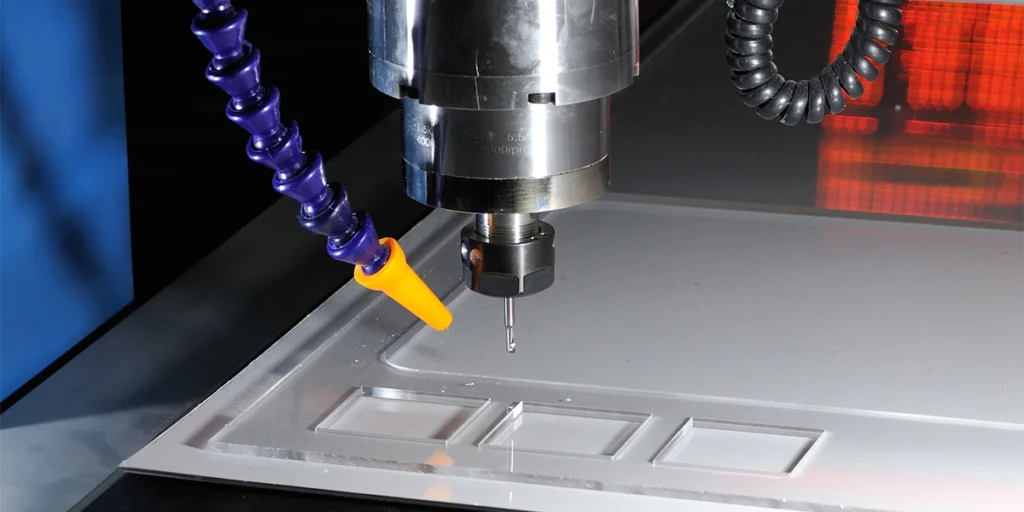
What is CNC precision machining?
CNC precision machining refers to a manufacturing method that uses a computer numerical control (CNC) system to perform high-precision dimensional and structural machining on parts, aiming for high stability and consistency. Its focus is not just on “being able to machine,” but also on whether it is accurate enough, stable enough, and able to maintain consistency over a long period.
To achieve this core objective, CNC precision machining is mainly reflected in the following aspects:
1. Precision control based on computer numerical control
CNC (Computer Numerical Control) transforms design drawings into executable numerical control programs, enabling the system to precisely control the machine tool’s motion trajectory, feed rate, and cutting process, reducing errors caused by human intervention and providing a fundamental guarantee for high-precision machining.
2. With “stable accuracy” as the core objective
Compared to conventional CNC machining, precision machining places greater emphasis on the stability and repeatability of the machining results. Whether for single-piece or batch production, parts must maintain a high degree of consistency in size, shape, and assembly fit.
3. Suitable for manufacturing high-requirement parts.
CNC precision machining is typically used for parts with complex structures, strict tolerance requirements, and high precision requirements for subsequent assembly, such as precision mechanical components, functional structural parts, and critical assembly parts.
4. Throughout the entire process of design, manufacturing, and testing.
From initial design and programming to machining process control, and then to post-machining inspection and correction, precision machining is a systematic manufacturing process, not just a single cutting action.
In short, CNC precision machining is a machining method based on numerical control technology and aimed at stable and high precision. It is an indispensable and important process in high-end manufacturing.
Definition of CNC precision machining
In the manufacturing industry, CNC precision machining is generally understood as:
Under the control of a computer numerical control (CNC) system, a machining method is used to achieve strict dimensional, tolerance, and structural requirements for parts through a stable and repeatable machining process. It emphasizes the controllability of the machining result, rather than just the machining capability itself.
From an industry perspective, CNC precision machining typically possesses the following defining characteristics:
1. With program control as the core
The machining process is entirely controlled by CNC programs to control the machine tool’s movement and machining parameters, ensuring that every cutting action is executed according to predetermined logic, thus reducing the impact of human factors on the results.
2. Tolerance control-oriented
Precision machining is not simply about pursuing “more complexity,” but rather about processing parts around their dimensions, tolerances, and fit relationships to ensure that the parts can meet design and assembly requirements.
3. Emphasize the repeatability of the processing procedure.
Under the same conditions, multiple machining operations should yield consistent results. This is one of the important standards that distinguishes CNC precision machining from ordinary machining.
4. Suitable for parts with high structural and functional requirements.
It is typically used for parts with specific requirements for stability, assembly precision, or functional performance, rather than general structural parts or rough-machined parts.
In summary, CNC precision machining is a machining definition based on numerical control technology and with tolerance and consistency as the core standards. It represents a higher level of requirements for the “reliability” and “controllability” of machining.
CNC precision machining accuracy level description
In CNC precision machining, “accuracy grade” is not a single numerical value, but a comprehensive judgment based on multiple dimensions such as tolerances, machine tool capabilities, and the stability of machining results. For ease of understanding, the industry typically explains it from the following aspects.
1. Understanding precision level by tolerance grade
Accuracy grades are often based on internationally accepted tolerance systems (such as IT tolerance grades), with smaller values indicating higher accuracy.
This can generally be understood as:
- High precision grade: Used for parts with extremely high requirements for dimensions and fit.
- Medium precision class: suitable for most functionalities and assemblies.
- Standard accuracy grade: Used for structural components or parts with low precision requirements.
This classification method is mainly used to determine whether a part falls under the “precision machining category”.
2. Classification by machine tool accuracy capability
There are significant differences in positioning accuracy and repeatability among CNC machine tools of different grades.
From the perspective of processing capacity, it can generally be divided into:
- General-purpose machine tools: meet routine machining needs
- Precision machine tools: Used for parts requiring dimensional consistency and stability.
- High-precision machine tools: designed for machining precision parts with high requirements and standards.
The grade of the machine tool directly determines the upper limit of the achievable precision.
3. Classified according to actual processing results
In actual production, the level of precision is ultimately reflected in the processing results, mainly including:
- Are the dimensions consistently within the design tolerance range?
- Consistency among multiple products
- Does it meet the requirements for subsequent assembly or functionality?
This is also the most intuitive standard for judging whether it belongs to CNC precision machining.
In general, the precision level of CNC precision machining is not isolated, but is determined by design requirements, equipment capabilities, and machining control level. In practical applications, the appropriate precision level should be selected based on the function of the part and the usage scenario.
Industries applicable to CNC precision machining
CNC precision machining is mainly used in industries with high requirements for dimensions, tolerances, and assembly. These industries share the characteristic that any deviation in parts can directly affect performance, safety, or service life.
The following are typical applicable industries:
1. Aerospace industry
Used for processing critical components with complex structures and extremely high precision requirements, ensuring that the parts work stably under high strength and high reliability conditions.
2. Medical Device Industry
Suitable for medical components and device parts with strict requirements for size matching, biosafety and manufacturing consistency.
3. Automobile and high-end equipment manufacturing
Used for machining engines, transmission systems, and functional structural components to ensure the consistency of precision and assembly reliability of parts in mass production.
4. Electronics and Precision Equipment Industry
It is often used to process small-sized, finely structured parts, which have high requirements for dimensional accuracy and surface quality.
5. Mold manufacturing industry
It is used for machining mold cavities and key structures, and directly affects the dimensional accuracy and surface quality of the final product.
6. Automation and Industrial Equipment
It is suitable for processing functional parts that require high precision in fit and high stability in operation, ensuring long-term stable operation of the equipment.
Overall, as long as the industry has clear requirements for the precision, stability, consistency, or assembly reliability of parts, CNC precision machining is usually an indispensable machining method.
Advantages of CNC Precision Machining
The advantages of CNC precision machining do not lie in “faster processing” or “lower cost” itself, but rather in the controllability and stability of the machining results. In the manufacturing of high-requirement parts, its advantages are mainly reflected in the following aspects:
1. High and stable machining accuracy
CNC precision machining can maintain stable dimensional and positional accuracy over a long period of time, reduce part deviations, and ensure that the machining results meet design requirements, rather than relying on operational experience for correction.
2. Strong product consistency
By using standardized processing procedures and process parameters, a high degree of consistency can be achieved for batches of parts, reducing assembly difficulty and minimizing rework and quality risks caused by dimensional fluctuations.
3. Suitable for complex and demanding parts
For parts with complex structures, many details, and strict tolerances, CNC precision machining can complete the machining within a controllable range to meet functional and assembly requirements.
4. The processing is predictable and manageable.
The processing is highly standardized, with clear parameters and repeatable results, which is beneficial for quality control and production management, and improves overall manufacturing reliability.
5. Reduce overall manufacturing risks
Consistent processing quality can reduce rework, scrap, and subsequent assembly issues, thereby improving overall production efficiency, not just the speed of individual processing runs.
Overall, the advantages of CNC precision machining lie in its reliability, stability, and repeatability. It is a rational choice for high-precision parts and high-quality manufacturing needs, rather than a solution that simply pursues machining efficiency.
At last
CNC precision machining is a machining method based on numerical control technology, with stable accuracy and consistency as its core objectives. It not only focuses on whether parts can be machined, but also emphasizes the reliability of dimensions, tolerances, and assembly results. Due to its high precision, repeatability, and controllability, CNC precision machining has become an indispensable key process in industries such as aerospace, medical, electronics, and high-end equipment manufacturing.