


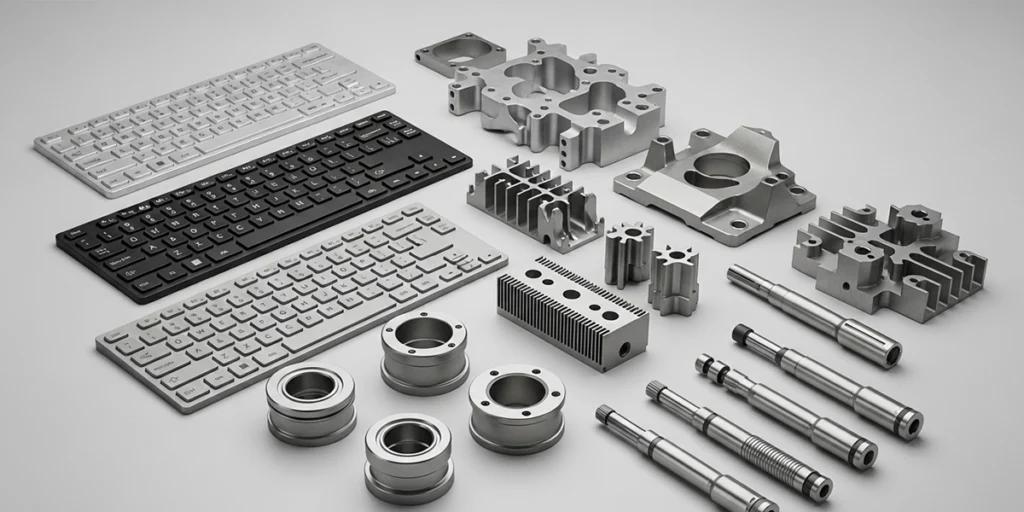
Types of metals that CNC machine tools can process
CNC machine tools have a wide range of applications in metal processing, and different metals vary significantly in hardness, machinability, and application scenarios. Commonly machinable metal types can generally be categorized as follows:
1. Ferrous metals
This type of metal is most commonly used in mechanical manufacturing, has mature processing experience, and is suitable for various CNC processes.
- Carbon steel: such as Q235 and 45 steel, has a balance of strength and machinability, and is often used in structural parts and general mechanical parts.
- Alloy steels, such as 40Cr and 42CrMo, are superior in strength and wear resistance, making them suitable for parts with high load-bearing requirements.
- Stainless steel: such as 304 and 316, has good corrosion resistance and is widely used in the food, medical and chemical industries.
- Cast iron: including gray cast iron and ductile cast iron, has good vibration damping properties and is often used for machine tool and equipment parts.
2. Non-ferrous metals
Non-ferrous metals are typically lightweight and have good thermal conductivity, making them very common in precision machining.
- Aluminum alloy: Lightweight and easy to process, suitable for most CNC machine tools, and one of the most common materials in CNC machining.
- Copper alloys, such as brass and bronze, have good electrical conductivity and wear resistance, and are often used in electrical parts and precision components.
- Titanium alloys: High strength and corrosion resistance, but difficult to process, and are often used in aerospace and medical fields.
- Magnesium alloys: low density, suitable for parts with high requirements for lightweighting.
3. Special Purpose Metals
These types of materials typically require high equipment performance and process control.
- High-temperature alloys: mainly used in key components under high temperature and high load environments.
- Hard alloys: Extremely high hardness and wear resistance, mostly used for mold or wear-resistant parts processing.
- Precious metals: such as gold and silver, are commonly used in the processing of electronic or precision parts.
In general, most commonly used metals can be processed by CNC machine tools. The key is to select the appropriate machine tool configuration and processing method according to the material characteristics, which lays the foundation for subsequent process and quality control.
How to process metal using CNC machine tools
Machining metal using CNC machine tools is essentially a process from “clearly defining the requirements” to “stable execution.” The key is not complex operations, but a clear process and proper execution of each step. It can generally be carried out in the following steps:
1. Define processing requirements
Before machining, confirm the basic information of the part, including the type of metal material, dimensional requirements, precision grade, and whether there are any special surface requirements. The key to this step is knowing what kind of part is being made, thus avoiding repeated modifications later.
2. Select a suitable CNC machine tool
Based on the part’s structure and machining method, determine whether to use a CNC lathe, CNC milling machine, or machining center, and confirm whether the machine tool’s stroke, power, and accuracy meet the metal processing requirements.
3. Prepare and clamp the workpiece.
Secure the metal raw material to a suitable fixture, ensuring a firm and stable clamping position. The reliability of the clamping directly affects the safety and dimensional consistency of the machining process.
4. Install the cutting tools and complete the tool setting.
Install the appropriate cutting tools according to the machining requirements, complete the tool setting operation, and establish the correct machining reference. The goal of this step is to enable the machine tool to accurately determine the positional relationship between the cutting tools and the workpiece.
5. Prepare and check the processing procedures.
The CNC machining program is prepared based on the part structure. Before the actual machining, it is checked or run dry to confirm that there are no obvious problems with the tool path and machining sequence.
6. Start processing and observe the operating status.
After entering automatic machining mode, focus on whether the machine tool is running smoothly and whether the cutting is normal, to ensure that the entire machining process is completed under controllable conditions.
7. After processing, inspect the parts.
After processing, the workpiece is removed and its basic dimensions and appearance are checked to confirm that the part meets the expected requirements before proceeding to the next process or subsequent processing.
This process is applicable to most common metal CNC machining scenarios, with the focus on standardized operation and reducing errors, laying the foundation for subsequent precision control and quality stability.
Metalworking process of CNC machine tools
In CNC machine tools, metal processing typically follows a standardized, repeatable process. The goal of this process is to ensure processing efficiency, dimensional consistency, and stable quality, and it can generally be divided into the following stages:
1. Confirmation of processing requirements
Before formal machining, it is necessary to clarify the type of metal material, the structure of the part, the dimensional range, and the precision requirements. This step determines the type of machine tool, the machining method, and the complexity of the process.
2. Process planning
Develop a machining plan based on the characteristics of the parts, including the machining sequence, the division between roughing and finishing, and whether multiple clamping or multi-face machining is required, so as to make overall arrangements for the actual machining.
3. CNC programming and path planning
The CNC program is generated based on the process plan, and the tool path, machining sequence and basic cutting parameters are determined to ensure that the machine tool can complete metal cutting in the expected way.
4. Trial operation and process confirmation
Before formal processing, conduct program checks or trial runs to verify whether the processing path is reasonable and to avoid interference, collisions or obvious processing risks.
5. Formal processing execution
After the process is confirmed to be correct, the formal processing stage begins. The machine tool completes metal cutting according to the established program, with a focus on ensuring the stability of the processing.
6. Processing Completion and Result Confirmation
After processing is completed, a basic inspection is carried out on the parts to confirm whether the dimensions and appearance meet the expectations before proceeding to the subsequent processing or assembly stage.
This process is applicable to most CNC metal processing scenarios. The key is that the process is clear and the steps are controllable, providing a stable foundation for subsequent precision control and quality optimization.
Common precautions for CNC machine tool metal processing
When performing metal processing using CNC machine tools, even with the correct workflow, improper handling of details can easily affect the processing results. Here are some of the most common and noteworthy points to consider in actual processing:
1. Determining the properties of metallic materials
Different metals vary significantly in hardness, toughness, and thermal conductivity. Before processing, it is necessary to have a basic understanding of the material properties and avoid using the same processing method to treat all metals.
2. Tool and material matching
The material and structure of the cutting tool must be matched with the type of metal. An unsuitable cutting tool can easily cause accelerated wear, unstable cutting, and even affect the quality of the parts.
3. Cutting parameter control
Cutting speed, feed rate, and depth of cut need to be kept within a reasonable range. Setting the parameters too high or too low may lead to a decrease in machining efficiency or unstable accuracy.
4. Heat and deformation during processing
Heat is generated during metal processing. If not properly controlled, it may cause workpiece deformation or dimensional deviation. Therefore, attention needs to be paid to cooling and processing rhythm.
5. Clamping stability and repeatability
Insecure clamping or inconsistent positioning can easily cause dimensional deviations, especially during multiple clamping or batch processing.
6. Continuous observation of the processing status
During the machining process, attention should be paid to the cutting sound, the condition of the chips, and whether the machine tool is running smoothly. Any abnormalities should be detected and adjusted in a timely manner.
These precautions are not complicated, but they often determine whether the processing is stable and the finished product is reliable. They are fundamental aspects that cannot be ignored in CNC machine tool metal processing.
Application Cases of CNC Machine Tool Machining of Metal
CNC machine tools are widely used in metal processing, covering multiple industries and part types. The following are some key application scenarios to help readers intuitively understand the practical value of CNC machining:
1. Automobile manufacturing
- Engine components: such as cylinder block, cylinder head, crankshaft, connecting rod, etc., high-precision complex parts machining.
- Gearbox housing: Milling, drilling, boring and other processes to ensure dimensional and surface quality.
- Body structural components: Large parts such as the frame, longitudinal beams, and crossbeams require large-stroke, high-precision CNC machining.
- New energy vehicle components, such as battery trays and motor housings, have high requirements for material consistency.
2. Aerospace
- Fuselage and wings: Aluminum alloy or titanium alloy plates are cut and milled, requiring high precision and stability.
- Engine blades: The complex curved surfaces of titanium alloys and nickel-based high-temperature alloys are mostly machined using five-axis CNC.
- Landing gear and fasteners: high-precision, high-strength parts, requiring strict control over machine tool rigidity and thermal stability during machining.
3. Shipbuilding
- Hull structural components: cutting and milling of large components such as hull plates, ribs, and keels.
- Marine power system components: precision machining of key components such as diesel engine block, crankshaft, and propeller.
- Outfitting components: Batch and efficient processing of metal parts such as cabin structures and pipe supports.
4. Mold manufacturing
- Injection molds: Precision machining of cavities and cores ensures complex curved surfaces and high dimensional accuracy.
- Stamping dies: Machining of the cutting edges of punches and dies to ensure die life.
- Die casting molds: Cavity polishing and finishing to improve mold quality.
5. Construction Machinery
- Large structural components: such as excavator booms, sticks, and frames, undergo rough and fine machining.
- Hydraulic components: hydraulic cylinders, valve bodies, requiring high precision and surface quality.
- Transmission components: gears, sprockets, drive shafts, ensuring precision and transmission performance.
6. Power equipment manufacturing
- Generator parts: rotor and stator milling and drilling.
- Transformer components: core, winding support, high-precision machining.
- Power transmission equipment parts: insulator supports, surge arrester housings, suitable for mass production.
7. Rail Transit
- Vehicle body structural components: frame, roof panel, side wall panels, ensuring dimensional accuracy and surface quality.
- Bogie components: wheelsets, axle boxes, brake discs, high-precision machining ensures reliability.
- Interior trim parts: High-efficiency machining of metal parts such as seat brackets and armrests.
8. Medical devices
- Surgical instruments: forceps, scissors, clamps, requiring high precision and surface quality.
- Implantable devices: titanium alloy bone scaffolds and dental implants, manufactured with high precision and high cleanliness.
- Medical equipment parts: metal structural components and transmission parts for equipment such as CT and MRI.
9. Electronic and electrical appliances
- Mobile phone frame: Aluminum alloy or stainless steel, precision milled, drilled, and tapped.
- Heat sinks: CPU and power supply heat sinks require precision machining and high-quality appearance.
- Connectors: Ensure dimensional accuracy and contact performance, enabling mass production.
10. Metallurgical equipment manufacturing
- Rolling mill equipment parts: rolls, mill frames, guaranteed high precision and strength.
- Steelmaking equipment parts: blast furnace, converter, and electric furnace components, requiring high stability during processing.
- Metal processing equipment components: shearing machine, bending machine, and punching machine parts, ensuring efficient and precise manufacturing.
Summarize
CNC machine tools play an irreplaceable role in metal processing. By rationally selecting machine tools, cutting tools, and machining processes, high-precision and high-efficiency machining can be achieved on various metals. From material selection and operating procedures to precautions and practical applications in various industries, mastering these key points can help enterprises and machining personnel improve production efficiency, ensure machining quality, and fully realize the value of CNC machining.