


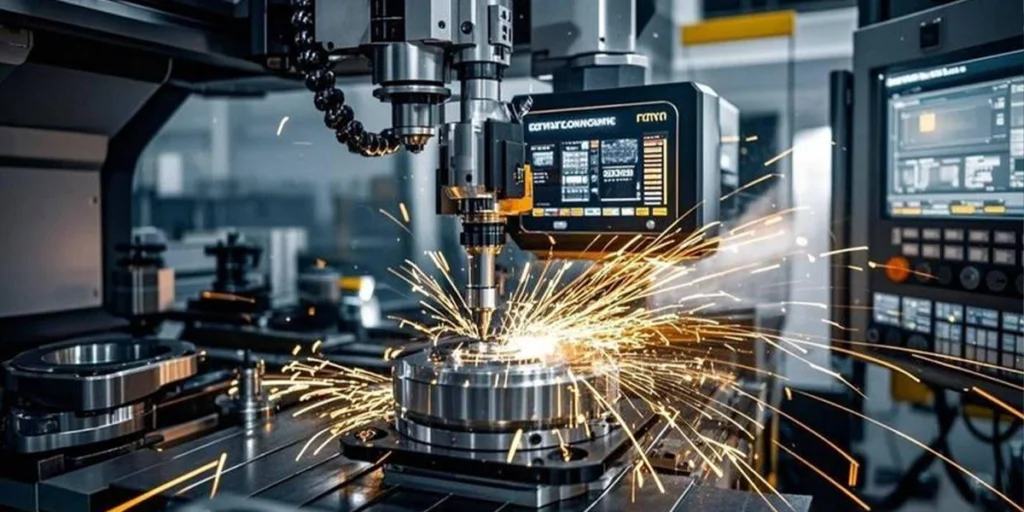
Advantages of China’s CNC Turning Industry
Over the past two decades, China has gradually developed from a “low-cost manufacturing base” into a globally important precision manufacturing center. In the field of CNC turning, China’s supply chain not only possesses price competitiveness, but also has formed a complete advantage in terms of equipment scale, material supply, delivery efficiency, and engineering response speed.
For overseas buyers, the core reason for choosing Chinese CNC turning manufacturers is usually not just low price, but also a better balance between cost, capacity, speed and manufacturing flexibility.
1. Efficiency advantages brought by a complete industrial chain
One of the biggest competitive advantages of China’s manufacturing industry is its mature and concentrated industrial support system.
A CNC turning project typically involves:
- Raw material procurement
- CNC machining
- Heat treatment
- Surface treatment
- Detection
- Package
- International Logistics
In many countries, these processes may be scattered across different regions, resulting in long coordination cycles and high costs. In contrast, China has formed mature clusters in multiple manufacturing areas, enabling a faster supply chain response.
This means that customers can obtain:
- Shorter delivery time
- Lower collaboration costs
- Higher project progress efficiency
2. Large-scale equipment investment and sufficient production capacity.
Many Chinese manufacturing companies continue to invest in automation equipment, CNC machine tools, and testing equipment, which has led to a rapid improvement in their overall manufacturing capabilities.
In the field of CNC turning, customers are more concerned with:
- Can the goods be delivered on time?
- Whether mass production can be scaled up
- Can it handle complex orders?
Factories with large-scale equipment are generally more stable in these aspects.
At Zhuohua Hardware, we have approximately 100 CNC turning machines and over 300 milling machines, which can support customers’ one-stop needs from sample development to mass production delivery.
3. Fast transition from prototype to mass production
When many overseas clients develop new products, the common path is:
- Phase 1: Prototyping and Validation
- Phase 2: Small-batch trial production
- Phase 3: Stable Mass Production
Chinese manufacturers typically possess greater flexibility in production, enabling them to quickly switch order types rather than solely focusing on large-volume production. This is particularly important for startups, new product teams, and equipment upgrade projects.
4. Abundant material selection
China’s CNC turning supply chain can typically obtain a variety of materials quickly, including:
- Aluminum alloy
- Stainless steel
- Brass
- Copper
- Alloy steel
- Tool steel
- Titanium alloy
- Engineering plastics (POM, ABS, nylon, PTFE, etc.)
This means customers have more flexibility:
- Cost-reducing alternative materials
- Upgrade material properties
- Multi-version sample testing
5. Engineering coordination capabilities continue to improve.
In the past, customers worried that Chinese suppliers “only manufactured according to drawings and didn’t understand engineering logic.” This situation is rapidly changing, and more and more factories are beginning to possess this knowledge.
- DFM (Manufacturability Recommendation)
- Drawing optimization feedback
- Tolerance risk identification
- Cost optimization recommendations
- Assembly thinking
This is crucial for overseas procurement, because truly excellent suppliers should help customers solve problems, rather than just fulfilling orders.
6. Global sourcing practices are well-established.
Chinese manufacturers have long served markets in Europe, America, Southeast Asia, and the Middle East, and have developed mature international business models.
- Clear drawing and quotation process
- International logistics coordination
- Experience in bulk shipping
- Quality document support
This significantly lowers the barrier to entry for cooperation with overseas clients.
Cost vs. Quality Analysis
When overseas customers are looking for Chinese CNC turning suppliers, the most common question is: Does “Made in China” mean low prices but inconsistent quality?
Low-priced suppliers may pose risks, but reputable Chinese manufacturers typically offer both reasonable costs and reliable quality. The key isn’t “China,” but rather the type of factory you choose.
1. Why is Chinese manufacturing more cost-competitive?
Chinese suppliers typically have a price advantage, mainly due to industry efficiency rather than simply compromising quality.
include:
- Large-scale procurement of raw materials
- High equipment utilization rate
- Centralized supporting supply chain
- Mature engineering experience
- High production organization efficiency
This results in lower unit component costs. The advantages of China’s supply chain are even more pronounced, especially for medium-volume and long-term orders.
2. The Real Risks of Low-Price Quotes
There are indeed factories offering extremely low prices in the market, but common issues include:
- Substitution of materials and shoddy workmanship
- Unstable tolerance control
- Poor surface treatment quality
- Delivery delay
- Good sample, poor mass production
If procurement only focuses on the unit price, higher hidden costs are often incurred later on.
- Rework
- Postpone
- Customer complaints
- Inventory losses
- Repetitive development suppliers
3. Criteria for Judging High-Quality Suppliers
Don’t just compare prices; compare total procurement costs. We recommend focusing on evaluating:
- Does it have stable equipment production capacity?
- Do you understand the drawing requirements?
- Whether to proactively propose engineering suggestions
- Is there a testing process?
- Do you have experience with export projects?
- Whether the response is timely
These metrics are more decisive in determining the success or failure of a project than the unit price.
4. Optimal cost ≠ lowest price
Mature procurement teams typically aim for the lowest total cost, not just the lowest price.
For example, a factory might offer a price that is 8% lower, but the delivery time is delayed by two weeks, causing the customer’s project to be postponed. The actual loss may be far greater than the amount saved.
Therefore, the more reasonable logic is:
- Reasonable unit price
- Stable quality
- Smooth communication
- On-time delivery
The Importance of Export Experience
When selecting CNC turning suppliers, many buyers focus only on price, equipment, and delivery time, but overlook an important factor that determines the smoothness of cooperation: export experience.
Even if a factory has good processing capabilities, it may still encounter frequent problems in documentation, communication, packaging, logistics, and quality understanding if it lacks experience in international projects, ultimately increasing procurement costs.
1. Understand the drawing standards and requirements of international clients.
The drawing conventions of customers in different countries are not entirely the same, for example:
- Metric/Imperial Dimension System
- GD&T geometric tolerance annotation
- Surface roughness standard
- Material grade substitution standards
- Special inspection requirements
Suppliers with export experience are usually more familiar with these specifications and can quickly understand the requirements, reducing the time spent on back-and-forth confirmations. This is crucial for the speed of project initiation.
2. More mature pricing and project processes
International procurement typically requires:
- Define the unit price structure
- Delivery time details
- Prototyping cycle
- Packaging method
- Transportation Recommendations
- Payment Terms
Inexperienced factories may only respond with a price, while experienced suppliers will provide complete business information to facilitate internal approval and procurement decisions for clients.
3. Packaging capacity directly affects the quality of delivered goods.
Many precision-machined parts are qualified when they leave the factory, but are damaged during transportation, usually due to insufficient packaging.
- Thread damage
- Surface scratches
- Precision shaft bending
- Collision caused by mixed parts
Insufficient rust prevention leads to corrosion.
Factories with export experience will adopt the following methods based on product characteristics:
- Individually packaged
- Layered isolation
- Rust-proof packaging
- Buffer protection
- Outer box reinforcement
This can significantly reduce the rate of abnormal deliveries.
4. Document and quality record support
Overseas clients often need:
- Documentation Certificate
- Dimensional inspection report
- Shipment List
- Certificate of Origin
- Batch traceability information
If suppliers cannot cooperate with these documents, the procurement process will be slowed down, and may even affect customs clearance and customer acceptance.
5. Communication efficiency determines the speed of project progress.
International projects often involve:
- Time difference communication
- Engineering changes
- Sample feedback
- Emergency order replenishment
- Handling quality anomalies
Suppliers with export experience usually understand this better:
- The importance of response speed
- Accuracy of information expression
- Project milestone management methods
This kind of soft power often determines the quality of long-term cooperation.
How to avoid communication risks
In international manufacturing cooperation, many problems are not caused by processing technology, but by communication errors.
Common situations include:
- Misunderstanding of drawings
- Tolerance focus not confirmed
- Incorrect material version
- Surface treatment requirements omitted
- Misunderstanding regarding quantity and delivery date
- Inconsistent sample validation standards
Once these issues enter the production stage, the rework costs are usually far higher than the initial confirmed costs. Effective communication, in essence, reduces manufacturing risks.
1. Use clear and complete technical documentation.
We recommend that clients provide:
- 2D drawings (including dimensions, tolerances, and materials)
- 3D files (STEP / IGES, etc.)
- Surface treatment requirements
- Assembly Critical Dimensions Description
- Special appearance standards
Do not just send pictures or verbal descriptions, otherwise the probability of error is very high.
2. Define the “critical dimensions”
Not all dimensions are equally important. Experienced buyers will specify:
- Fitting dimensions
- Sealing size
- Coaxiality requirements
- Thread standard
- Appearance Grade A
This allows suppliers to focus their resources on truly critical areas and avoid ineffective processing costs.
3. First confirm the standard during the sample stage.
The real purpose of prototyping is not just to obtain the parts, but to confirm their authenticity.
- Do the sizes match?
- Is the assembly smooth?
- Is the surface satisfactory?
- Does the material meet expectations?
- Are the subsequent mass production standards clearly defined?
The more thorough the confirmation at the sample stage, the more stable the mass production will be.
4. All changes must be confirmed in writing.
Many projects got out of control because of last-minute verbal changes.
- Change the aperture
- Change material
- Change color
- Rescheduled delivery period
It is recommended that all changes be confirmed via email or official records to avoid ambiguity regarding responsibility later.
5. Choose suppliers who proactively ask questions.
A warning sign is that after the customer sends the drawings, the supplier quotes a price and starts production without asking any questions.
Truly professional factories will proactively confirm:
- Is this tolerance necessary?
- Are the materials alternatives?
- Is a certain structure difficult to manufacture?
- Are the surface requirements suitable for the current material?
- Are there any special requirements for packaging?
Asking questions proactively usually indicates that the person has a sense of responsibility for the project.
The value proposition of choosing Zhuohua Hardware
Choosing a Chinese CNC turning manufacturer is not ultimately about choosing “a particular factory,” but about choosing a manufacturing partner that can provide long-term, stable support for project growth.
For the purchasing party, the truly important issues are usually:
- Can you deliver goods reliably?
- Is the quality consistently consistent?
- Is the pricing reasonable and transparent?
- Is the communication efficient?
- Do you have the capacity to expand your orders?
- Is someone responsible when problems arise?
The value of Zhuohua Hardware lies in solving these core problems simultaneously.
1. One-stop manufacturing combining CNC turning and milling reduces supply chain complexity.
Many projects are not simply about turning parts, but also include:
- Shaft-type machined parts
- Milled parts for housings
- Grooving, side hole machining, and surface machining
- Surface treatment requirements
- Assembly requirements
If you are looking for multiple suppliers, a common problem is:
- High communication costs
- Unclear responsibility for size matching
- Delivery time has been extended.
- Complex procurement management
We possess:
- Approximately 100 CNC turning machines
- 300+ CNC milling machines
- 3-axis/5-axis machining capability
It can help customers achieve one-stop delivery from single parts to assemblies.
2. Stable accuracy, suitable for long-term bulk orders.
Getting the samples to pass inspection isn’t difficult; the real challenge is ensuring consistency across batches 1, 10, and 50.
We can provide:
- Machining accuracy ±0.02mm
- Stable process control
- Critical dimension inspection
- Batch consistency management
This is especially important for the following projects:
- Medical equipment parts
- Automated equipment components
- Recurring purchases of industrial parts
- Assemble tolerance-sensitive products
3. Rapid response, shortening project progress cycle
We emphasize rapid execution:
- Quick quote feedback
- Quick identification of engineering problems
- Delivery within 5 business days (depending on the project)
- Flexible scheduling for urgent orders
This is crucial for new product development, seizing market opportunities, and fulfilling after-sales orders.
4. Supported by 50+ materials to help optimize cost and performance.
We support a wide range of material processing, including:
- Aluminum alloy
- Stainless steel
- Brass / Copper
- Carbon steel / Alloy steel
- Tool steel
- Titanium alloy
- Engineering plastics such as POM , Nylon , ABS , and PTFE .
This means that customers are not limited to a single material; we can assist in optimizing based on their needs.
- Reduce material costs
- Improved corrosion resistance
- Improve strength
- Improve appearance
- Shorten the procurement cycle
5. Support business growth from prototype making to mass production.
Many suppliers are only suitable for one stage:
- Only willing to produce in large quantities
- Only accept small orders.
- Fast sample production but weak mass production
We support the entire manufacturing path:
- R&D prototyping
- Small-batch trial production
- Bulk delivery
- Long-term repeat orders
Clients do not need to frequently change suppliers as the project grows.
6. Mature export experience makes cooperation easier.
We have extensive experience serving overseas clients and are familiar with international procurement and cooperation processes. We can support:
- Drawing review
- Materials and testing documents
- Stable packaging solutions
- International logistics collaboration
This means that clients can reduce communication friction and execution risks.
7. We not only process drawings, but also provide engineering advice.
A truly valuable supplier doesn’t just say “it can be done”.
Instead, it can tell the customer:
- Which tolerances are over-designed?
- Which structures will increase costs?
- Which materials are more suitable for the current application?
- Which process has a faster delivery time?
- How to improve mass production stability
Such suggestions can often directly save on procurement costs and development time.
If you are looking for a new CNC turning manufacturer in China , Zhuohua Hardware can assist you with drawing evaluation, manufacturing advice, quotation, and delivery support.