


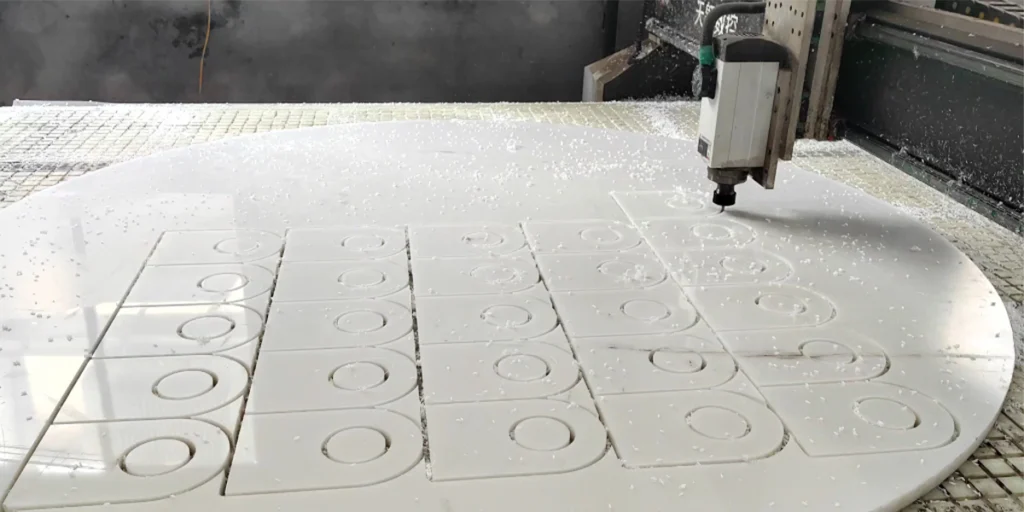
Working principle of CNC milling machine
The working principle of a CNC milling machine is essentially to use digital programs to precisely control the machine tool’s movement and cutting process, so that machining no longer depends on human experience, but is completed automatically according to pre-set instructions.
The entire process can be understood as three consecutive steps: “program command, system calculation, and equipment execution”.
First, based on the part’s design drawings and machining requirements, the part’s shape, dimensions, machining path, and cutting parameters are converted into CNC programs using manual programming or CAM software. These programs typically exist in the form of G-codes and M-codes, which explicitly specify how the tool should move, when to cut, and at what speed.
Next, the machining program is input into the CNC system. The CNC system analyzes and calculates the program, breaking down the complex machining path into a large number of continuous and precise motion commands. In this way, the machine tool can run stably along the set trajectory, rather than simply moving “point-to-point”.
Subsequently, the CNC system sends the calculated instructions to the drive system, which in turn drives the various moving parts of the machine tool to work in coordination, creating a precise relative movement between the tool and the workpiece. Simultaneously, the spindle drives the milling cutter to rotate at high speed, cutting the material under controlled conditions to gradually machine the target shape.
Throughout the machining process, the machine tool continuously monitors the actual motion status and compares it with the program instructions. If any deviation occurs, the system will automatically correct it to ensure that the machining process is stable, repeatable, and maintains good accuracy consistency.
It is through this high degree of coordination between digital control and mechanical motion that CNC milling machines can achieve high-efficiency and high-precision automated metal cutting.
Basic methods of CNC milling
CNC milling refers to the removal of material from a workpiece using a rotating milling cutter under the control of a CNC system. The milling method varies depending on the contact pattern between the cutter and the workpiece, the cutting direction, and the machining target. Understanding these basic methods helps in understanding how CNC milling machines flexibly respond to the needs of different parts in actual machining.
Classified by cutting method
Common CNC milling methods mainly include peripheral milling and end milling.
Peripheral milling uses the cutting teeth on the circumference of a milling cutter to cut. The cutting teeth sequentially enter and exit the workpiece surface, making it suitable for machining structures such as planes, grooves, and steps.
End milling uses the cutting teeth on the end face of a milling cutter to perform cutting. It is often used for machining larger flat surfaces and can achieve good surface quality while ensuring efficiency.
Distinguished by cutting direction
Based on the relationship between the tool rotation direction and the workpiece feed direction, milling can be divided into climb milling and conventional milling.
In climb milling, the cutting direction of the tool is consistent with the feed direction of the workpiece, and the cutting process is relatively stable, which is beneficial to improving surface quality and reducing tool wear, but it requires high machine tool stability.
In reverse milling, the cutting direction of the tool is opposite to the feed direction, making it highly adaptable and insensitive to equipment clearance. It still has practical value under certain machining conditions.
Classified by processing target
In actual production, CNC milling is usually divided into roughing, semi-finishing and finishing, depending on the different machining stages.
Rough processing focuses on quickly removing excess material and prioritizes efficiency.
Semi-finishing is used to control dimensions and shape, preparing for subsequent processing;
Finishing focuses on dimensional accuracy and surface quality to achieve the final product effect.
By rationally combining different milling methods, CNC milling machines can achieve a balance between efficiency, accuracy, and stability, thereby meeting diverse machining needs.
The core structure of a milling machine
The stable and precise completion of machining tasks by CNC milling machines relies on the coordinated operation of their various core components. Although different models of milling machines may differ in configuration, their basic structural composition is largely the same.
Bed and column
The basic support structure of the machine tool, usually made of high-strength cast iron or steel, is used to bear the weight of the entire machine and ensure overall rigidity and stability. Good structural rigidity is an important prerequisite for the continuous and stable machining of CNC milling machines.
Spindle Box and Spindle
The core functional units of a CNC milling machine. The spindle is responsible for driving the tool to rotate and providing power for cutting; its speed and operational stability directly affect the machining effect. The spindle headstock provides support and power transmission for the spindle, keeping the cutting process smooth and controllable.
Worktable
Used to fix and support the workpiece, and to move in position according to program instructions during machining. Through reasonable clamping and positioning methods, the worktable can ensure the stability of the workpiece during machining, providing a reliable foundation for subsequent cutting operations.
Guide System and Servo System
responsible for realizing the precise movement of various moving parts of the machine tool. The guide rail provides guidance and support for the movement, while the servo system controls the movement speed and position according to the instructions of the CNC system, so that the tool and the workpiece can move in coordination according to the set trajectory.
CNC Control System
It is essentially the “brain” of the entire milling machine. It receives the machining program, coordinates the work of the spindle, worktable, and various motion axes, enabling the entire machine to automatically complete the machining task according to a predetermined process.
It is precisely the rational design and coordination of these core structures that makes CNC milling machines outstanding in terms of efficiency, stability, and machining capabilities, making them an important piece of equipment widely used in modern manufacturing.
What metals can CNC milling machines process?
CNC milling machines have strong material adaptability and can process a variety of common metals and alloys. The differences in strength, hardness, and cutting characteristics of different metals directly affect the machining difficulty and application scenarios.
Aluminum Alloys
Aluminum alloys are one of the most common materials used in CNC milling. They are lightweight, have good machinability, and easily achieve high surface finishes, making them widely used in the machining of aerospace, automotive, and electronic components.
Stainless Steel
Aluminum alloys possess good corrosion resistance and structural strength, and are commonly used in food processing equipment, medical devices, and industrial parts. Compared to aluminum, stainless steel requires higher standards for equipment stability and machining control.
Carbon Steel
Aluminum alloys, due to their low cost and high strength, are widely used in the machining of structural components and general mechanical parts, making them one of the most widely used metal materials in industrial manufacturing.
Copper and Copper Alloys
Aluminum alloys possess good electrical and thermal conductivity and excellent machinability, making them commonly used in the machining of electrical components, heat dissipation components, and precision structural parts.
Titanium Alloys
Aluminum alloys are known for their high strength, lightweight, and corrosion resistance, and are widely used in aerospace and medical fields. Although they are more difficult to machine, CNC milling machines can still reliably complete the machining of complex parts.
In addition, some high-performance alloy materials, such as nickel-based alloys and magnesium alloys, can also be machined by CNC milling machines, mainly used in special industries with high performance requirements.
Overall, CNC milling machines can cover most machining needs, from conventional industrial metals to high-performance alloys, and have strong versatility and flexibility.
Typical application scenarios of CNC milling machines
With their high machining accuracy, stability, and adaptability, CNC milling machines are widely used in various manufacturing fields, especially suitable for machining parts with complex structures and strict dimensional requirements.
Mold Manufacturing
CNC milling machines are commonly used to machine mold cavities, cores, and various complex contour structures. Stable cutting control effectively ensures the dimensional consistency and surface quality of molds, meeting the manufacturing requirements of plastic molds, die-casting molds, and stamping molds.
Aerospace Industry
CNC milling machines are mainly used to machine high-strength, complex-shaped structural parts and critical components. These parts typically have high requirements for precision and reliability, and CNC milling machines can complete the machining of complex contours under controlled conditions.
Automotive Manufacturing
NC milling machines are widely used in the machining of engine parts, chassis structural parts, and various functional parts, meeting both mass production needs and suitable for customized and small-batch parts manufacturing.
General Machinery Manufacturing
CNC milling machines are commonly used to machine key components such as gears, bearing housings, and connectors, providing a stable and reliable structural foundation for various mechanical equipment.
Electronics and Medical Fields
CNC milling machines are primarily used for machining precision structural parts and functional components, meeting dimensional accuracy requirements while also improving product consistency and reliability.
Overall, CNC milling machines are suitable for a wide range of machining tasks, from conventional industrial manufacturing to demanding applications, making them an indispensable piece of equipment in modern manufacturing systems.