


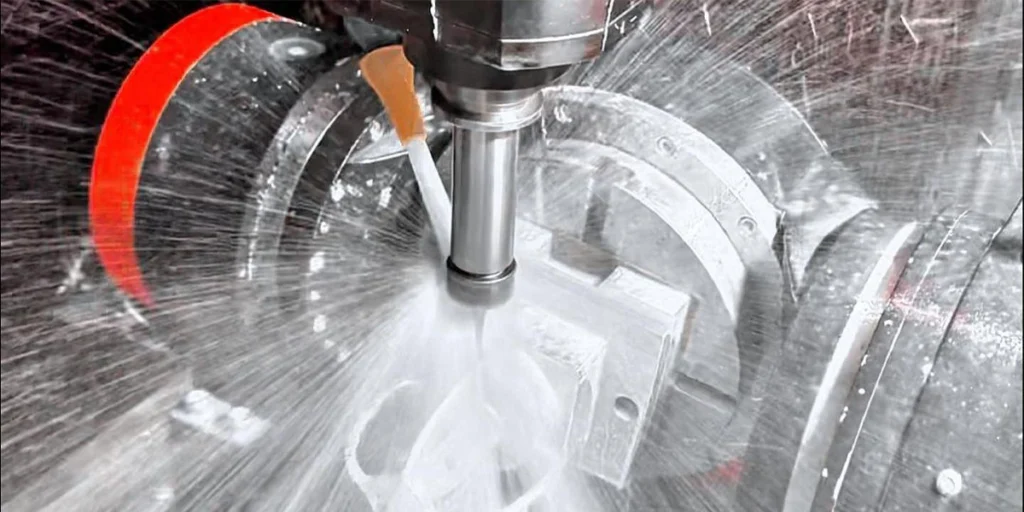
What types of CNC machine tools are there?
There are many types of CNC machine tools, and simply listing their names can easily lead to confusion.
In practical applications, CNC machine tools are usually classified from different perspectives, rather than belonging to only one type.
To make it easier to understand, we can look at the types of CNC machine tools from the following common dimensions.
Classification by processing method
This is the most intuitive and common classification method, mainly based on how the machine tool processes the material.
CNC machine tools for metal cutting
The material is cut with a cutting tool to remove excess material and obtain the desired shape and size.
Common types include CNC lathes, CNC milling machines, CNC grinding machines, and CNC drilling machines, which are widely used in the processing of various metal parts.
CNC machine tools for metal forming
It mainly shapes materials through extrusion, stamping, bending, etc., rather than cutting.
Common equipment includes CNC bending machines, CNC punching machines, and CNC pipe bending machines, which are mostly used for processing sheet metal and pipes.
Specialized CNC machine tools
It utilizes energy such as electricity, light, heat or chemicals for processing, and is suitable for materials or structures that are difficult to process using traditional cutting methods.
Examples include CNC laser processing machines, electrical discharge machining (EDM) machines, and wire cutting machines.
Classification by motion control method
This classification method is more focused on the machine tool’s control capabilities and machining paths.
Point-to-point control CNC machine tools
It only controls the tool or worktable to move precisely from one position to another without cutting during the movement.
Linear control CNC machine tools
It can not only perform point positioning, but also complete cutting operations along a straight line trajectory.
Contour control CNC machine tools
It can control multiple coordinate axes in a coordinated manner, enabling the tool to move continuously along complex curves or surfaces, and is currently the most widely used type.
Classification by number of linkage axes
This is a key factor that many users are very concerned about when selecting a machine tool, as it mainly reflects the machine tool’s ability to process complex data.
- Two-axis and three-axis CNC machine tools
- Four-axis and five-axis CNC machine tools
- Multi-axis CNC machine tools with higher axis count
The more axes a machine tool has, the more complex the spatial machining it can perform, but this also places higher demands on equipment, programming, and cost. Machine tools with different numbers of axes are suitable for machining parts of varying complexity.
Classification by machine tool structure
In terms of structural layout, CNC machine tools can also be divided into different types, which directly affects the processing space and applicable workpiece size.
- Vertical CNC machine tools
- Horizontal CNC machine tool
- Gantry CNC machine tool
- Other composite or special structure machine tools
The choice of structural form is usually closely related to the size, weight, and processing stability of the part.
CNC milling machine
CNC milling machines are one of the most widely used types of CNC machine tools and are also “general-purpose equipment” in many CNC machining scenarios.
It uses a high-speed rotating milling cutter to cut the workpiece in multiple directions, thereby machining the required shape and structure.
Basic machining methods of CNC milling machines
Unlike CNC lathes, which primarily rotate the workpiece, the core characteristic of CNC milling machines lies in:
- The cutting tool rotates to perform cutting.
- The workpiece is usually fixed on the worktable.
- Can perform feed motion in multiple directions
This machining method is very suitable for machining planes, grooves, holes, and complex contours, and offers high flexibility.
What materials can CNC milling machines process?
CNC milling machines are highly adaptable to various materials, and common materials that can be machined include:
- Various metal materials (such as aluminum alloys, steel, stainless steel, etc.)
- Engineering plastics
- Composite materials and non-metallic materials (such as acrylic, carbon fiber, etc.)
The wide range of materials used is one of the important reasons why CNC milling machines are widely used.
Types of parts that CNC milling machines are suitable for machining
From the perspective of part structure, CNC milling machines are typically used for machining:
- Flat-shaped parts
- Structural components with grooves and steps
- Parts requiring multi-faceted machining
- Parts with relatively complex shapes but requiring stable dimensional accuracy
CNC milling machines are particularly common in multi-variety, small-batch, or customized processing.
Typical application scenarios of CNC milling machines
Due to their versatility, CNC milling machines are widely used in many industries, such as:
- Mechanical manufacturing and equipment parts processing
- Mold and tooling manufacturing
- Processing of structural components for electronic products
- Aerospace and automotive parts
The requirements for machine tool configuration and processing capabilities will vary depending on the application scenario.
Main features of CNC milling machines
Overall, CNC milling machines have the following typical characteristics:
- Wide range of applicable materials
- Flexible processing and highly versatile
- Suitable for machining parts with various complex structures.
- Easy to use with other CNC equipment
Because of these characteristics, CNC milling machines are often one of the most basic and core machine tool types in CNC machining.
CNC lathe
A CNC lathe is a type of CNC machine tool that primarily rotates the workpiece and is mainly used for machining various rotating parts.
In actual production, it is often used to complete the machining of structures such as outer circles, inner holes, and end faces, and is the core equipment in the machining of shaft and disc parts.
Basic machining methods of CNC lathes
The machining characteristics of CNC lathes can be simply summarized as follows:
- Workpiece rotates at high speed
- The tool cuts along a fixed trajectory.
- The processing is stable and highly repeatable.
This machining method is very suitable for machining parts with strong symmetry and high coaxiality requirements.
Types of parts that CNC lathes are suitable for machining
From the perspective of part structure, CNC lathes are mainly used for machining:
- Various types of shaft parts
- Cylindrical or conical parts
- Parts with internal or external threads
- Rotating components requiring high coaxiality
For parts with regular shapes and high requirements for dimensional consistency, CNC lathes have a clear advantage.
Common application scenarios of CNC lathes
Due to their high machining stability, CNC lathes are widely used in:
- Manufacturing of mechanical equipment parts
- Automotive parts processing
- Production of standard hardware parts
- Various mass production scenarios
In medium to large-volume production, CNC lathes are often able to maintain high efficiency and consistency.
Main features of CNC lathes
Overall, CNC lathes have the following characteristics:
- Especially suitable for machining rotating parts
- High processing efficiency and stable repeatability.
- Easy to achieve mass production
- Highly compatible with other CNC equipment
In CNC machining systems, CNC lathes and CNC milling machines are often used in combination to complete the overall machining of complex parts.
CNC engraving machine
A CNC engraving machine is a type of CNC equipment characterized by high speed and light cutting, mainly used for fine processing and contour shaping of materials.
Compared to traditional CNC milling machines, CNC engraving machines place more emphasis on surface details and machining precision, rather than large cutting volumes.
Processing characteristics of CNC engraving machines
In terms of processing methods, CNC engraving machines typically have the following characteristics:
- High spindle speed, suitable for precision cutting
- Smaller cutting depth per pass, with a greater emphasis on surface finish.
- The processing is smooth, making it suitable for intricate structures.
This processing method is ideal for parts that require high standards of appearance and detail.
Commonly processed materials for CNC engraving machines
CNC engraving machines are mostly used to process relatively soft or easy-to-machine materials, such as:
- Wood and engineered wood products
- Non-metallic materials such as acrylic and plastic
- Light metal materials such as aluminum alloys
Engraving machines can achieve better surface finishes and processing efficiency on these materials.
Typical application scenarios of CNC engraving machines
In practical applications, CNC engraving machines are commonly used in the following scenarios:
- Processing of signage, advertising and display products
- Model and sample production
- Processing of electronic product casings and panels
- Machining of parts requiring fine textures or patterns
These application scenarios typically have high requirements for appearance consistency and detail.
Main positioning of CNC engraving machine
Overall, CNC engraving machines are more suitable for:
- Fine structure and shallow processing
- Light-load, non-heavy-cutting operations
- Processing requirements with high surface finish
In CNC machining systems, CNC engraving machines are typically used as supplementary equipment, complementing CNC milling machines and CNC lathes.
Machining Center
A machining center is a CNC machine tool that integrates multiple machining processes. It is usually based on a CNC milling machine, but equipped with an automatic tool changer and more complete control functions.
Its core advantage lies in the fact that multiple processing operations can be completed in a single setup.
Basic characteristics of machining centers
Compared to ordinary CNC machine tools, machining centers typically have the following characteristics:
- Equipped with an automatic tool changer, it can continuously complete multiple processes.
- High degree of automation in the processing
- Reduce errors caused by multiple clamping operations
- Improve overall processing efficiency and stability
These characteristics give machining centers a clear advantage in machining complex parts.
Suitable processing types for machining centers
In terms of processing capacity, machining centers are typically used for:
- Parts processed in multiple continuous steps
- Parts with complex structures and numerous machining steps
- Parts requiring high dimensional consistency and stability
When multiple operations such as milling, drilling, and tapping need to be performed simultaneously, machining centers are often the more suitable choice.
Typical application scenarios of machining centers
In actual production, machining centers are commonly found in the following fields:
- Processing of mechanical equipment and industrial parts
- Mold and tooling manufacturing
- Automotive and related parts processing
- Mass production projects that require improved processing efficiency
For processing needs that prioritize efficiency and stability, machining centers have high application value.
Positioning of machining centers in CNC machine tools
Overall, a machining center can be understood as:
- Based on CNC milling
- Improve efficiency through automation systems
- Suitable for machining medium to high complexity parts.
In CNC machining systems, machining centers typically undertake efficiency-oriented and integrated machining tasks, forming a division of labor and cooperation with other types of CNC machine tools.
Main uses of each type
There is no absolute relationship between different types of CNC machine tools, such as “which is more advanced” or “which is necessarily better”. The key is whether they are suitable for specific processing needs.
From a practical application perspective, various CNC machine tools typically undertake different processing tasks.
Main uses of CNC milling machines
CNC milling machines are mainly used for:
- Machining of various planar and contour structures
- General machining of multi-faceted and multi-featured parts
- Small-batch, multi-variety, or customized parts production
Due to their versatility, CNC milling machines can be used in most CNC machining scenarios.
Main uses of CNC lathes
CNC lathes are more suitable for:
- Machining of rotating parts such as shafts and discs
- Parts requiring high coaxiality and roundness
- Medium to large batches of repetitive production tasks
In the machining of regular rotating parts, CNC lathes are often more efficient.
Main uses of CNC engraving machines
CNC engraving machines are typically used for:
- Fine contour and shallow structure processing
- Parts requiring high surface finish
- Processing scenarios for non-metallic or light metal materials
It focuses more on detail rather than heavy machining.
Main uses of machining centers
Machining centers are mainly used in:
- Parts that require multiple processes to complete consecutively.
- Products with complex structures and numerous processing steps
- Projects with high requirements for processing efficiency and consistency
Machining centers have a clear advantage in reducing the number of clamping operations and improving overall efficiency.
How to select the appropriate CNC machine tool according to its application
When selecting a model, you can simply follow these guidelines:
- For parts primarily with rotary structures, CNC lathes will be the preferred choice.
- Complex part structure with many features → CNC milling machine or machining center
- High requirements for detail and surface finish → CNC engraving machine
- Pursuing efficiency and multi-process integration → Machining Center
Defining the part structure and processing objectives is often more important than simply comparing equipment parameters.