


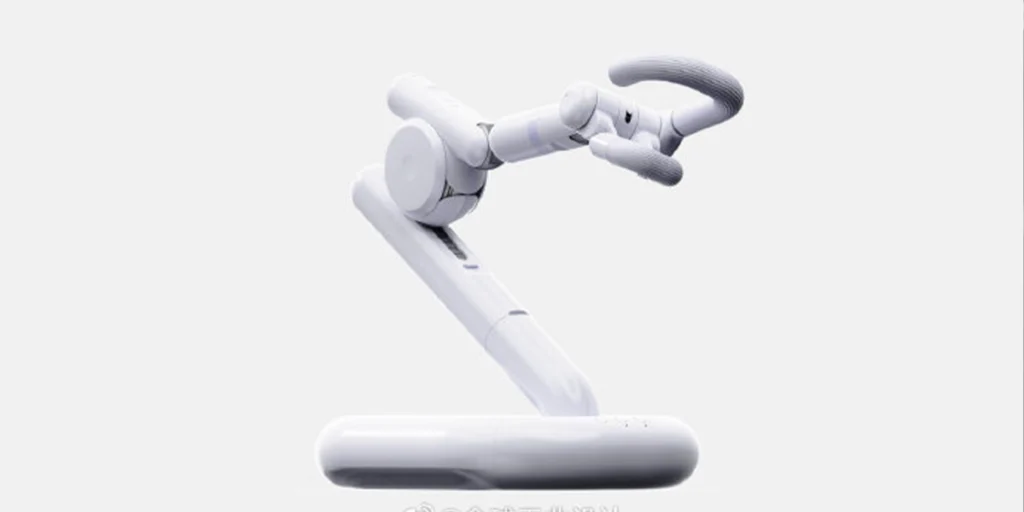
What is an articulated robotic arm?
Articulated robot arms are the most common structural form of industrial robots. They consist of multiple rotary joints connected in series, and through the coordinated movement of each joint, they can achieve multi-angle and multi-directional operations in space.
A typical articulated robotic arm usually contains 4 to 6 degrees of freedom, and its structure is similar to that of a human arm, including the shoulder, elbow, and wrist. Each joint is driven by a motor and a reduction gear, enabling the robotic arm to perform complex actions such as positioning, handling, assembly, and welding.
Structurally, a standard articulated robotic arm typically consists of the following parts:
- Base
- Upper arm/Forearm (Arm & Forearm)
- Joints
- Wrist structure
- End Effector
This series structure gives it a large workspace and high flexibility, making it widely used in automated production lines.
It should be noted that the more joints there are, the stronger the mobility, but it also means a more complex structure and higher requirements for the machining precision and assembly consistency of the parts.
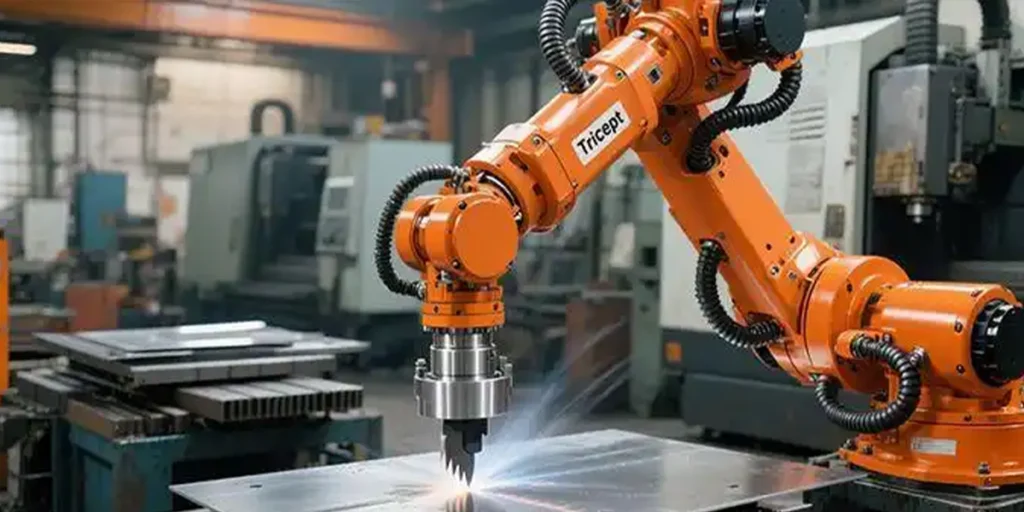
Why does DOF determine the performance of a robotic arm?
In robotic arm design, degrees of freedom (DOF) is a fundamental but crucial concept.
Simply put, a degree of freedom refers to the number of directions or axes in which a mechanical system can move independently. For articulated robotic arms, each additional joint typically adds one degree of freedom.
Degrees of freedom of an articulated robotic arm
A typical industrial articulated robotic arm usually has 4 to 6 degrees of freedom, with the 6-axis structure being the most common.
- Base rotation: Controls the overall left and right rotation
- Shoulder: Controls the up-and-down movement of the upper arm
- Elbow: Controls the range of arm length changes
- Wrist rotation: Adjusting posture and direction
- Wrist swing: Control the tilt angle
- End-effector rotation: Precisely positions the tool orientation
A 6-DOF robotic arm can achieve:
- Location positioning in any spatial position (X / Y / Z)
- Adjustable posture (angle control)
This is why most industrial robots use a 6-axis structure.
Does more freedom equate to greater ability?
Functionally, the more degrees of freedom a robotic arm has, the more flexible it is, and the more complex trajectories and movements it can perform.
However, in engineering implementation, the increase in degrees of freedom comes at a significant cost:
- Increased structural complexity
- Increased difficulty in control
- Increased costs
- The sources of error have increased significantly.
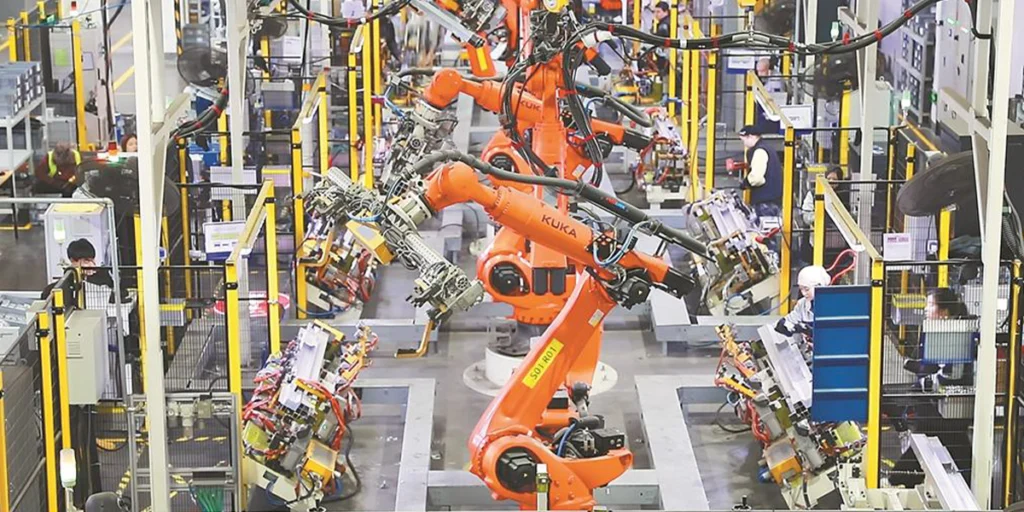
How does a robotic arm obtain power?
The movement of a robotic arm is essentially the rotation and linkage of its various joints, and the realization of these movements depends on a complete power and transmission system.
In simple terms, the power transmission path of an articulated robotic arm is typically: motor → reduction gear → joint output → link motion.
This process determines the speed, precision, and load capacity of the robotic arm.
1) Drive source: Motor system
Currently, industrial robotic arms mainly use the following two driving methods:
Servo Motor
The mainstream choice is characterized by:
- High control precision
- Fast response time
- Enables closed-loop control
It is suitable for most industrial robots, especially for applications requiring high trajectory accuracy.
Stepper motor
Mostly used in light-load or low-cost systems:
- Simple to control
- Lower cost
However, it has been gradually replaced by servo systems in high-load and high-precision scenarios.
2) Key component: speed reduction mechanism
The motor itself has a high speed and low torque, so it cannot directly drive the joints of the robotic arm. Therefore, it needs to be converted through a reduction mechanism.
Common deceleration methods include:
- RV reducer
- High rigidity
- High impact resistance
- Suitable for heavy-duty joints (such as bases and shoulders).
Harmonic Drive
- Small size
- High accuracy
- Small return clearance
It is typically used in precision moving parts such as the wrist.
The performance of the reducer directly affects:
- Positioning accuracy of the robotic arm
- Repeatability
- Service life
3) Power transmission: joint structure
The decelerated power is output through the joint structure, driving the robotic arm to move.
This involves several key mechanical components:
- Output Shaft
- Bearings
- Gears or transmission components
- Housing
These components together determine the joint’s:
- Rigid
- Stability
- Rotational accuracy
Key issue: Balancing torque and precision
In the design of robotic arms, the power system must not only provide sufficient torque, but also ensure that the precision during the transmission process is not compromised.
Common challenges include:
- Structural deformation under high load
- Increased gaps after prolonged operation
- Accumulated errors caused by multi-stage transmission
This is why the power system of a robotic arm is not just a “drive problem,” but is essentially a “precision manufacturing problem.”
Direct relationship with machining accuracy
In actual manufacturing, power system-related parts have very high machining requirements, for example:
- Coaxiality of the reducer housing
- Gear meshing accuracy
- Shaft and bearing fit tolerances
- Flatness of the joint mounting surface
If these critical dimensions are not properly controlled, it will directly lead to:
- Increased vibration
- Increased noise
- Decreased accuracy
- Shortened lifespan
Therefore, these types of parts typically require high-precision CNC machining, especially in:
- Machining of multi-axis complex structures
- Components requiring high coaxiality
- Precision mating parts
High-precision components for robot articulated arms
If you are developing or manufacturing articulated robotic arms, then you are already aware of a real problem: the machining quality of the mechanical structure directly determines the performance of the entire machine.
Whether it’s the joint housing, transmission components, or structural connectors, these core components require stable and high-precision manufacturing support to ensure:
- Smooth joint movement
- Stable positioning accuracy
- Reliable for long-term use
As a professional precision component manufacturer, we can provide you with high-precision CNC manufacturing services . We have extensive experience in machining robot structural components, covering joint parts, transmission structures, robotic arm connectors, and various custom hardware parts, with an accuracy of ±0.02 mm.
It supports a variety of materials, including aluminum , steel , titanium , and engineering plastics , and can deliver quickly from prototype to mass production.
If you are working on a robotics project, please submit your drawings or requirements, and we will provide you with processing solutions and quotations.