


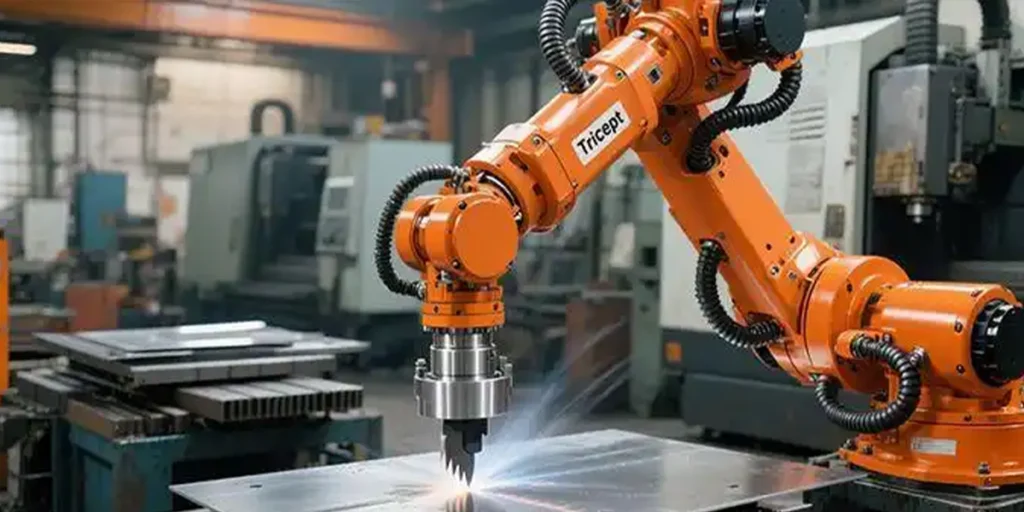
The essence of a robotic arm’s work is to achieve position and attitude control of the end effector in space through the coordinated movement of multiple joints. The entire process can be broken down into three core parts: kinematic calculation, control system execution, and mechanical structure implementation.
The movement principle of robotic arms
During the operation of the robotic arm, the control system does not directly control “how the end effector moves”, but achieves the target position by calculating the angles of each joint.
This involves two fundamental concepts:
Forward Kinematics
Given the angle of each joint, calculate the position and orientation of the end effector.
Simply put, it means: given “how the joint moves,” find “where the distal end is.”
Inverse Kinematics
Given the target position and orientation of the end effector, deduce the angle that each joint should rotate.
In other words: given “where the distal end is going”, find “how each joint moves”.
In practical applications:
- The operator or program provides the target path.
- The control system calculates joint angles using inverse kinematics.
- Then, the motor drives each joint to perform the operation.
This is also the basis for the robotic arm to complete complex trajectories (such as welding curves and assembly paths).
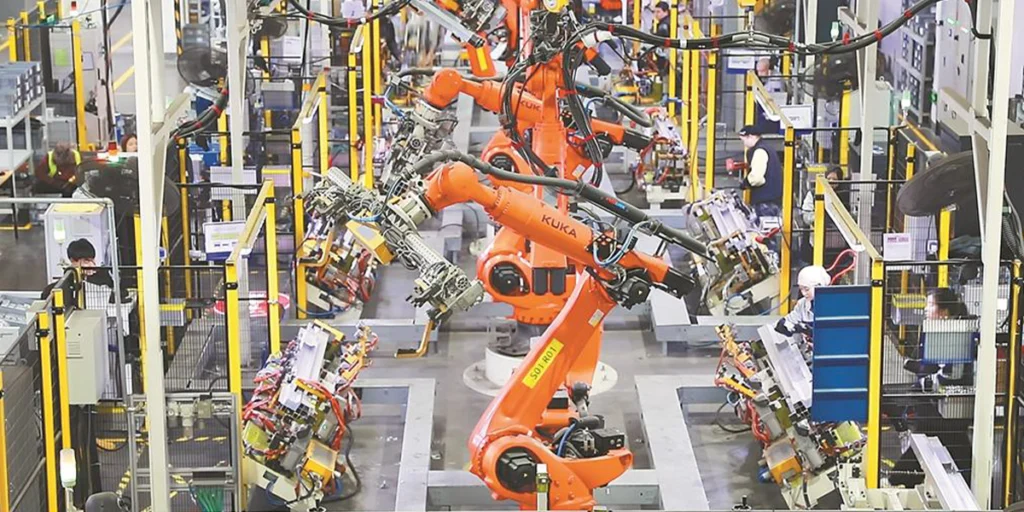
Control System: How Servo Motors and Controllers Drive Robotic Arms
The movement of a robotic arm depends not only on its structure, but also on the precise drive of each joint by the control system.
The core components are simple: controller + servo motor + feedback system.
Controller
The controller is like the “brain” of the robotic arm, responsible for:
- Receive program instructions (path, location, speed)
- Perform kinematic calculations (inverse kinematics)
- Output motion commands for each joint
In actual operation, the controller continuously calculates the target position of each joint and adjusts the motion trajectory in real time.
Servo Motor
The servo motor is responsible for executing the controller’s instructions and is the power source for each joint.
Its characteristics are:
- High response speed
- High positioning accuracy
- Supports closed-loop control
Each joint typically corresponds to an independent servo system, enabling multi-axis synchronous motion.
Feedback system
To ensure accuracy, robotic arms are typically equipped with feedback devices such as encoders for real-time detection.
- Joint position
- Rotational speed
- Motion status
The controller continuously corrects errors based on feedback, forming a closed-loop control.
However, the control system can only optimize performance based on existing mechanical precision, but cannot compensate for errors in the structure itself.
The precision of a robotic arm comes from the combined effect of its structure and algorithms.
The operational accuracy of a robotic arm is usually understood as the capability of its control system, but in practical engineering, the source of accuracy can be broken down into two parts:
- Control system (algorithm and control capability)
- Mechanical structure (machining accuracy and assembly quality)
Both are indispensable, but the mechanical structure determines the upper limit.
The control system determines the “path calculation capability”.
Through kinematic algorithms and closed-loop control, the control system can achieve:
- Trajectory planning
- Position Correction
- Multi-axis synchronous control
This ensures the theoretically achievable motion precision of the robotic arm.
Mechanical structure determines “actual execution accuracy”.
In actual operation, the final performance depends on the stability of the mechanical parts:
- Does the joint have a gap?
- Is the transmission smooth?
- Has the structure undergone any minor deformation?
These issues will not be reflected in the algorithm, but will be directly reflected in the results, for example:
- Track offset
- Repeat positioning error
- Accuracy decreases over long periods of operation
Why is manufacturing precision key?
The key sources of precision in robotic arms are concentrated in the following aspects:
- Joint fit accuracy (shaft and bearing)
- Machining quality of gears and reduction mechanisms
- Dimensions and geometric tolerances of structural components
- Assembly consistency of multi-joint systems
These factors together determine:
- Repeatability
- Motion stability
- Service life
These core indicators all essentially depend on basic manufacturing capabilities.

High-precision robotic arm component manufacturing
If you have needs for machining robotic arm joint structures or precision parts, we can provide you with stable and reliable CNC manufacturing services.
We specialize in the machining of key components for articulated robotic arms and have extensive experience in manufacturing structural and transmission components, including:
- Joint housing and connecting structure
- High-precision shafts and mating parts
- Gears and transmission-related parts
- Various non-standard robotic arm structural components
The machining accuracy can reach ±0.02 mm, supporting complex structures and multi-axis machining, and can respond quickly from prototype to mass production.
If you are working on a robotics project, you can submit your drawings or requirements directly, and we will provide processing suggestions and quotation support.