


In the manufacturing of copper parts , many purchasing personnel and product engineers encounter a question: should copper parts be machined by CNC milling or CNC turning?
Both of these processes belong to precision CNC machining, but they are suitable for different part structures, machining efficiency, costs, and mass production methods.
For conductive components, heat dissipation systems, industrial copper fittings, and high-precision electronic parts, choosing the right processing technology will not only affect the processing quality but also directly impact project costs and delivery time.
Below, we will analyze in detail the differences between CNC milling and turning of copper from an engineering and manufacturing perspective.
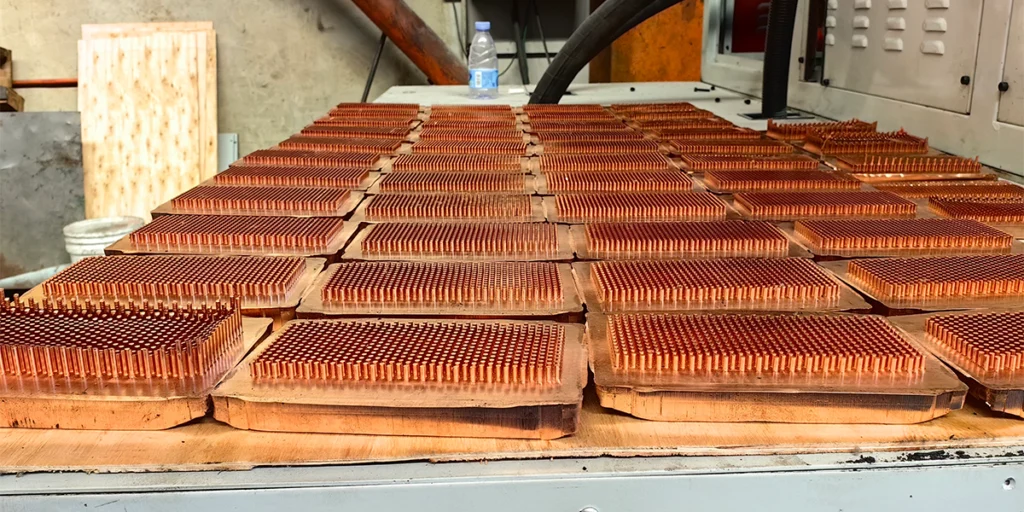
Introduction to Copper CNC Milling
CNC milling of copper is a machining method that uses a rotating cutting tool to cut a stationary workpiece. Compared to turning, milling is more suitable for machining:
- Complex geometric structures
- Planar features
- Slot
- Cavity
- Irregular shape
For complex copper parts in modern electronics, thermal management, and industrial equipment, CNC milling is often a more flexible solution.
Suitable for complex structures
One of the biggest advantages of copper milling is its ability to handle complex geometries. Many high-performance copper parts are not simply circular, but rather contain:
- Deep grooves
- Heat sink fins
- Irregular contours
- Tiny holes
- Multi -faceted machined structures
For example:
- AI server cooling plate
- High-frequency connector housing
- Copper heat dissipation module
- Conductive structural components
- Industrial electrical components
These parts often require machining in multiple directions, and milling makes it easier to achieve complex path control.
For multi-faceted parts, 3-axis machining may no longer meet the requirements, therefore many high-precision copper parts will use:
- 3+2 axis machining
- 5-axis linkage machining
This reduces repeated clamping and improves:
- Position accuracy
- Flatness
- Concentricity
- Batch consistency
At Zhuohua Hardware, we have extensive experience in manufacturing complex copper components, including:
- Precision conductive components
- Copper heat dissipation system
- Industrial copper structural components
- Multi-faceted irregular-shaped copper components
For projects with complex structures, we typically conduct preliminary analysis during the Design for Manufacturing (DFM) phase.
- Are there any blind spots in the processing?
- Is it easily deformed?
- Will it produce burrs?
- Is it suitable for stable mass production?
This is very important for reducing the risks in later processing.
Typical copper milled parts
CNC milling of copper is typically used for the following types of parts:
| Part type | Typical applications |
| Copper heat sink | AI servers, electronic devices |
| Cooling plate | Power supply system, GPU cooling |
| Conductive structural components | electrical equipment |
| Connector housing | Telecommunications industry |
| PCB mounting assembly | Precision Electronics |
These parts typically have the following characteristics:
- Multiplanar structure
- Non-circular outline
- High surface quality requirements
- Micropores
- Localized thin walls
The demand for copper milling is growing rapidly, especially in the thermal management industry.
As the power of AI computing devices continues to increase, more and more companies are starting to adopt copper cold plates and high thermal conductivity copper heat dissipation structures, and these complex structures can usually only be achieved through high-precision CNC milling.
For this type of project, the focus is not only on “being able to process,” but more importantly:
- Thermal contact surface quality
- Batch consistency
- Burr control
- Stability of subsequent coatings
This is why high-precision copper milling typically relies more on experienced suppliers.
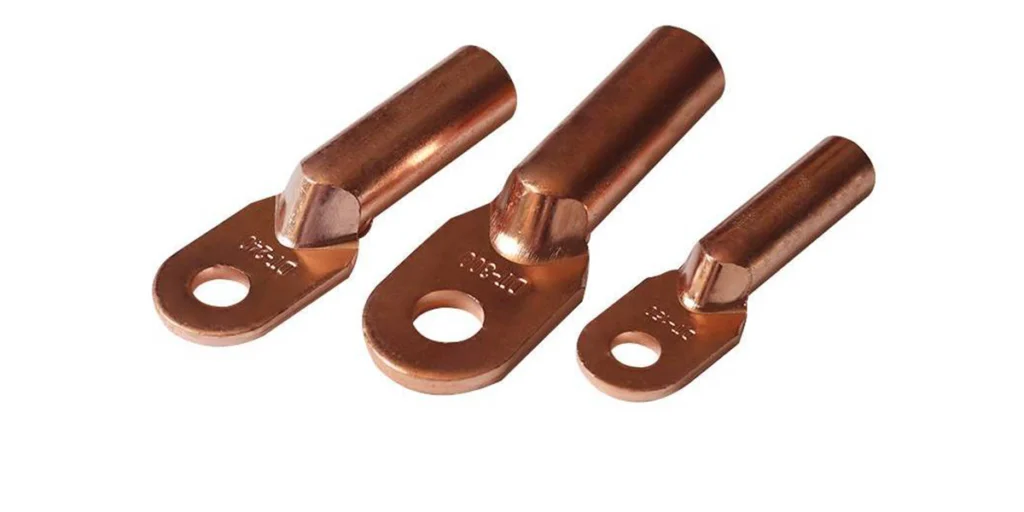
Introduction to CNC Turning of Copper
Copper CNC turning is a machining method that completes cutting by rotating the workpiece and moving the tool.
Turning is more suitable than milling:
- Circular structure
- Shaft-type parts
- High concentricity parts
- High-volume rotating parts
For many conductive connectors and precision electronic components, turning often achieves higher efficiency and lower unit cost.
Suitable for shafts and round parts
If a copper part is rotationally symmetric, then turning is usually the more reasonable choice. Typical structures include:
- Cylindrical parts
- Threaded parts
- Pins
- Connectors
- Sleeves
- Shaft assemblies
Compared to milling, turning has the following advantages:
- Faster processing speed
- More stable concentricity
- Higher surface smoothness
- More suitable for mass production
For many customers in the electronics industry, the demand for machined copper parts is often quite large.
For example:
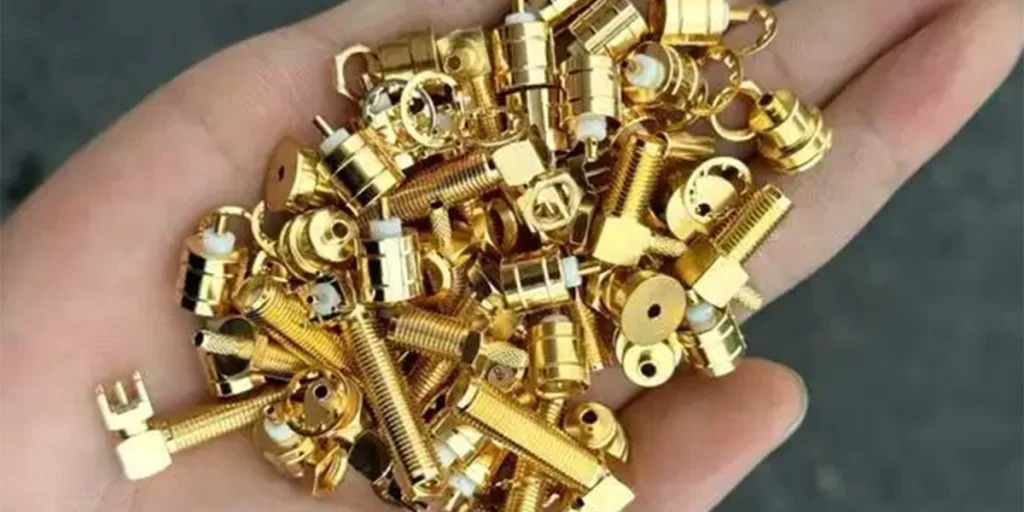
- Communication connector
- Conductive needle
- Terminal assembly
- High-frequency contact components
These parts are typically small in size, but have very high requirements:
- Coaxiality
- Roundness
- Surface quality
In this context, high-precision CNC turning is often more cost-effective than milling.
At Zhuohua Hardware, we support:
- Precision copper turning
- Machining of miniature copper parts
- Multi-axis turning
- Mass production of complex copper components
For small, precision copper parts, we typically use:
- Automated turning equipment
- Precision clamping system
- Online size inspection
To improve batch stability.
Typical machined copper parts
CNC turning of copper is widely used in the following products:
| Part type | Typical industries |
| Copper Pins | Electronics industry |
| Copper Connectors | Communication equipment |
| Conductive Terminals | PCB system |
| Copper Connectors | Industrial equipment |
| Precision Sleeves | Automated equipment |
These parts typically have:
- High conductivity requirements
- Tiny size
- High precision tolerances
- Mass production requirements
For this type of project, turning not only improves efficiency but also provides more stable control:
- Outer diameter
- Concentricity
- Thread accuracy
- Surface roughness
Especially in OEM mass production projects, a stable turning process can significantly reduce:
- Size fluctuation
- Human intervention
- Subsequent assembly issues
Therefore, many long-term electronics customers will prioritize copper machining suppliers with experience in precision turning, rather than just focusing on a single quote.
How to choose between copper milling and turning?
For many purchasing personnel, the question of whether CNC milling or turning of copper is “which is more advanced” is not, but rather: which process is more suitable for the current part.
In actual manufacturing, the choice of process usually has a direct impact on:
- Parts cost
- Delivery cycle
- Batch stability
- Subsequent assembly precision
Therefore, making the right choices at the beginning of a project can reduce many subsequent problems.
Structural complexity
Part structure is usually the primary factor determining the machining method. If the part contains:
- Plane
- Slot
- Cavity
- Multifaceted structure
- Irregular outline
CNC milling is usually more suitable in this case.
Especially for copper heat dissipation systems, conductive structural components, and complex electronic components, many require multi-directional machining. These parts are typically machined using 3-axis, 3+2-axis, or even 5-axis machining. And for:
- Cylindrical structure
- Shaft-type parts
- PIN pins
- Threaded connector
- Symmetrical rotating parts
CNC turning is generally more efficient and less expensive.
Many projects are not actually “pure milling” or “pure turning”. For example, some connector components may have their main structure machined by turning, while local planes, holes, or slots require subsequent milling. Therefore, suppliers with milling and turning capabilities are usually more flexible in handling complex copper parts.
Tolerance requirements
Different processes also exhibit significant differences in dimensional control. For parts requiring high concentricity and roundness, turning is generally more advantageous because the workpiece itself is in a rotating state, the machining datum is naturally consistent, and it is easier to control.
- Outer diameter
- Coaxiality
- Circular jumping
- Thread accuracy
Therefore, many precision conductive pins, connectors, and miniature copper shaft parts are preferentially machined using CNC turning.
For parts with complex planar positional relationships, overlapping tolerances, or multi-faceted features, milling is more suitable. For example:
- Heat dissipation contact surface
- Multi-hole copper structural components
- Precision mounting surface
These types of parts rely more on high-rigidity milling equipment and stable clamping.
In actual projects, we typically focus on analyzing the client’s drawings:
- Which dimensions are truly critical?
- Which areas require key control?
- Can consistency be improved by reducing clamping?
For copper parts, the real challenge is often not “manufacturing” them, but maintaining their consistency over a long period.
Batch demand
Production volume also influences process selection. For small to medium batches of complex copper parts, milling is generally more flexible because it is better suited for rapid program adjustments and structural optimization, especially for:
- Prototype development
- New product validation
- Small batch customization
For mass production of standardized rotating parts, turning usually has a significant efficiency advantage.
Parts such as copper terminals/connectors/conductive pins/micro connectors can achieve very high production efficiency on automated turning equipment while maintaining stable dimensional consistency.
For long-term OEM projects, we usually conduct further evaluations:
- Is it suitable for automated production?
- Is it suitable for multi-axis machining?
- Can secondary processes be reduced?
- Can it reduce human intervention?
Because the core objective of a truly mature copper processing project is not only to complete the processing, but also to establish a stable and sustainable mass production capability.
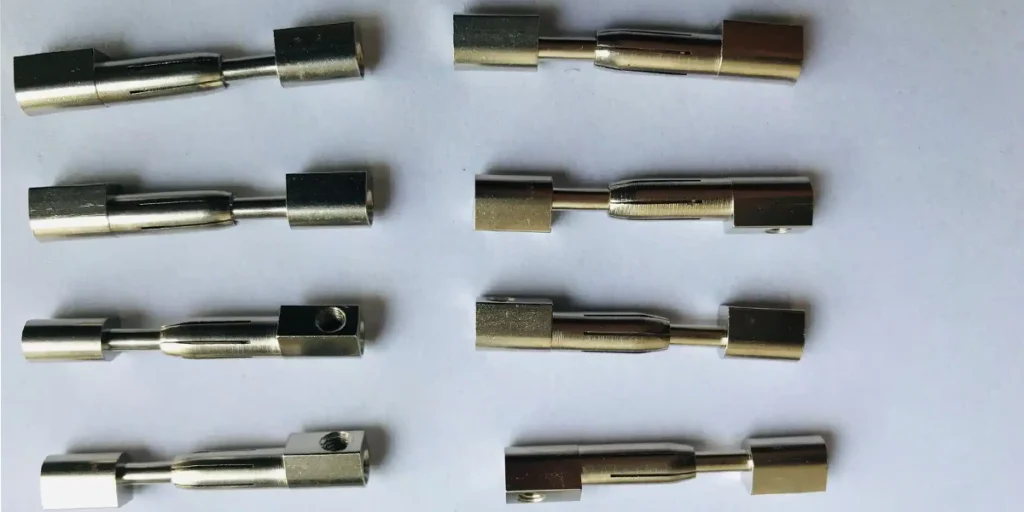
How to reduce costs in mill-turn machining centers
As electronic, communication, and thermal management components become increasingly complex, more and more copper parts are being machined using milling and turning.
Simply put, milling and turning is the process of completing the same task simultaneously on the same machine or in the same operation.
- Turning
- Milling
- Drilling
- Tapping
- Multi-faceted processing
The biggest advantage of this is that it reduces the need for repeated clamping.
For copper parts, each additional clamping operation may result in the following:
- Concentricity deviation
- Positioning error
- Surface indentation
- Cumulative dimensional error
The mill-turn combination can significantly improve:
- Size consistency
- Processing efficiency
- Surface quality
- Batch stability
In particular, many complex connectors, conductive components, and precision communication parts are difficult to manufacture using a single process.
In addition, reducing the number of processes also means:
- Shorter delivery time
- Less manual operation
- Lower scrap rate
- Lower overall manufacturing costs
This is especially important for long-term, high-volume OEM projects.
At Zhuohua Hardware, we select the most suitable manufacturing solutions for our clients based on the component structure and annual demand, including:
- Precision CNC turning
- Multi-axis CNC milling
- Milling and turning machining
- Machining of miniature copper parts
The goal is not just to complete the drawings, but to help customers obtain more stable and sustainable supply chain solutions.