


Why Choose a Precision CNC Milling Parts Manufacturer
In CNC machining, price is never the only variable. What truly affects the project outcome is stability and controllability.
For parts that require functional verification, assembly, or end-use, it is not enough to choose a supplier that can “process” them; the more crucial factor is to choose a manufacturer that can “deliver consistently and stably.”
Quality stability
Producing a qualified part on the first try is not difficult; the challenge lies in achieving batch consistency. Common problems in actual production include:
- First piece passed inspection, but batch size drifted.
- Deviations exist between different batches
- Inconsistent surface quality
These problems are usually not due to a lack of equipment, but rather a lack of system control:
- Is the process route standardized?
- Is tool life managed?
- Is there a process detection mechanism?
For precision parts (e.g., at the ±0.02 mm level), stability depends on:
- Equipment accuracy
- Programming skills
- Quality control process
In a mature manufacturing system, every step is recorded and reused to ensure that the result of the first piece is consistent with that of the 1000th piece. This is especially critical for industries such as aerospace, medical, and automation.
Delivery guarantee
Delivery time issues are often not due to “slow processing,” but rather to uncontrollable processes.
Typical risks include:
- Inappropriate production scheduling → Delayed start-up time
- High rework rate → Repeated processing
- Unstable outsourcing → Delayed delivery
A manufacturer with delivery capabilities typically possesses the following characteristics:
- Sufficient equipment resources (avoiding single-point bottlenecks)
- Mature production scheduling system (supports multiple projects in parallel)
- Stable supply chain (materials and surface treatments are controllable)
For example, in multi-category, small-batch production, without sufficient equipment and scheduling capabilities, the delivery time can easily increase from “5 days” to “more than 2 weeks”.
From the customer’s perspective, delivery time is not just a matter of time; it directly impacts:
- Product development cycle
- Time-to-Market
- Capital turnover efficiency
Therefore, when selecting a supplier, delivery capability is essentially an assessment of whether the team has “continuous delivery capability,” rather than completing the task once and for all.
How to evaluate CNC suppliers
There are many CNC suppliers on the market, but the differences often lie not in pricing, but in delivery results. The key to evaluation is not whether they can do it, but whether they have the capability for long-term, stable cooperation.
You can quickly filter based on three dimensions: equipment, experience, and quality system.
Equipment
The equipment determines the upper limit, but it doesn’t represent everything. Let’s look at the basic configuration first:
- Does it have 3-axis/4-axis/5-axis capability?
- Does the machining size range match your parts?
- Does it support multiple materials (aluminum, stainless steel, titanium, engineering plastics, etc.)?
But the more crucial factor is “scale and utilization rate”:
- Are there enough machines? (This affects production scheduling capacity)
- Is there a reliance on a single device (risk point)?
- Does it support parallel processing of multiple projects?
Even with good technology, if the equipment is limited in scale, the following problems can easily arise:
- Scheduling congestion
- Difficulty in inserting orders
- Delivery time is unstable.
This is crucial for projects that require continuous prototyping or mass delivery.
Experience
Equipment can be purchased, but experience cannot be gained overnight. An experienced team is usually characterized by these details:
- It can identify design problems in advance, rather than waiting for manufacturing failures.
- Able to provide alternative solutions (reducing costs or improving manufacturability)
- Familiar with the processing characteristics of different materials
Quality System
This is the most easily overlooked, yet most crucial, aspect. Without a quality system, it means:
- Each batch of products is “re-validated”.
- There is no unified standard.
- The problem cannot be traced.
The basic judgment criteria include:
- Does it comply with standard tolerance systems (such as ISO 2768)?
- Is there a complete testing process (first article/process/final inspection)?
- Can you provide a test report?
Our Advantages
The aforementioned evaluation criteria essentially answer a real-world question: what kind of supplier can consistently deliver stable results in long-term collaborations?
In real-world manufacturing environments, what truly differentiates suppliers is not a single capability, but rather the combined performance of equipment scale, industry experience, and quality and delivery systems. Only when these elements work in synergy can suppliers effectively handle complex projects and maintain continuous delivery.
Equipment Scale
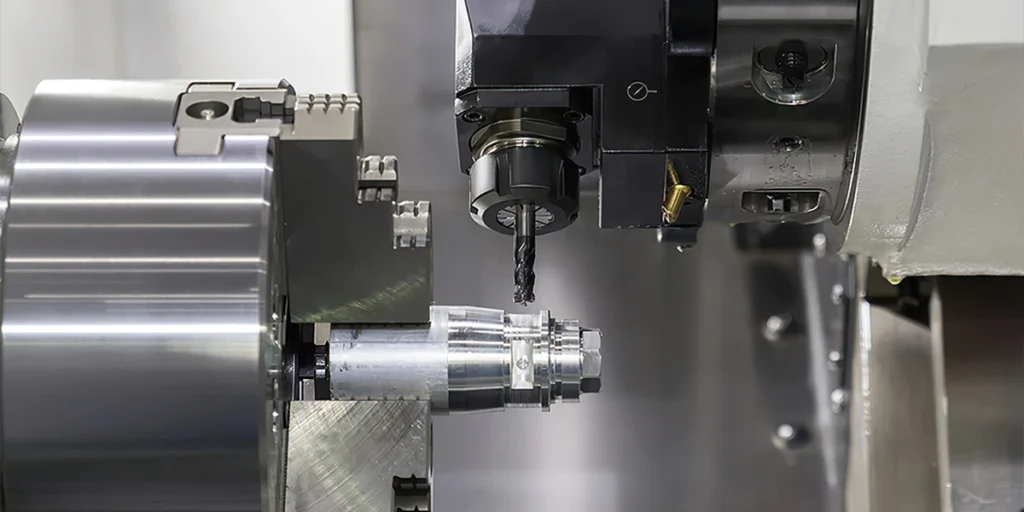
We currently have over 300 CNC milling machines, covering 3-axis, 3+2-axis, and 5-axis machining capabilities, and are also equipped with over 100 CNC turning machines. This configuration allows us to handle multiple projects in parallel production at the same time without them crowding out each other’s processing cycles due to limited equipment resources.
Industry experience
We have long served industries such as aerospace, medical devices, automotive parts, robotics and automation, and consumer electronics, which have high requirements for precision, structural complexity, and consistency.
Global delivery
We support the entire process from rapid prototyping to mass production, with no minimum order quantity, adapting to project needs at different stages. In the prototype stage, delivery can be completed in as little as 5 business days.
In terms of delivery, we have established stable service experience in the European, American, and Southeast Asian markets, enabling us to meet the requirements of customers in different regions regarding quality standards, delivery cycles, and documentation support. The entire process, from CAD file confirmation and quotation evaluation to manufacturing execution, quality inspection, and final delivery, is operated using standardized management methods.
If you are evaluating CNC machining suppliers, upload your CAD files to receive a free DFM analysis and quotation.