


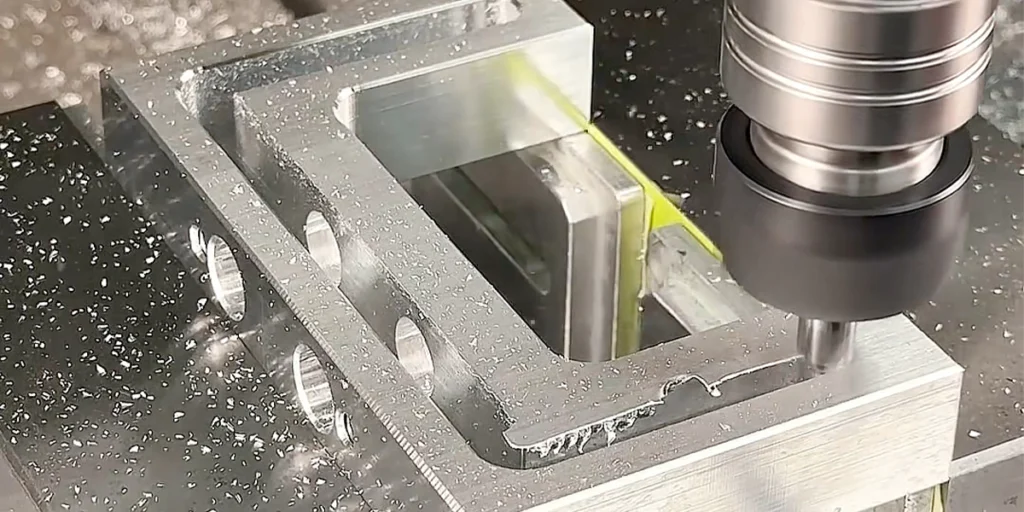
What is a seven-axis CNC machine tool?
A seven-axis CNC machine tool is a computer numerical control machine tool with seven controllable motion axes, belonging to the high-end type of multi-axis CNC equipment.
Compared to common three-axis and five-axis machine tools, seven-axis CNC is not simply “adding more axes”, but rather achieving more complex and higher degree of freedom machining capabilities through the combination and linkage of linear and rotary axes.
In practical applications, a seven-axis CNC machine typically consists of three linear motion axes (X, Y, Z) combined with multiple rotary axes or additional functional axes. This structure allows the machine tool to process workpieces simultaneously or continuously from multiple angles within a single machining cycle, significantly expanding the range of machinable space.
From a machining positioning perspective, seven-axis CNC machine tools are mainly used in manufacturing scenarios requiring complex structures, high precision, and high consistency. They can maintain stable machining accuracy and surface quality while reducing the number of setups, something that ordinary multi-axis machine tools struggle to achieve.
It’s important to note that seven-axis CNC machine tools are not designed for all machining needs. They represent the upper limit of manufacturing capabilities and are suitable for manufacturing tasks with extremely high requirements for structural complexity, machining efficiency, and precision control, rather than being a general choice for conventional parts.
Structural Description of a Seven-Axis CNC Machine Tool
A seven-axis CNC machine tool is a multi-axis linkage machining system formed by introducing multiple rotary axes or functional additional axes on the basis of the traditional three-axis structure (X, Y, Z). The core goal of its structural design is not simply to increase the number of axes, but to improve the degree of freedom and complex machining capabilities while ensuring rigidity and precision.
From an overall structural perspective, a seven-axis CNC machine tool typically consists of the following key components:
1. Machine tool foundation structure
The machine tool bed and column form the load-bearing foundation of the entire machine. They are typically constructed of high-strength cast iron or welded steel, with reinforcing ribs or box-shaped structures to enhance overall rigidity. This design is intended to withstand the complex cutting forces generated during multi-axis machining, ensuring the machine tool remains stable under high loads.
2. Spindle System
The spindle system is responsible for the actual cutting motion and is one of the core components of a seven-axis CNC machine. Depending on the machine model, the spindle can be a traditional mechanical spindle or an electric spindle to meet the requirements of high speed, high precision, and long-term stable operation. The spindle system is usually equipped with precision bearings and cooling designs to reduce the impact of thermal deformation on machining accuracy.
3. Feed and Rotary Axis System
The motion system of a seven-axis CNC typically includes:
- Three linear axes (X, Y, Z) are responsible for basic spatial positioning.
- Multiple rotary axes or additional functional axes for changing the angle and orientation of the tool or workpiece.
These axes are independently controlled by a servo system and can achieve multi-axis synchronous linkage, enabling the machine tool to complete continuous machining operations in complex spaces.
4. Worktable and Tool System
The worktable is used for workpiece positioning and fixation, and typically has high positioning accuracy and load-bearing capacity. To meet complex machining needs, seven-axis CNC machine tools are generally equipped with an automatic tool changer (ATC) system, which enables rapid tool changes during machining and reduces auxiliary time.
5. Control and Auxiliary Systems
The CNC system is responsible for the unified coordination and precise control of multi-axis motion, and is the key to achieving seven-axis linkage. At the same time, the machine tool is also equipped with auxiliary systems such as cooling, lubrication, and chip removal to ensure long-term stable operation and maintain machining accuracy.
Overall, the structural characteristics of seven-axis CNC machine tools lie in multi-axis collaboration, high integration, and high rigidity design. It is this complex and precise structural combination that gives them the fundamental conditions to handle highly difficult machining tasks.
Applications of 7-axis CNC machine tools
The main applications of seven-axis CNC machine tools are concentrated on machining tasks with complex structures, high precision, and high consistency requirements. Compared to conventional multi-axis equipment, it is better at solving manufacturing problems that “ordinary machine tools cannot complete efficiently,” rather than handling large-volume routine machining.
From a practical production perspective, seven-axis CNC machine tools are typically used for the following types of machining needs:
1. Machining of complex spatial structure parts
Seven-axis CNC machine tools can perform continuous machining of workpieces from multiple angles and directions in the same clamping state. This feature is particularly suitable for complex curved surfaces, irregular structures, or multi-feature parts, and can effectively reduce positioning errors caused by repeated clamping.
2. Manufacturing of key components requiring high precision
In machining parts with extremely high requirements for dimensional accuracy, geometric tolerances and surface quality, seven-axis CNC can maintain a stable machining posture through multi-axis linkage, thereby improving the overall machining accuracy and consistency.
3. Composite processing and process integration
Some seven-axis CNC machine tools have mill-turning or multi-process integration capabilities, allowing multiple machining steps to be completed on a single machine. This is primarily used to shorten machining processes, reduce process changeover costs, and improve overall production efficiency.
4. Small-batch, high-difficulty customized processing
For customized parts with complex structures, small batch sizes, but high technical requirements, seven-axis CNC machine tools can flexibly meet different processing needs while ensuring accuracy, reducing the time spent repeatedly adjusting tooling for a single part.
Overall, the purpose of seven-axis CNC machine tools is not to “process more parts,” but to process more complex parts. They play a more challenging role in the manufacturing system, providing capability support for high-end manufacturing.
High-end application scenarios of seven-axis CNC machine tools
Seven-axis CNC machine tools are typically used in manufacturing scenarios where high precision, structural complexity, and stability are required. These applications do not rely on the number of axes themselves, but rather on the spatial freedom and machining consistency advantages brought by seven-axis linkage.
In actual manufacturing systems, seven-axis CNC machine tools are mainly used in the following high-end fields:
1. Aerospace Manufacturing
Aerospace components are generally characterized by complex structures, continuous curved surfaces, and extremely high precision requirements. Seven-axis CNC machine tools can complete multi-angle machining in a single setup and are widely used in the manufacture of key engine parts, complex structural components, and high-precision connecting parts to meet stringent performance and reliability requirements.
2. High-end automobile and new energy manufacturing
In the high-end automotive and new energy vehicle sectors, component structures are becoming increasingly complex, leading to ever-increasing demands for assembly precision and consistency. Seven-axis CNC machine tools are commonly used for machining complex housings, structural components, and high-precision molds, helping to improve component quality and shorten manufacturing cycles.
3. Precision mold and complex cavity machining
Precision molds typically contain deep cavities, multiple angles, and complex curved surface features, requiring extremely high machining stability. Seven-axis CNC machine tools, with their multi-axis collaborative capabilities, can achieve continuous and smooth cutting, making them suitable for the manufacturing needs of high-precision molds and complex cavities.
4. Medical and Precision Equipment Manufacturing
Medical devices and precision equipment components have stringent requirements for dimensional accuracy, surface quality, and structural consistency. Seven-axis CNC machine tools can meet the precision machining needs of complex geometries and are commonly used in the production of high-end medical equipment and precision mechanical parts.
5. Scientific Research and High-End Equipment Field
In scientific research institutions and high-end equipment manufacturing, many components have highly customized and complex structural features. Seven-axis CNC machine tools can support small-batch, high-difficulty machining tasks, providing stable and reliable manufacturing capabilities for scientific research experiments and high-end equipment.
Overall, the high-end applications of seven-axis CNC machine tools are concentrated in manufacturing fields characterized by “high difficulty, low fault tolerance, and strong consistency,” and they serve as an important support for multi-axis machining technology in high-end manufacturing systems.