


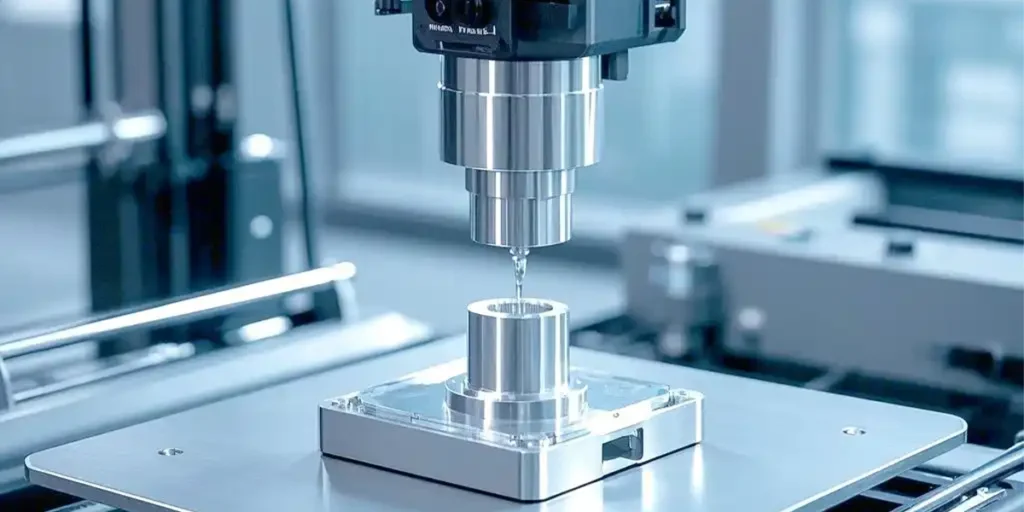
What is CNC aluminum machining?
CNC aluminum machining refers to a manufacturing method that uses numerical control machine tools (CNC) to perform precision cutting of aluminum or aluminum alloy materials.
By controlling the movement of machine tools through computer programs, aluminum materials can be processed into parts with accurate dimensions, complex structures, and extremely high repeatability.
Simply put, it is not about “manually handling aluminum materials,” but rather about converting design drawings into digital instructions, which are then automatically processed by machine tools following a predetermined path.
In actual production, CNC aluminum machining typically involves processing aluminum alloy blanks as follows:
- Milling
- Turning
- Drilling
- Tapping
Various processing operations are performed to meet the structural and assembly requirements of different parts.
This processing method is widely used in the manufacture of industrial parts, structural components, functional components, and housing parts, and is especially suitable for projects that require dimensional accuracy, consistency, and processing efficiency.
It is important to note that CNC aluminum processing emphasizes the “processing method” rather than a specific piece of equipment or a fixed process. It is more like a complete aluminum processing solution with digital control at its core.
Properties of aluminum materials
The core reason why aluminum has become one of the most common materials in CNC machining is that it achieves a good balance between weight, machining performance and stability.
Lightweight
Aluminum is a low-density metal, significantly lighter than steel. This allows for a reduction in the overall weight of parts while maintaining structural strength, which is a major reason why aluminum is widely used in structural and enclosure components.
High strength and adjustability
By adding different alloying elements and heat-treating, aluminum can achieve a range of properties from medium to high strength, meeting the needs of ordinary industrial parts as well as structural components requiring strength.
Good thermal conductivity
Aluminum has good thermal conductivity and dissipates heat more easily during processing and use, making it ideal for components that require heat management.
Stable corrosion resistance
Aluminum naturally forms a dense oxide film in the air, which can provide protection in most environments, allowing aluminum parts to maintain a good service life even without complex protection.
Good ductility and formability
Aluminum has good ductility, which can be processed into simple parts as well as complex structures and thin-walled designs, providing greater design freedom for CNC machining.
These material properties enable aluminum to balance processing efficiency, structural performance, and application flexibility in CNC machining, and also lay the foundation for subsequent processing method selection and process control.
Why is aluminum suitable for CNC machining?
Among many metal materials, aluminum has become a common choice for CNC machining because it offers a balance between machining efficiency, structural performance, and stability.
Good machinability and high processing efficiency
Aluminum has low cutting resistance, resulting in stable operation of CNC machine tools during machining. This not only allows for faster machining speeds but also helps reduce tool wear. This makes aluminum ideal for projects requiring high efficiency or repeated machining operations.
Balancing lightweight and strength
Aluminum is lightweight yet can achieve reliable structural strength through alloying. With the precise control of dimensions and shape achieved through CNC machining, aluminum parts can be designed to be lighter while still meeting strength requirements.
Dimensionally stable, suitable for precision control
Aluminum is less prone to severe internal stress during processing, which helps maintain dimensional consistency. This characteristic makes it more advantageous in machining parts requiring high assembly precision.
Good environmental resistance
The naturally formed oxide layer on the aluminum surface gives it stable corrosion resistance in normal use environments, and also reduces the complexity of subsequent use and maintenance.
Suitable for diverse design needs
Aluminum has good ductility, which can be combined with CNC machining to achieve thin-walled structures, complex contours and fine features, providing greater freedom for product design.
In summary, aluminum is not only “can be CNC machined,” but is also very suitable for CNC machining, which is an important reason why it has been widely used in industrial manufacturing for a long time.
Points to note during aluminum processing
Although aluminum is very suitable for CNC machining, there are still some key points that need special attention in actual production, otherwise it can easily affect the machining quality and the stability of the finished product.
Tool selection and status
Aluminum materials require high-sharpness cutting tools. If the cutting tools are unsuitable or severely worn, they can easily cause surface scratches and increased burrs, affecting the appearance of the finished product and assembly accuracy.
Cutting heat and deformation control
Aluminum has good thermal conductivity, but in the processing of thin-walled or complex structures, localized heat accumulation can still cause slight deformation. Properly controlling the processing pace helps maintain dimensional stability.
Surface quality management
Aluminum has a relatively soft surface and is easily scratched during processing and clamping. Care must also be taken during handling and storage after processing to avoid affecting the final appearance.
Tolerances and assembly requirements
Aluminum parts are often used in structures that require assembly. Before processing, key dimensions and tolerance requirements should be clearly defined to avoid affecting the fit accuracy due to excessive pursuit of speed.
Chip handling and cleaning
Aluminum shavings are relatively light and easily adhere to the surface of workpieces or equipment. Timely cleaning helps maintain a stable processing environment and reduces interference with subsequent processes.
These points are not complicated, but in CNC aluminum machining, they often determine whether the quality of the parts is stable and whether they can be repeatedly produced.
Common Applications of CNC Aluminum Machining
Because aluminum combines lightweight, strength, and good machinability, CNC aluminum machining is widely used in many industries with high precision and structural requirements.
Aerospace
Used to manufacture various structural and functional components, CNC machining has high requirements for dimensional accuracy, weight control, and consistency, and can meet the needs of complex structures and stable quality.
Automotive and Transportation Industry
Commonly found in vehicle body structural components, powertrain components, and exterior parts, CNC aluminum machining enables lightweight design while ensuring assembly precision and reliability.
Electronics and consumer electronics products
It is widely used in electronic device housings, heat dissipation components, and internal structural parts, satisfying both appearance consistency requirements and structural strength and heat dissipation performance.
Medical devices and equipment
Used for the machining of structural components and precision parts for medical devices, where high requirements are placed on dimensional control and surface quality, aluminum materials combined with CNC machining can achieve stable and repeatable manufacturing results.
Industrial equipment and automation
Including mechanical structural components, brackets, and connectors, CNC aluminum machining helps to realize complex structural designs and improve the overall stability and assembly efficiency of equipment.
Architectural and decorative applications
It is commonly found in door and window systems, decorative components, and functional structural parts, satisfying both aesthetic design requirements and good durability.
Overall, CNC aluminum machining is not limited to a single industry, but is widely used in scenarios that require precision, efficiency, and structural reliability.