


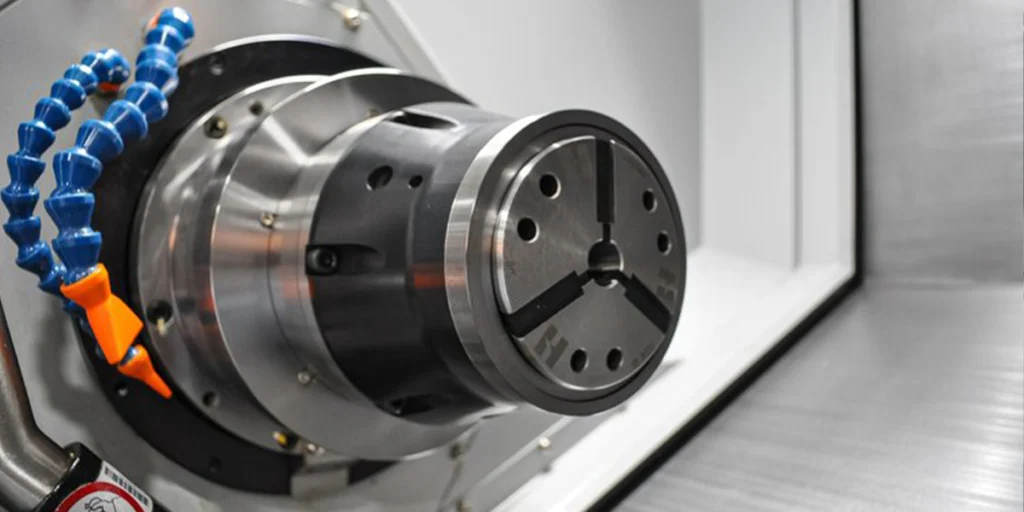
Advantages of CNC turning
CNC turning has long occupied a core position in the global manufacturing industry is not because it is “traditional”, but because it has achieved a very good balance between efficiency, precision, stability and cost.
For a large number of shaft, sleeve, thread, and connector parts, CNC turning remains one of the most direct, mature, and commercially valuable machining methods.
1. High processing efficiency, suitable for mass production.
Turning is generally more efficient than other machining methods when machining circular or rotationally symmetric parts.
The reason is:
- Workpiece rotation ensures continuous and stable cutting.
- Bar stock can be automatically fed for continuous production.
- Short cycle time for single-piece processing
- High cable replacement efficiency
This means that for medium to large volume orders, CNC turning usually has a lower unit cost.
2. Stable dimensional accuracy and high consistency.
CNC turning uses programmed control, which can effectively reduce human error and is especially suitable for parts that require stable tolerances.
Common control items include:
- Outer diameter
- Inner hole size
- Length dimension
- Concentricity
- Circular jumping
- Thread accuracy
For customers making continuous purchases, batch consistency is often more important than single-batch accuracy. At Zhuohua Hardware, we achieve accuracy control of ±0.02mm and ensure stable batch delivery through process inspection.
3. Good surface quality
After proper tool parameter optimization, machined parts can usually achieve a good surface finish, and some parts can even be directly assembled and used without additional post-processing.
Especially suitable for:
- Mating axial surface
- Sealing contact surface
- Exterior metal parts
- Precision connectors
For even higher aesthetic standards, we can also provide:
- Polishing
- Sandblasting
- Anodizing
- Electroplating
- Wire drawing
4. Wide range of material applications
CNC turning can process a variety of materials, including:
Metallic materials
Plastic materials
This enables CNC turning to serve multiple industries, not just the mechanical field.
5. Fast switchover from prototyping to mass production
CNC turning requires no mold making; production can be arranged as soon as the customer provides the drawings.
This is especially important for the following projects:
- New product development
- Small-batch trial production
- Quick verification
- Multi-version iterative design
Once the design is confirmed, it can be quickly scaled up to bulk orders.
6. Ideal for export procurement projects
International procurement typically emphasizes:
- Stable delivery time
- Consistent size
- Repeat orders are allowed
- Drawings kept confidential
- Communication efficiency
CNC turning has the advantage of standardized production, so it has long been an important category for overseas procurement by European and American customers.
Zhuohua Hardware’s Actual Advantages
As a manufacturer that has long served global clients, we offer not only processing capabilities but also project execution capabilities:
- Approximately 100 CNC turning machines
- Maximum diameter 431mm
- Maximum length 990mm
- Accuracy ±0.02mm
- Prototype to mass production support
- Multi-material processing capabilities
- Fast quotes and delivery
Customers are not buying machine time, but reliable results.
Disadvantages of CNC turning
Every manufacturing process has its limitations. CNC turning is no exception. Truly professional purchasing decisions don’t just look at the advantages, but rather understand what it’s suitable for and what it’s not, and mitigate risks in advance.
1. There are natural limitations on the shape of the parts.
CNC turning is best suited for rotationally symmetric structures. If the part is:
- Large plate-like structure
- Complex irregular outer contour
- Polyhedral structure
- Large-area planar parts
Therefore, it is generally not suitable for simple turning, but more suitable for:
- CNC milling
- Wire cutting
- Laser cutting
- Finishing after die casting
This is why many projects ultimately adopt a combination of turning and milling processes.
2. Extremely complex features may require secondary processing.
If the part contains:
- Lateral hole
- Eccentric structure
- Hexagonal position
- Keyway
- Multi-angle milling
Traditional lathes usually cannot complete the process in one go and require secondary processing on a milling machine.
The solution is to use:
- Power turret equipment
- Milling and turning machine tool
- Multi-axis equipment
This will directly affect costs and delivery time.
3. Some materials are difficult to process.
Not all materials are easy to machine, for example:
- High-hardness tool steel
- Stainless steel with adhesive blade
- High temperature alloy
- Ultra-soft plastic materials
These materials may bring:
- The cutting tool wears out quickly.
- Decreased processing efficiency
- Surface quality fluctuation
- Rising costs
Therefore, the choice of materials is crucial.
4. The cost of small-batch production of complex parts may be relatively high.
If the order quantity is small but the structure is complex, it is necessary to:
- Multiple blade changes
- Multiple clamping
- Long-term machine adjustment
Therefore, the cost per unit will be relatively high.
At this point, an evaluation may be necessary:
- Should the structural design be modified?
- Whether to use 3D printing for prototyping
- Whether to merge component designs
5. Long, thin shaft-like parts are at risk of deformation.
Parts with a large length-to-diameter ratio may encounter the following problems during machining:
- Vibrating knife
- Curved
- Concentricity deviation
- Abnormal surface texture
These types of projects are highly dependent on clamping solutions, tooling strategies, and engineering experience.
6. Low-priced suppliers often exaggerate these shortcomings.
Many procurement problems are not caused by the turning process itself, but by the supplier’s insufficient capabilities, for example:
- Using low-end equipment due to excessively low prices
- Errors in process planning
- No inspection process
- Disorganized knife management
- Slow communication response
This ultimately led to rework, delays, and scrapping.
How does Zhuohua Hardware manage these risks?
We conduct assessments at the beginning of the project:
- Is the part suitable for turning?
- Is a mill-turn machining center required?
- Are the tolerances reasonable?
- Is the material suitable for mass production?
- How to reduce processing costs
By conducting preliminary engineering assessments, we help clients avoid subsequent problems, rather than waiting to remedy them after production.
Which parts are best suited for turning?
When choosing a manufacturing process, many customers first ask: Can this part be made? But a more professional question should be: What process is most suitable for making this part?
If the part’s structure is naturally suited for turning, you will achieve lower costs, faster delivery times, and more consistent precision. Conversely, even if it can be done with difficulty, it may result in low efficiency, high prices, and inconsistent quality.
The parts most suitable for CNC turning usually have a core characteristic: the parts are rotationally symmetrical with the central axis as the reference.
1. Shaft-type parts
These are the most typical turning products, including:
- Motor shaft
- Drive shaft
- Positioning axis
- Roller shaft core
- Guide rod
- Precision spindle components
These types of parts often require:
- High outer diameter accuracy
- Small circular bounce
- Concentricity stable
- Good surface roughness
CNC turning has a natural advantage in these requirements.
2. Sleeves and bushings
For example:
- Bearing sleeve
- Bushing
- Spacer sleeve
- Guide sleeve
- Coupling inner sleeve
These types of parts typically possess the following characteristics:
- Outer diameter requirements
- Inner hole size requirements
- Coaxiality requirements of inner and outer circles
If other manufacturing processes are used, the cost is often higher.
3. Threads and connectors
Include:
- Pipe fittings
- Nuts
- Connector body
- Hydraulic joint
- Sensor threaded parts
Turning can be completed efficiently:
- External thread
- Internal thread
- Pipe threads
- Precision custom threads
These types of products have long been in high demand for export procurement.
4. Circular outer shell and housing components
For example:
- Aluminum electronic casing
- Lamp housing
- Camera housing
- Instrument casing
- Communication connector housing
Turning can quickly achieve good roundness and surface quality, which can then be done later.
- Sandblasting
- Anodizing
- Polishing
- Wire drawing
Ideal for the consumer electronics and industrial equipment sectors.
5. High-precision small parts
For example:
- Medical connectors
- Miniature bushings
- Precision nozzle
- Instrument parts
- Automated positioning components
These types of products are typically produced in large batches, are small in size, and have strict tolerances, which places high demands on the stability of the supplier’s equipment.
6. Long-term repetitive procurement of standard parts
If a certain part is purchased continuously every month, the advantages of turning will be further amplified, for example:
- Connector-type parts
- Connecting shaft
- Sleeve-type components
- Standard interface components
Because turning is suitable for continuous and stable production, it can significantly reduce long-term procurement costs.
How to avoid drawbacks through professional suppliers
Many buyers believe that finding a factory that can process the goods is enough.
The reality is often the opposite. Many projects’ problems aren’t due to the difficulty of obtaining the parts, but rather the lack of expertise of the suppliers. Many of the so-called “disadvantages” of CNC turning can be avoided in advance by using experienced suppliers.
1. Avoid high-cost structures through DFM assessment
Many drawings, while capable of being manufactured, can lead to problems due to their design methods:
- Too many tool changes
- Processing time is too long
- Specialized fixtures are expensive.
- Increased scrap rate
Professional suppliers will offer DFM (Design for Merchandising) suggestions during the quotation stage, for example:
- Optimize chamfer dimensions
- Adjust the trench width
- Relax non-critical tolerances
- Simplify the thread structure
This usually results in a significant reduction in unit price.
2. Avoid complex structural problems by using the correct equipment.
If the part contains:
- Horizontal holes
- Planar position
- Eccentric structure
- Hexagonal face
Ordinary lathes are inefficient, or even incapable of performing the task.
Professional suppliers will arrange according to the structure:
- Power turret lathe
- Milling and turning composite equipment
- Multi-axis equipment
More processes can be completed in a single setup, improving accuracy and reducing delivery time.
3. Mitigating material risks through engineering experience
For example:
- Stainless steel tends to stick to knives.
- Long shaft components are prone to vibration.
- Aluminum parts are prone to surface scratches.
- Plastic parts are prone to heat deformation.
Experienced factories will make adjustments:
- Knife material
- Cutting parameters
- Clamping method
- Cooling strategy
These factors determine the final product quality.
4. Mitigating batch instability through a quality system
Many suppliers’ samples were fine, but mass production started to get out of control.
Professional suppliers will establish:
- First item confirmed
- Process inspection
- Sampling and re-inspection
- Final inspection before shipment
- Batch traceability
Make sure that item 1000 is consistent with item 10.
5. Avoid delivery delays through capacity management
Common problems in low-cost factories:
- Chaotic order insertion
- Production scheduling out of control
- Temporary material shortage
- Shipping delays
Professional suppliers have more mature delivery systems, which are especially suitable for long-term customer projects.
How Zhuohua Hardware Helps Customers Mitigate Risks
We offer more than just processing; we provide complete project support:
- Approximately 100 CNC turning machines
- Supports collaborative operation of 300+ CNC milling devices
- Maximum diameter 431mm / Length 990mm
- ±0.02mm accuracy control
- 50+ materials can be processed
- From prototype to mass production
- Quick quotes and delivery response
What customers gain is a stable supply capability, not just a batch of parts.
If you already have drawings or your existing suppliers are not performing well, Zhuohua Hardware can assist in reassessing your process route and providing a more robust manufacturing solution.