


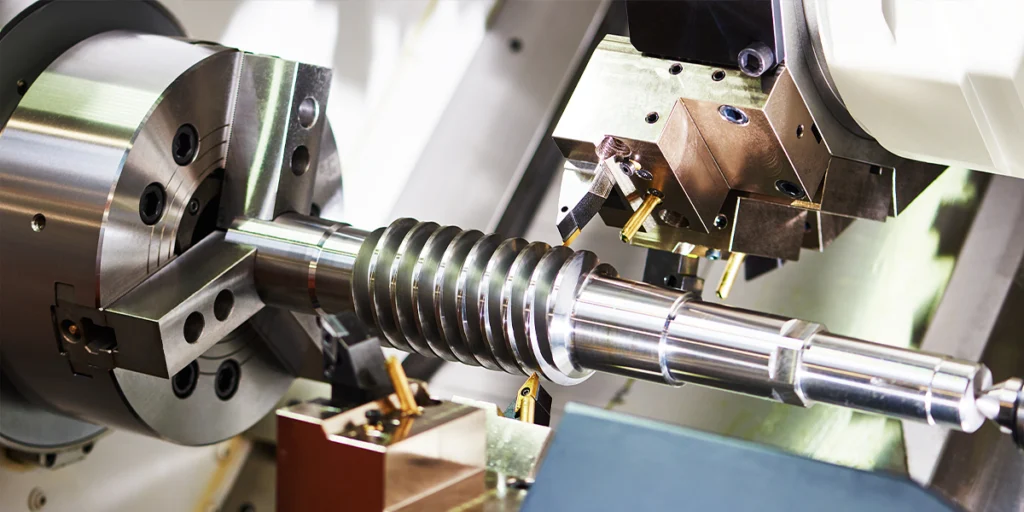
What is mill-turn machining?
CNC turning and milling combined services essentially integrate CNC turning and CNC milling into the same manufacturing process, and even complete multiple machining actions on the same machine and in the same setup.
In traditional manufacturing, many parts need to be turned first, and then transferred to a milling machine for secondary processing. For example:
- First machine the outer circle, inner hole, and end face.
- Mill the plane, drill holes, and slot.
- Finally, inspection and surface treatment are carried out.
While this approach is feasible, it will increase:
- Multiple clamping errors
- Process connection time
- Manual handling costs
- Delivery time risk
- Batch consistency fluctuations
The core value of mill-turn machining lies in integrating these disparate processes to improve overall manufacturing efficiency.
1. Turning is used for rotary structures, while milling is used for asymmetrical structures.
The simplest way to understand mill-turn machining is:
- Turning: Suitable for circular, shaft, and sleeve structures
- Milling: Suitable for flat surfaces, holes, keyways, and irregular contours.
Many real industrial parts possess both of these characteristics, so a single process is often insufficient.
For example, a connecting shaft component may require:
- Dimensional accuracy of outer circle
- Inner hole coaxiality
- Side wrench position
- Lateral hole
- Threaded structure
This part is ideal for milling and turning composite manufacturing.
2. How does a mill-turn machine work?
Modern milling and turning machines typically have the following features:
- Spindle rotation (turning function)
- Powered turret (milling, drilling)
- Y-axis control
- Multi-station tooling system
- Automatic tool changer
- Subspindle (double-end machining)
This means that one device can complete:
- External turning
- Internal hole machining
- End face processing
- Milling a plane
- Drilling and tapping
- Machining of eccentric holes
- Keyway machining
- Multi-faceted positioning machining
This significantly reduces the traditional “half done on a lathe, half done on a milling machine” model.
3. Why are more and more customers choosing composite processing?
From a purchasing perspective, customers are usually not concerned with the equipment name, but rather with the result:
- Are the parts more precise?
- Is the cost lower?
- Is the delivery time faster?
- Is the supply chain simpler?
Milling and turning machines can often meet all four requirements simultaneously, hence the continued growth in demand.
This is especially evident in the following scenarios:
- High-precision parts
- Small to medium batch orders
- Multi-feature complex parts
- High value-added industry parts
4. A typical case
For example, the drive shaft used in a certain automated device requires:
- Outer diameter tolerance ±0.02mm
- Threaded at both ends
- Open plane in the middle
- Lateral positioning holes
- Surface anodizing
Traditional method: Lathe machining → Milling machine machining → Secondary calibration → Inspection
Composite method: Most processes are completed in one clamping.
The result is usually:
- More stable accuracy
- Shorter cycle
- Unit cost decreased
5. Zhuohua Hardware’s composite manufacturing capabilities
We have extensive experience serving complex parts projects for overseas clients and possess the following capabilities:
- CNC turning capability (approximately 100 machines)
- CNC milling capability (300+ machines)
- 3-axis/5-axis machining support
- Precision control ±0.02mm
- From prototype to mass production
- Supports multiple materials (50+)
Even if a part cannot be completed on a single machine, we can achieve a high-efficiency delivery solution that is close to milling and turning through mature process routes.
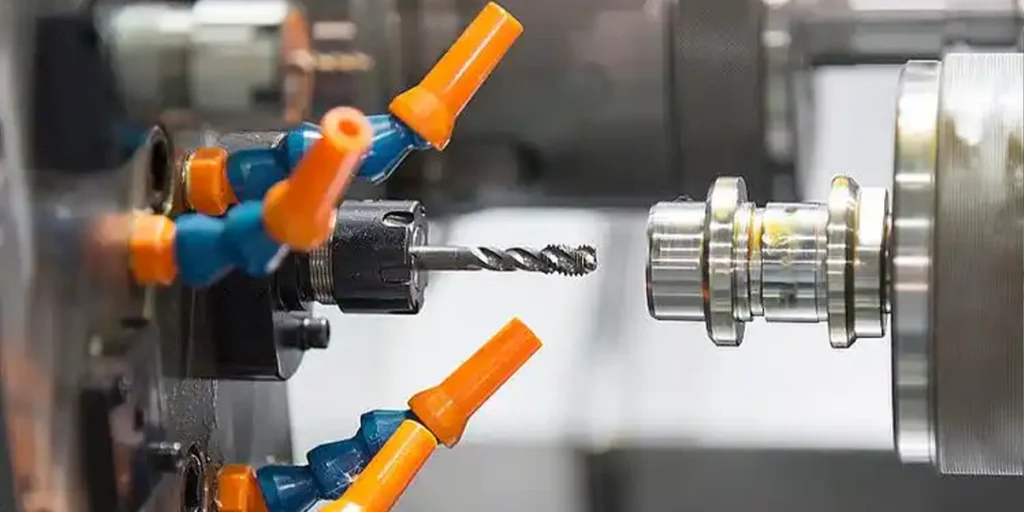
Why do complex parts require turning and milling?
Many clients encounter a problem during the design phase: the part is neither purely circular nor purely planar. Using only turning or only milling for such parts often yields unsatisfactory results.
The reason is that modern industrial parts increasingly emphasize:
- Multifunctional integration
- Compact structure
- High assembly precision
- Lightweight design
Therefore, complex parts naturally require a combination of turning and milling.
1. A single process often cannot efficiently complete all features.
The problem of using only turning
It can be completed efficiently:
- Outer circle
- Inner hole
- Thread
- Stepped axis
But not good at:
- Plane
- Side holes
- Keyway
- Irregular outline
The problem with using milling alone is that while it can create complex contours, it is less efficient and more costly for machining cylindrical structures. Therefore, combining the two processes is a more realistic manufacturing approach.
2. Common structural combinations of complex parts
Many customer drawings exhibit the following combination of features:
- Precision outer diameter + multiple holes
- Threaded shaft + wrench face
- Sleeve + Horizontal Hole
- Cylindrical shell + window structure
- Connector + Hexagonal positioning surface
Processing these structures separately would increase errors and costs.
3. High-precision assembly parts require more assembly and machining.
When parts need to mate with bearings, motors, seals, or other structures, the following requirements are typically met:
- Coaxiality
- Hole position accuracy
- Plane perpendicularity
- Repeatability
If machining is performed multiple times by switching machines, errors will gradually accumulate. Therefore, a combination of turning and milling is more suitable for complex assemblies.
4. Particularly suitable for small to medium batch projects
Many overseas customers’ order volumes are not in the hundreds of thousands, but rather:
- 50 samples
- 300 trial production units
- 2,000 stable orders
If such projects require specialized fixtures or multiple processes, the cost will actually be higher.
The combination of turning and milling is more flexible and can take into account both:
- Development speed
- Cost control
- Ability to expand orders in the future
5. The actual needs of the industry are changing.
In the past, component designs were relatively simple, and a single manufacturing process was sufficient. Now, more and more industries require complex components.
- Robot joint parts
- Medical connectivity components
- Unmanned aerial vehicle (UAV) structural components
- Transmission components of automated equipment
- High-end electronic metal components
These products have driven the growth of combined turning and milling machining.
6. How does Zhuohua Hardware support complex component projects?
We often assist clients in optimizing manufacturing solutions for complex parts, including:
- Determine which features are suitable for turning.
- Which features are suitable for milling?
- Can the number of processes be reduced?
- Can tolerance risk be reduced?
- Can it reduce total costs?
After the client provides the drawings, we can offer more reasonable suggestions from an engineering perspective, rather than simply manufacturing according to the drawings.
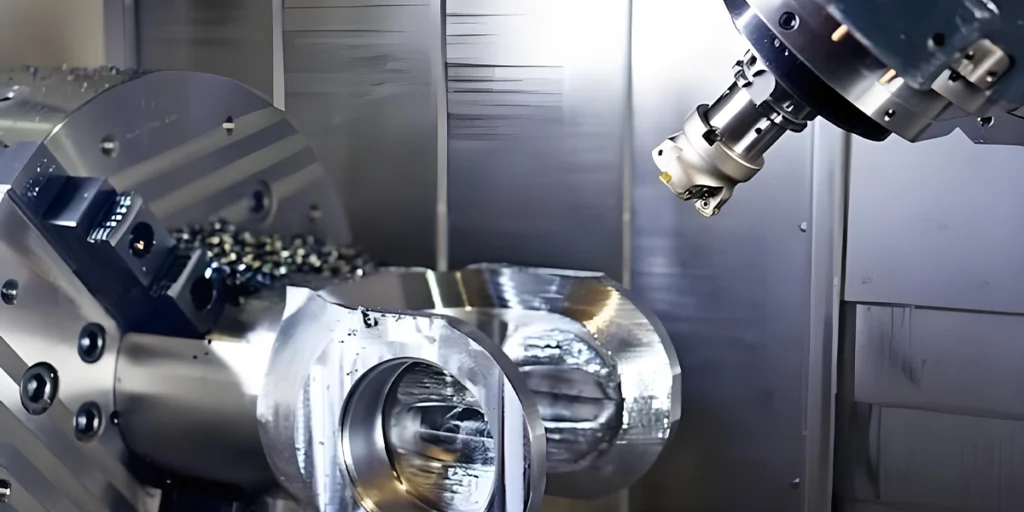
Advantages of reducing secondary clamping
In the manufacture of precision parts, many problems do not come from the equipment itself, but from repeated clamping.
In traditional manufacturing processes, a part may undergo the following processes:
- First clamping for turning.
- Remove the workpiece.
- Transfer to milling machine for repositioning
- Milling is performed in the second clamping.
- If necessary, perform a third clamping to correct details.
Each additional clamping operation increases the risk of error, time costs, and management complexity.
Therefore, one of the core values of mill-turn machining is to minimize secondary clamping and even complete multiple machining operations in a single clamping.
1. Improve dimensional and positional accuracy.
Every time a part is re-clamped, the datum needs to be re-aligned. Even experienced operators may produce slight deviations, for example:
- Coaxiality deviation
- Hole position offset
- Planar position error
- Verticality error
The impact on ordinary parts is limited, but on high-precision parts it may directly lead to assembly failure.
A single clamping operation can significantly reduce these cumulative errors, making it particularly suitable for requirements such as:
- ±0.02mm tolerance
- High concentricity
- Multi-hole fit
- High assembly consistency
2. Shorten the production cycle
Secondary clamping is not as simple as “clamping the workpiece once,” it actually includes:
- Waiting for the device to become available
- Workpiece transfer
- Repositioning
- Program switching
- First item confirmed
- Retest
These are all hidden time costs.
Reducing the number of setups usually results in a faster overall delivery time, especially suitable for:
- Urgent sample order
- Small-batch trial production
- Projects with tight timelines
This is also an important reason why many customers value composite processing.
3. Reduce labor and management costs
Multi-stage processing means more people are involved:
- Lathe operator
- Milling machine operator
- Quality inspectors
- Production coordinator
The more processes involved, the longer the communication chain, and the greater the management difficulty.
Reducing the number of clamping operations usually means:
- Less human intervention
- Lower probability of error
- Smoother production rhythm
For the procurement side, this is directly related to supplier stability.
4. Improve batch consistency
The biggest problem with bulk orders isn’t individual item scrap, but rather that the first batch is acceptable, the second batch deviates, and the third batch changes again. The reason is often not a program error, but rather inconsistent clamping methods each time.
When the process route is simplified, batch consistency will be significantly improved, making it more suitable for long-term supply projects.
5. Reduce the risk of surface damage
When parts are repeatedly clamped, especially on already machined surfaces, the following may occur:
- Indentation
- Scratches
- Clamping seal
- Appearance damage
This type of problem is very common for products with high appearance requirements, such as aluminum casings, medical components, and anodized parts. Reducing secondary clamping can lower rework and scrap rates.
6. How does Zhuohua Hardware control clamping risks?
In complex parts projects, we prioritize the following evaluation methods:
- Can more processes be completed in one clamping operation?
- Can the fixture method be optimized?
- Can the number of machine transfers be reduced?
- Can batch consistency be improved?
Combining our CNC turning and 300+ milling capabilities, we can design more reasonable manufacturing routes based on order volume, structural complexity, and budget.
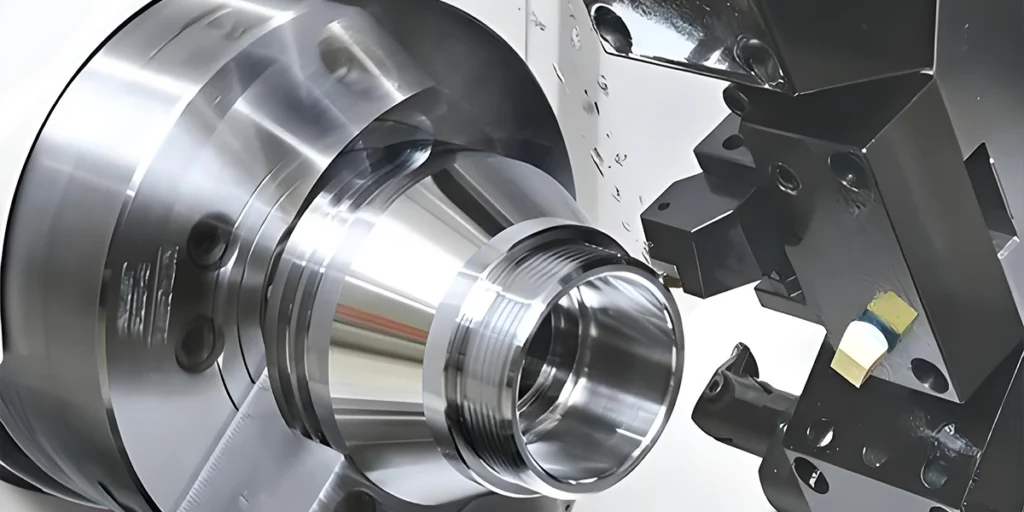
Suitable for which industries?
Milling and turning machining is not a “gimmick only for high-end equipment.” It is truly suitable for industrial parts with complex structures, high precision requirements, and sensitive delivery times.
With the accelerating trend of product miniaturization, integration, and lightweighting, more and more industries are beginning to rely on a combination of turning and milling for manufacturing.
1. Automated equipment and robot parts
This is one of the fastest-growing areas in terms of demand for mill-turn machining.
Common parts include:
- Drive shaft
- Coupling
- Transmission joint
- Joint structural components
- Precision sleeve
These parts typically possess the following characteristics:
- Cylindrical main structure
- Hole positioning requirements
- Keyway or planar structure
- High assembly precision
It is ideal for combined milling and turning machining.
2. Medical device parts
The characteristics of medical industry parts are:
- Small size
- High accuracy
- High surface quality requirements
- High batch consistency requirements
Common applications:
- Surgical instrument connectors
- Medical equipment shafts
- Precision stainless steel connectors
- Testing equipment components
Reducing the number of clamping operations is especially important for medical devices.
3. Automotive and New Energy Parts
The automotive industry requires a large number of metal parts that can be delivered in high-efficiency, stable batches, for example:
- Sensor housing
- Motor shaft
- Steering system parts
- Hydraulic joint
- Electric drive system components
New energy products focus more on:
- Lightweight aluminum components
- High consistency mass production
Milling and turning can balance efficiency and precision.
4. Aerospace parts
Aerospace parts are typically produced in small quantities, but have stringent requirements:
- High-strength materials
- Complex structures
- Stable accuracy
- Traceable production
For example:
- Titanium alloy connectors
- Precision bushings
- Instrument structural components
These types of projects are highly dependent on mature technological capabilities.
5. Industrial equipment and fluid control components
For example:
- Valve body connector
- Pump-type shafts
- Pressure system connector
- Sealing mating parts
These types of parts typically have threads, sealing surfaces, and hole structures, making them suitable for combined machining.
6. Consumer electronics and high-end equipment components
Especially aluminum housing parts, such as:
- Camera structural components
- Lamp housing
- Metal parts for audio equipment
- Communication equipment components
These types of products typically need to be both dimensionally stable and aesthetically pleasing.
The value of a one-stop supplier
Many procurement projects fail not because of price, but because of an overly fragmented supply chain.
The common situation is:
- Find a factory for turning.
- Find another factory for milling.
- Surface treatment outsourced to a third party
- Find a fourth company for testing or assembly.
On the surface, it seems like they’re “looking for the cheapest option,” but the actual result is often:
- Increased communication costs
- Delivery time is uncontrollable.
- The boundaries of responsibility are blurred
- Passing the buck on quality issues
- Low project progress efficiency
This is why more and more overseas customers prefer one-stop manufacturing suppliers. From the purchasing side, managing one less supplier is often more valuable than saving a few cents per item.
1. Reduce communication costs and improve response speed
When a part requires turning, milling, and surface treatment, if the supply chain is fragmented, procurement needs to be communicated separately for each part.
- Drawing version
- Process requirements
- Tolerance Standards
- Delivery schedule
- Packaging requirements
- Shipping time
Any discrepancy in information flow at any stage can lead to rework or delays. A one-stop supplier with internal collaboration can significantly reduce communication steps and improve response efficiency.
2. Smoother process integration
When collaborating with multiple suppliers, common issues include:
- Inappropriate dimensional allowances in previous processes
- Difficulty in clamping during subsequent processes
- Dimensions out of tolerance after surface treatment
- Deformation caused by improper processing sequence
A mature one-stop supplier will plan the process route uniformly at the beginning of the project, instead of each doing their own thing.
3. Delivery time is more controllable
When procurement is decentralized, a delay in one step can slow down the entire project.
- After turning is completed, wait for milling to be scheduled.
- Waiting for the surface treatment window after milling is complete
- Queuing again after returning to work
A one-stop supplier can unify scheduling, making it easier to achieve stable delivery. This is crucial for new product development, pilot production projects, and urgent replenishment orders.
4. Clearer quality responsibility
The most troublesome thing when a part malfunctions is:
- The turning shop said that milling caused the error.
- The milling plant said the incoming material dimensions were incorrect.
- The surface treatment plant said the original parts were defective.
Procurement often becomes the coordinator, consuming a significant amount of time. A one-stop supplier takes full responsibility for delivery, allowing for more direct problem-solving.
5. The total cost is often lower, not higher.
Many people mistakenly believe that splitting purchases will always be cheaper, but that’s not necessarily true.
Hidden costs include:
- Multiple logistics transportation
- Multiple packaging
- Time for multi-party communication
- Delivery delay costs
- Cost of quality defects
- Managing labor costs
After comprehensive calculation, a one-stop supply chain is usually more cost-effective.
Zhuohua Hardware’s one-stop manufacturing capabilities
We have long provided overseas clients with complete support from drawings to delivery, including:
CNC machining capability
- CNC Turning (approximately 100 machines)
- CNC Milling (300+ machines)
- 3-axis/5-axis machining support
- Combination manufacturing of turning and milling
Manufacturing capacity
- Prototype prototyping
- Small-batch trial production
- Medium to large-scale production
- Fast delivery support (as fast as 5 business days)
Precision and quality
- Tolerance control ±0.02mm
- Process inspection
- Outbound inspection
- Quality documents can be provided on a project-by-project basis.
Materials and Post-processing
- 50+ metal and plastic materials
- Anodizing
- Sandblasting
- Polishing
- Powder coating
- Surface treatments such as wire drawing
Zhuohua Hardware can provide manufacturing feasibility assessments, better process suggestions, quick quotations, and stable delivery solutions based on your drawings, quantities, materials, and delivery requirements. For customers, what really matters is not finding the lowest-priced factory, but finding a supplier that can consistently deliver results.