


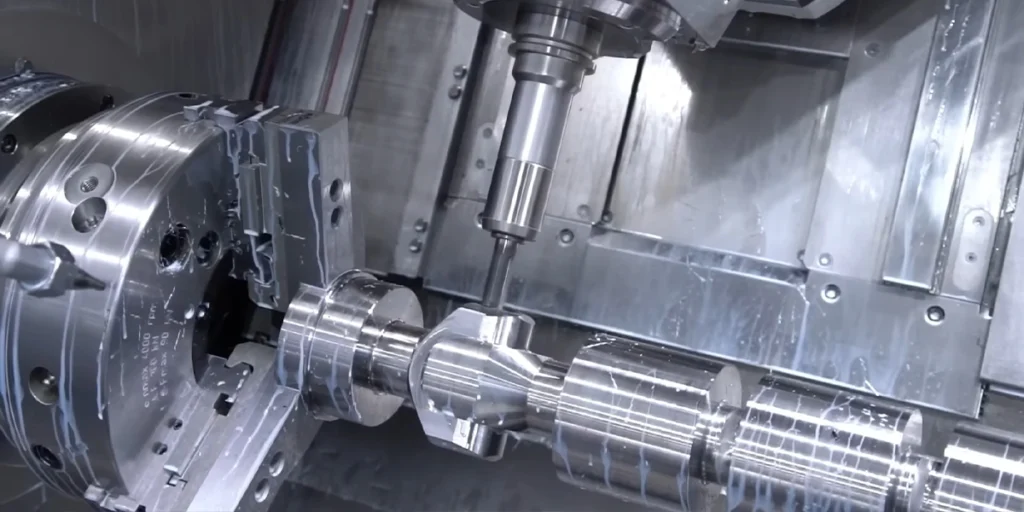
How Accurate Is CNC Milling?
One of the core reasons why CNC milling is widely used is that it can reliably achieve high-precision machining. However, “high precision” is not a fixed value, but rather depends on the combined results of processes, equipment, and control capabilities.
In real-world projects, accuracy is usually measured in “tolerance” rather than a single dimension.
Standard tolerance
Unless otherwise specified, most CNC milling operations follow general tolerance standards (such as ISO 2768):
- Standard tolerances for metal parts: approximately ±0.05 mm ~ ±0.1 mm
- Standard tolerances for plastic parts: approximately ±0.1 mm ~ ±0.2 mm
These fall within the “acceptable range” and apply to:
- General structural components
- Non-critical mating parts
- Exterior components
When entering more demanding scenarios, such as:
- Precision fit (shaft/hole fit)
- Medical or aerospace parts
- Functional sealing structure
Tolerances are usually tightened to:
- ±0.02 mm
- Even higher requirements
Factors affecting accuracy
The precision of CNC milling is not determined by a single factor, but is the result of the superposition of multiple variables.
1. Machine tool precision
- Precision of guide rails and lead screws
- Spindle stability
- Machine tool rigidity
The equipment itself determines the “theoretical upper limit”.
2. Cutting tools and wear
Tools will gradually wear down during the machining process:
- The size will change slightly.
- Surface quality deteriorates
Without a compensation mechanism, batch consistency will be directly affected.
3. Material properties
Different materials exhibit significantly different processing characteristics:
- Aluminum: Easy to process, good stability
- Stainless steel: Prone to heat deformation
- Plastics: Easily deformed, with significant elastic recovery
Materials not only affect the difficulty of processing, but also the final precision.
4. Processing technology
include:
- Toolpath
- Cutting parameters (speed/feed)
- Processing sequence
Inappropriate processes may lead to:
- Vibrating knife
- Deformation
- Dimensional deviation
5. Clamping method
This is a factor that is often overlooked but has a huge impact:
- Unstable clamping → Vibration
- Over-clamping → Part deformation
- Multiple clamping operations → Accumulated errors
6. Environmental factors
In high-precision machining, the environment also has an impact:
- Temperature change → Material expansion
- Prolonged processing → Heat accumulation
In demanding projects, even temperature-controlled workshops are required.
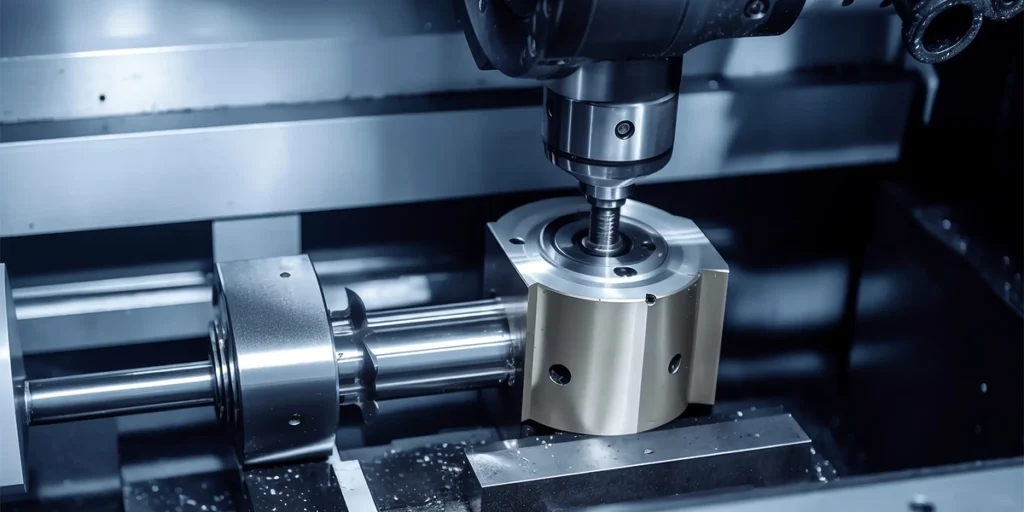
What is high-precision CNC milling service?
“High precision” is a general term used by many suppliers, but in an engineering context, it must be a quantifiable, verifiable, and reproducible capability. In other words, it’s not about “doing it occasionally,” but about consistently achieving it in batches.
High precision definition
In terms of results, high accuracy is usually reflected in three types of indicators:
- Dimensional tolerances: such as ±0.02 mm or tighter
- Geometric tolerances: flatness, perpendicularity, coaxiality, etc.
- Surface quality: roughness (Ra), uniformity
However, indicators alone are not enough; two prerequisites must also be met:
- Consistency: Maintained across both the same batch and different batches.
- Traceability: Inspection records are available for every critical dimension.
When is “high precision” needed?
Not all parts require extremely high precision. Typical scenarios include:
- Precision mating parts (shafts/holes, sliding structures)
- Sealed structure (airtight/liquid tight)
- Critical components for medical or aerospace applications
- High-speed moving or low-vibration components
In these applications, tolerances are not just “dimensional requirements,” but directly affect whether the function is working.
High precision ≠ single parameter
A common misconception is focusing only on a single dimensional tolerance. In reality, the “dimensional chain” is more crucial:
- Individual dimensions are acceptable, but overall assembly fails.
- High local accuracy, but with geometric deviations.
Therefore, high-precision service is essentially about overall geometric control capabilities, rather than single-point optimization.
Testing and Quality Control
High-precision machining is impossible without a corresponding inspection system. Inspection is not the final step, but rather an integral part of the entire process.
1. First Article Inspection
Before mass production, the first piece undergoes a comprehensive inspection:
- Verify that the procedures and processes are correct.
- Confirm that key dimensions meet the standards.
If the first batch is unstable, problems will inevitably arise in subsequent batches.
2. In-process Inspection
Sampling or online testing is conducted during the processing:
- Real-time monitoring of critical dimensions
- Tool wear compensation
- Prevent batch offset
The purpose of this step is to correct the problem before it escalates.
3. Final Inspection
Final confirmation after processing:
- Full or random inspection of dimensions
- Appearance and surface quality inspection
- Functional verification (such as assembly testing)
4. Detection methods
High-precision machining typically relies on the following equipment:
- Coordinate Measuring Machine (CMM)
- High-precision calipers/micrometers
- Surface roughness tester
For high-requirement projects, the following may also be offered:
- Inspection Report
- Material Certificate
- Traceable data
5. The core of stability
What truly distinguishes ordinary machining from high-precision services is not the equipment, but the system:
- Is there a standardized testing process?
- Whether process control is implemented
- Can it consistently output high-quality data over a long period?
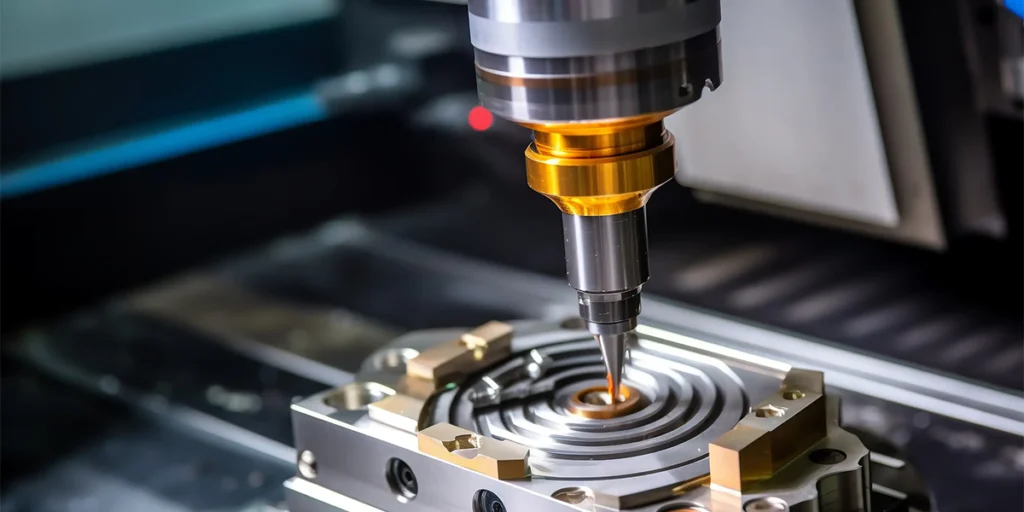
How to improve machining accuracy
Improving accuracy does not equate to “buying more expensive equipment.” In actual production, accuracy enhancement usually comes from system optimization: the synergy of equipment, processes, and materials.
The common mistake in many projects is that they focus only on machine tool parameters while ignoring more critical variables.
Equipment
The equipment determines the upper limit of accuracy, but not the final result.
1. Machine tool rigidity and stability
High-precision machining primarily depends on the machine tool structure:
- Insufficient rigidity → Prone to vibration → Poor surface quality
- Poor stability → Long-term machining dimensional drift
The advantages of high-rigidity equipment are:
- More stable cutting conditions
- Improved repeatability
- Lower vibration impact
2. Spindle performance
The spindle is not only “fast,” but more importantly:
- Operational stability
- Dynamic balancing control
- Thermal stability
At high speeds, insufficient spindle stability will directly lead to:
- Rough surface
- Precision fluctuation
3. Precision compensation capability
Modern CNC equipment typically features:
- Backlash compensation
- Thermal compensation
- Tool length/radius compensation
These functions can correct errors to some extent, but only if the operation and calibration are performed correctly.
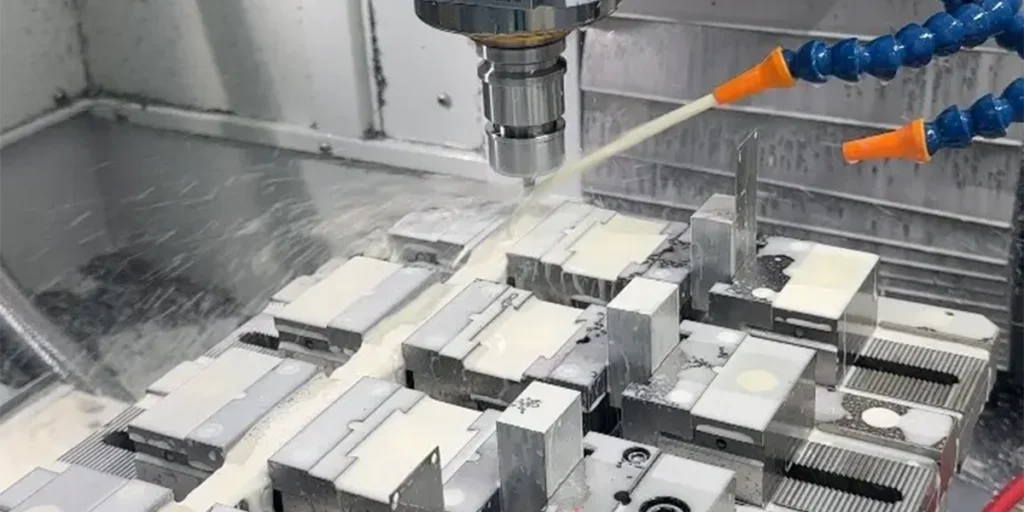
Process
If equipment determines “how well it can be done”, then process determines “how much it can actually be done”.
1. Processing sequence design
A proper processing sequence can significantly reduce errors:
- Start with the rough and work your way up to the fine.
- Start with the big picture, then move on to the details.
- Symmetrical material removal (reduces deformation)
An improper order may lead to:
- Stress concentration release
- Size offset
2. Toolpath optimization
Path design directly affects accuracy and stability:
- Constant cutting load → Reduces vibration
- Smooth path → Improve surface consistency
For example:
- Adaptive toolpaths for roughing
- Contour paths are used for surface finishing.
3. Tool Management
Tool condition is one of the key variables:
- New cutting tools → Stable precision
- Worn cutting tools → dimensional deviations
In actual production, the following usually applies:
- Set tool life
- Regular replacement or compensation
4. Clamping Strategy
In high-precision machining, clamping often determines success or failure:
- Excessive clamping force → Deformation
- Insufficient clamping → Vibration
Optimization directions include:
- Use soft claws or custom clamps
- Unified positioning benchmark
- Reduce repeated clamping
Material
The inherent properties of the material determine the “difficulty level” of processing.
1. Material stability
The performance of different materials varies significantly:
- Aluminum alloy → Easy to process, stable precision
- Stainless steel → Prone to heat deformation
- Engineering plastics → Easily deformable, but with good elastic recovery
The more “active” the material, the more difficult it is to control.
2. Internal stress
Untreated materials may contain residual stress:
- Release during processing → Part deformation
- Dimensions change after processing
Common solutions:
- Pretreatment (aging/heat treatment)
- Phased processing (rough → placement → finishing)
3. The impact of material selection on design
Inappropriate material selection during the design phase will directly increase the difficulty of processing.
- Excessively hard materials → Severe tool wear
- Soft materials → Surface quality is difficult to control
Therefore, material selection itself is part of precision control.
If your parts have specific precision requirements but you’re unsure how to achieve them: Upload your CAD drawings, and we’ll provide a free DFM analysis, tolerance optimization suggestions, and a quote within 24 hours.